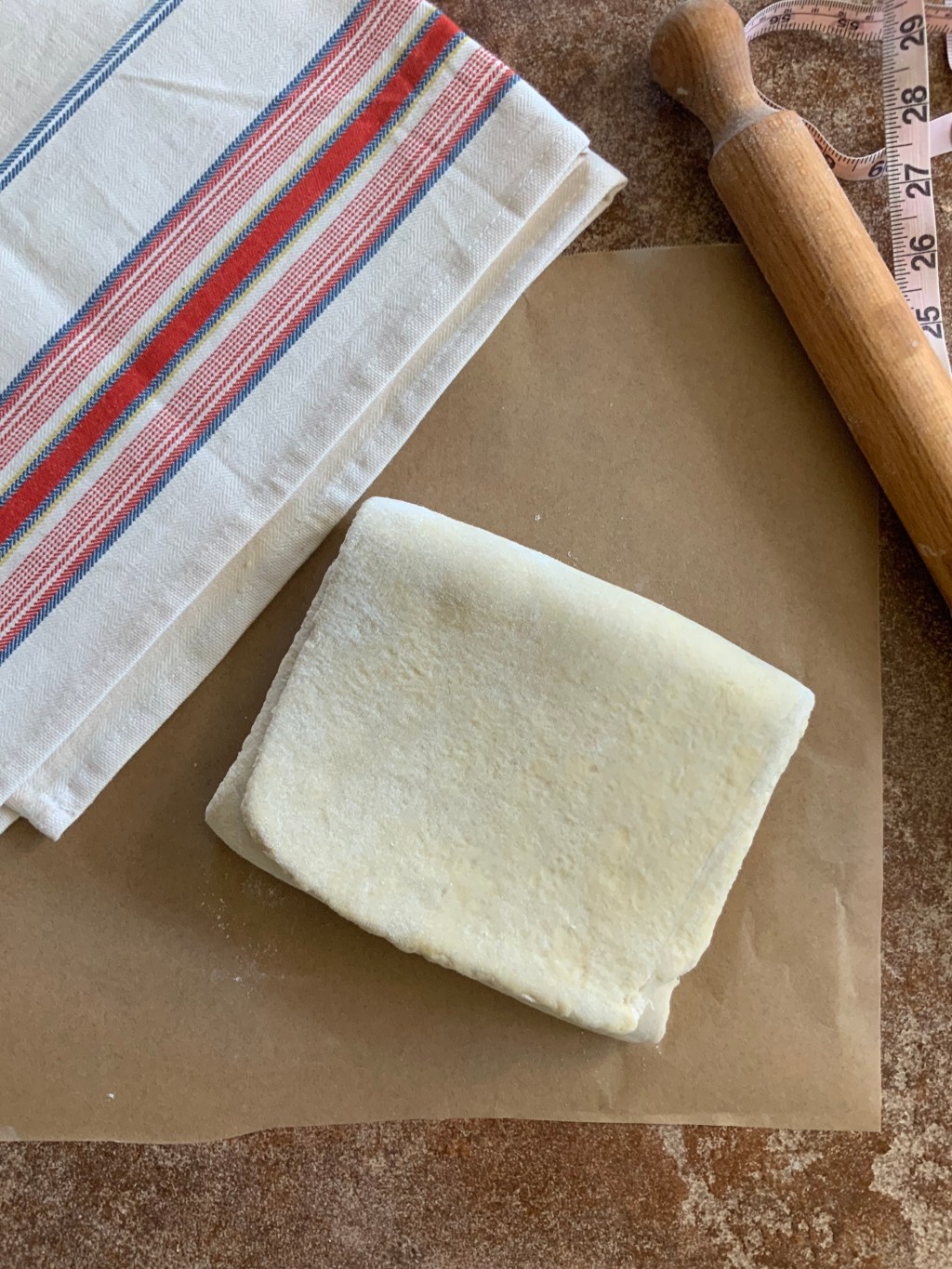
“It is puff paste that is the pride of all French pastry cooks, a pastry that swells into a light, unbelievably delicate, flaky crispness.” Louis Diat from Gourmet’s Basic French Cookbook (1990 edition.)
The frozen puff pastry sold in supermarkets is so convenient that many cooks have never made their own. For anyone unfamiliar with handmade puff pastry, the taste and texture of the commercial variety have come to define the pastry’s character.
The handmade version sets a different standard. It is, as Mr. Diat says, “unbelievably delicate”, so brittle that it gives and shatters under the slight pressure of a fork. Made entirely with butter, the pastry is dry and light, the layers distinct and crisp.
Thefoodlessprocessed puff pastry is made from all-purpose unenriched organic white flour made from hard wheat. The dough made from it is easier to handle than one made with soft wheat flour. It is less likely to tear when rolling and folding. -The same holds true for European-style unsalted butter–it creates a more manageable dough. This combination of ingredients is likely to provide a good first experience of making puff pastry.
All the ingredients have less processed options: Flour, Butter, Water, and Salt.
Here is a brief overview of the steps involved in creating the pastry. Each step is described in detail in the recipe following the summary.
- Mix the flour and water into a a rough dough and chill it for 30 minutes.
- Wrap cold butter in plastic and pound it out into a square. Chill it for 30 minutes unless it is still quite firm.
- Roll out the dough into a square. Place the butter in it and enclose it in the dough.
- Begin the “turns”: A turn describes rolling the dough out into a long rectangle and folding it into thirds like a letter.
- The total number of turns given to the dough is 6, divided into 3 sets of 2 turns each. Chill the dough for 45 minutes after completing set 1 and set 2 of the turns.
- After the third set of turns, refrigerate the dough for at least an hour (or better, overnight) before baking with it.
- If you have no immediate plans for using it, it may be kept in the refrigerator for several days or frozen and thawed later in the refrigerator.
- At any stage in the folding process, the dough may be wrapped in plastic and returned to the refrigerator and the turns resumed later–not necessarily on the same day– from the point where you left off.
Equipment
- a Mixing Bowl
- a Digital Scale
- a Pastry Board and Rolling Pin
- a Tape Measure
- Plastic Wrap
Ingredients
- 310 g (2 and 1/2 cups) of Organic Unenriched Hard Wheat White Flour
- 1 teaspoon of Sea Salt
- 180 ml (3/4 cup) of Cold Bottled Spring Water
- 30 g (2 Tablespoons) of European-Style Unsalted Butter, melted and cooled
- 225 g (1 cup) of European-Style Unsalted Butter
I. Mixing the Dough
- Mix together the flour and salt in the bowl.
- Stir the melted butter into the flour
- Add the cold water and mix to form a rough dough.
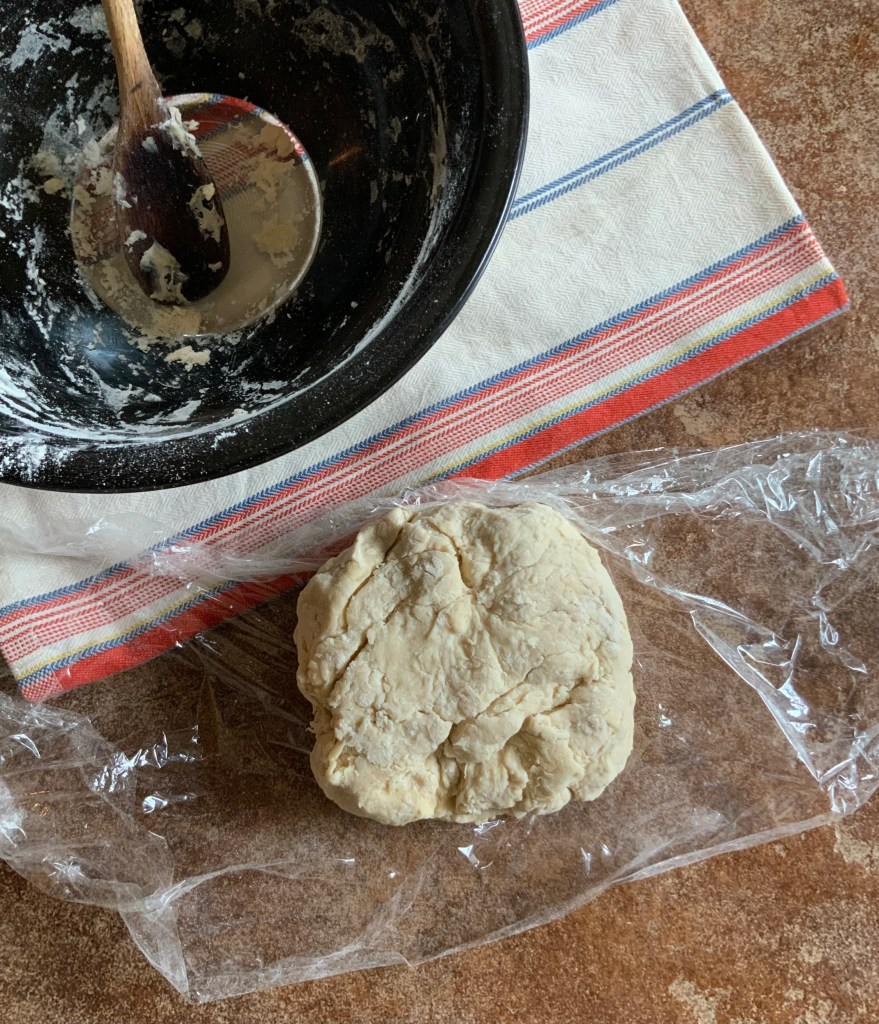
- Shape into a square, wrap and chill it for 30 minutes. The dough will be rough and uneven in texture. (This is sometimes described as “scrappy”.)
Forming the Butter Block
Note: European butter will probably be in a single rectangular block of 225 g. This is roughly equal to two sticks of American butter which are placed side by side and pounded to form a single block.
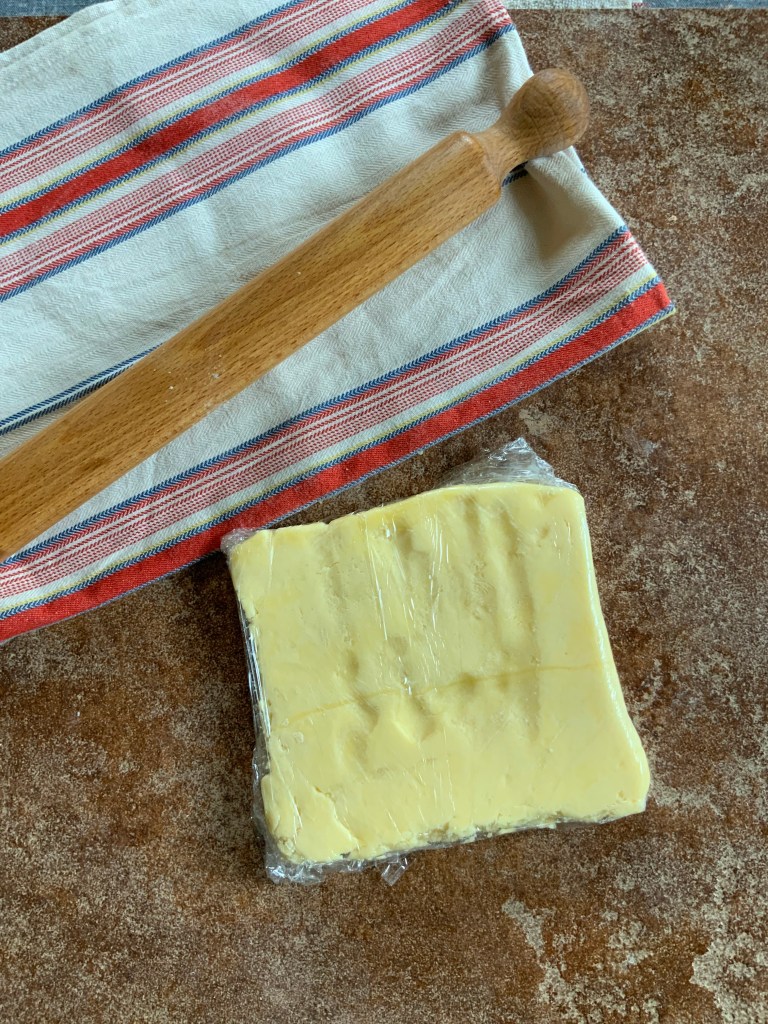
- Wrap the single block, or the two sticks together, in plastic wrap and pound them out with a rolling pin into an 18 cm (7-inch) square.
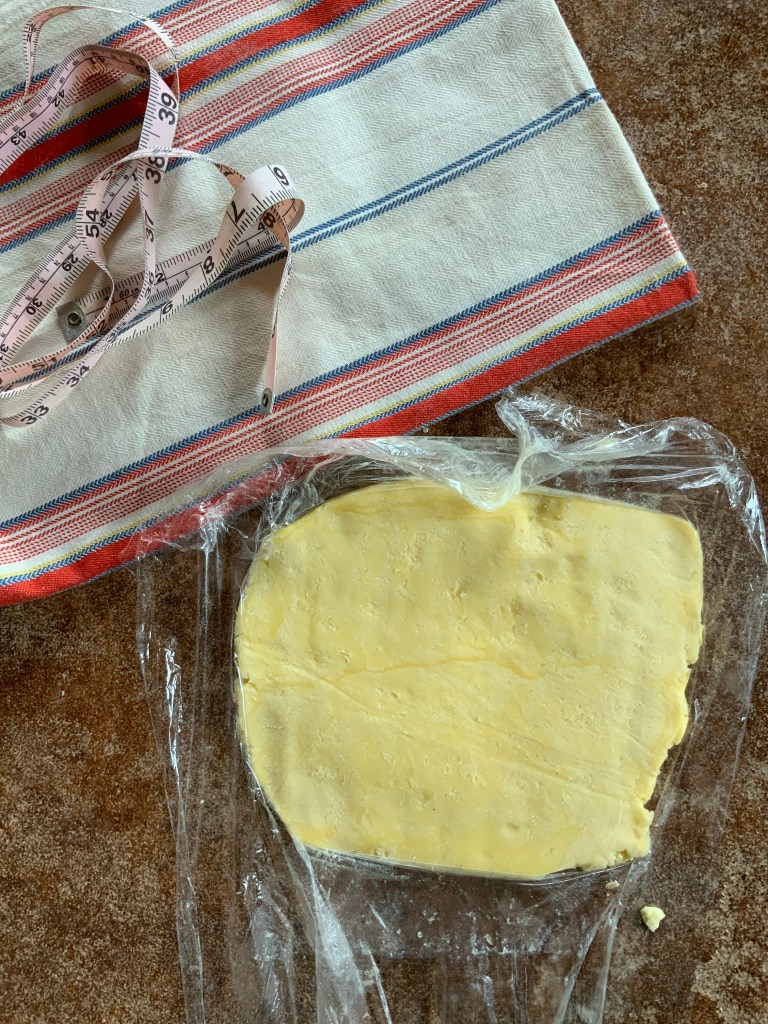
- With your hands on the outside of the plastic wrap, fold in the edges of the butter to create a more regular square.
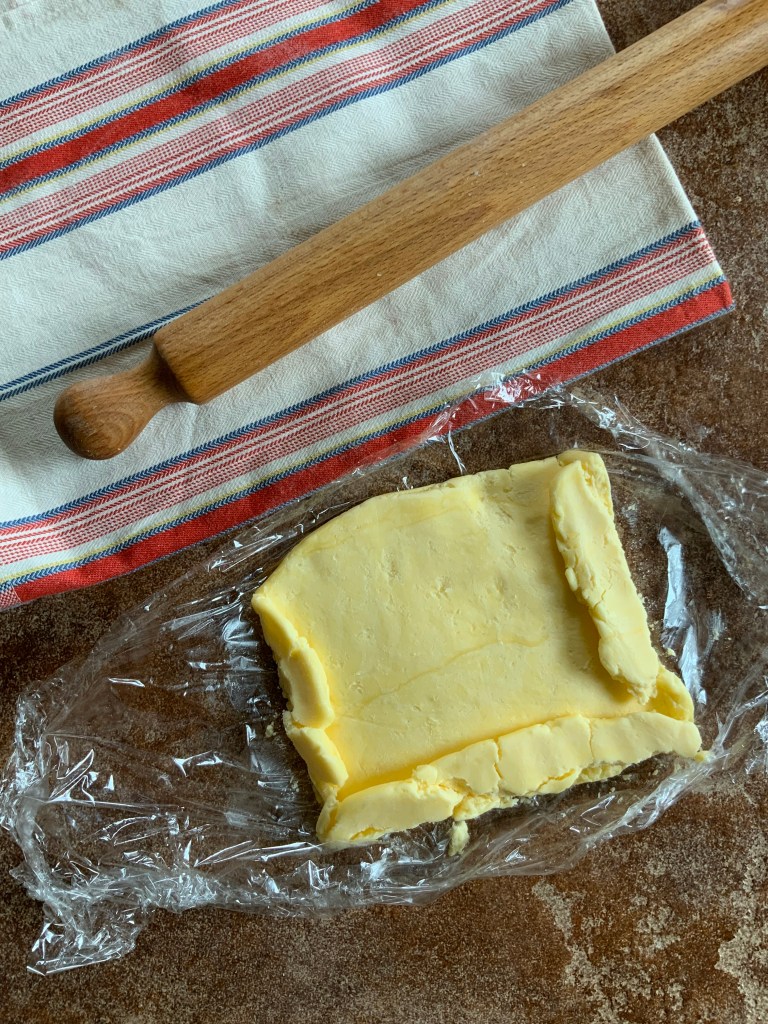
- Rewrap the butter and gently pound it to an even thickness. Chill it for 30 minutes unless it is still quite firm.
Enclosing the Butter
- Lightly flour the pastry board and roll out the dough into a 25 cm (10-inch) square.
- Place the butter square diagonally on the dough square.
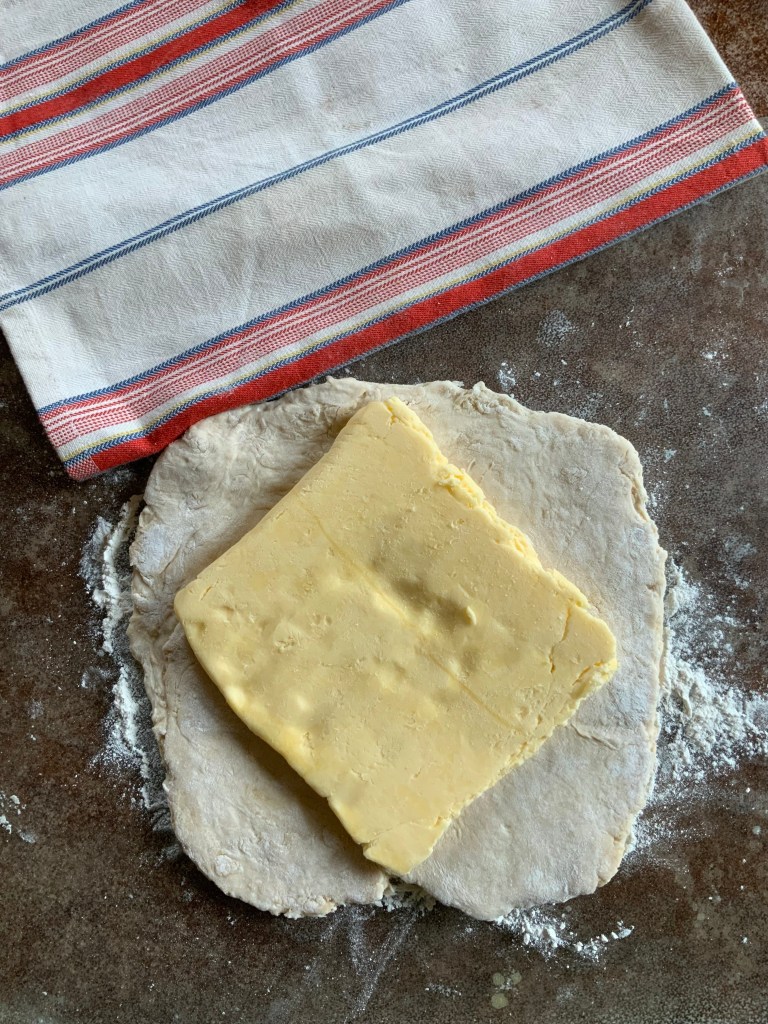
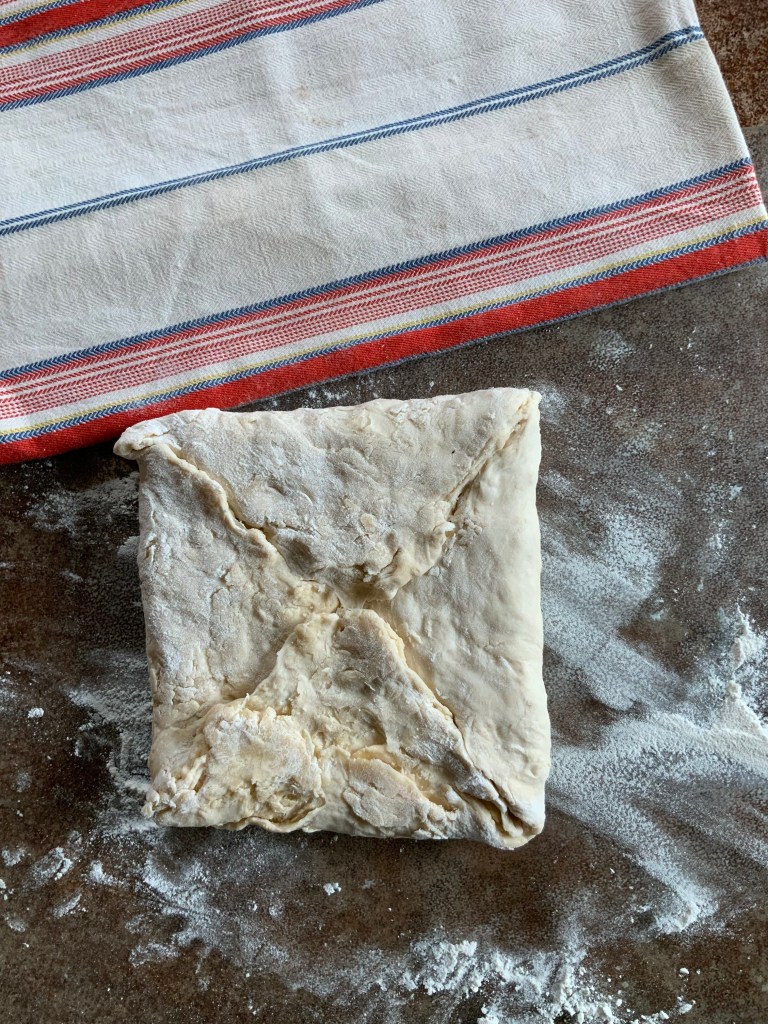
- Fold the corners of the dough in over the butter to enclose it fully and seal the edges lightly. Chill the dough/butter square for 10 minutes.
The First Set of Turns
- Place the chilled square on the pastry board, seals up, and gently begin rolling it out into a 15 cm (6-inch) by 46 cm (18-inch) rectangle.
- Begin rolling gently from the center outward, leaving the short ends until later, to help the butter bond with the dough and prevent it from breaking through as the rectangle forms.
- Continue to roll gently from the center toward the short ends, avoiding firm pressure on the sides at first, to give the butter time to bond with the dough and prevent its breaking through. As the rectangle nears 46 cm (18-inches) in length, begin gently rolling out the short ends as well.
- Fold the rectangle into thirds–like a letter: Fold the bottom third of the dough upward so that it covers roughly one-third of the length of the dough.
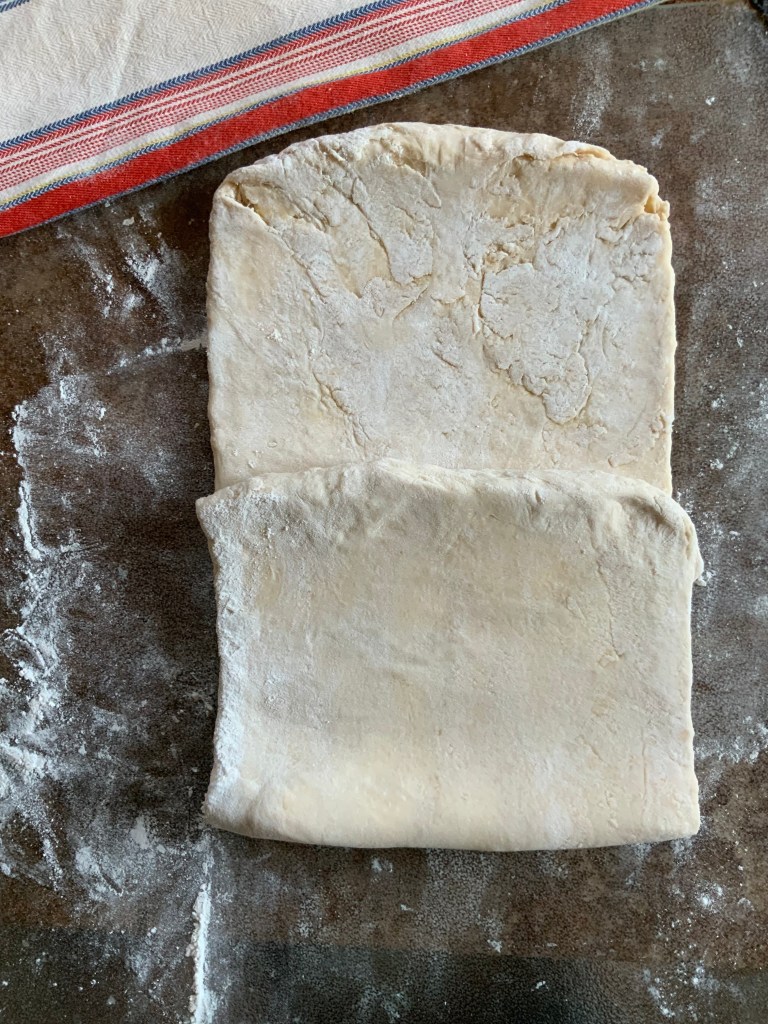
- Fold the top third downward over the first fold so that it covers the top fold, forming three layers, like a folded letter. This completes Turn 1 of the first set. The dough’s surface is still not very smooth at this point.
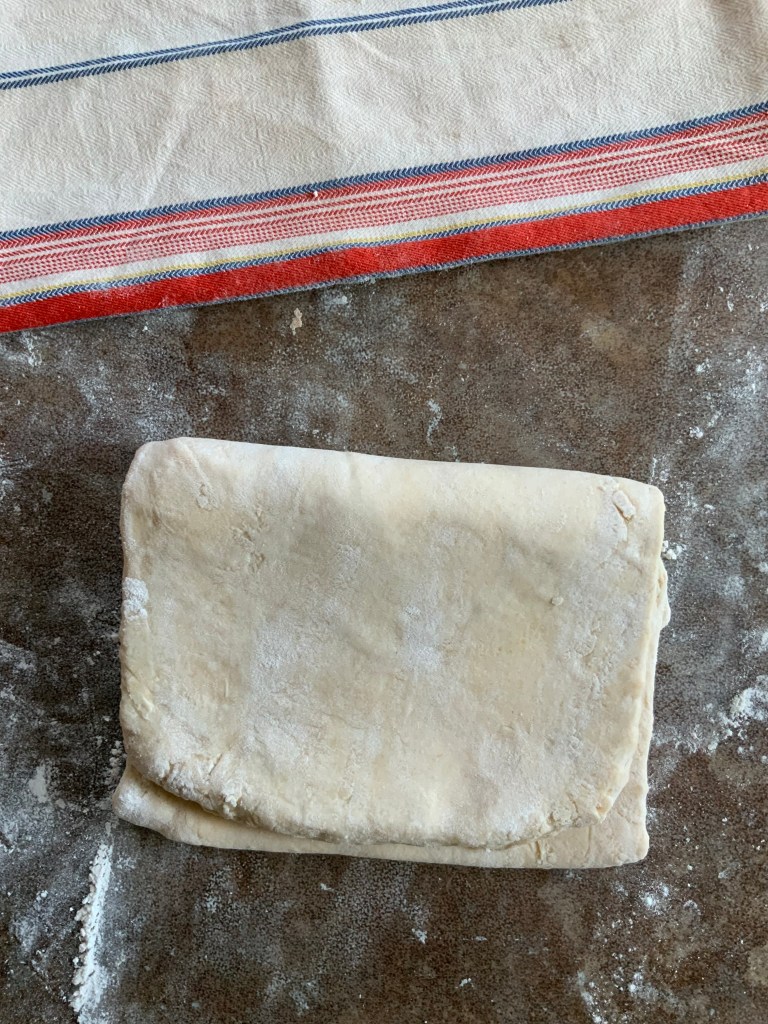
- Turn the dough 90 degrees.
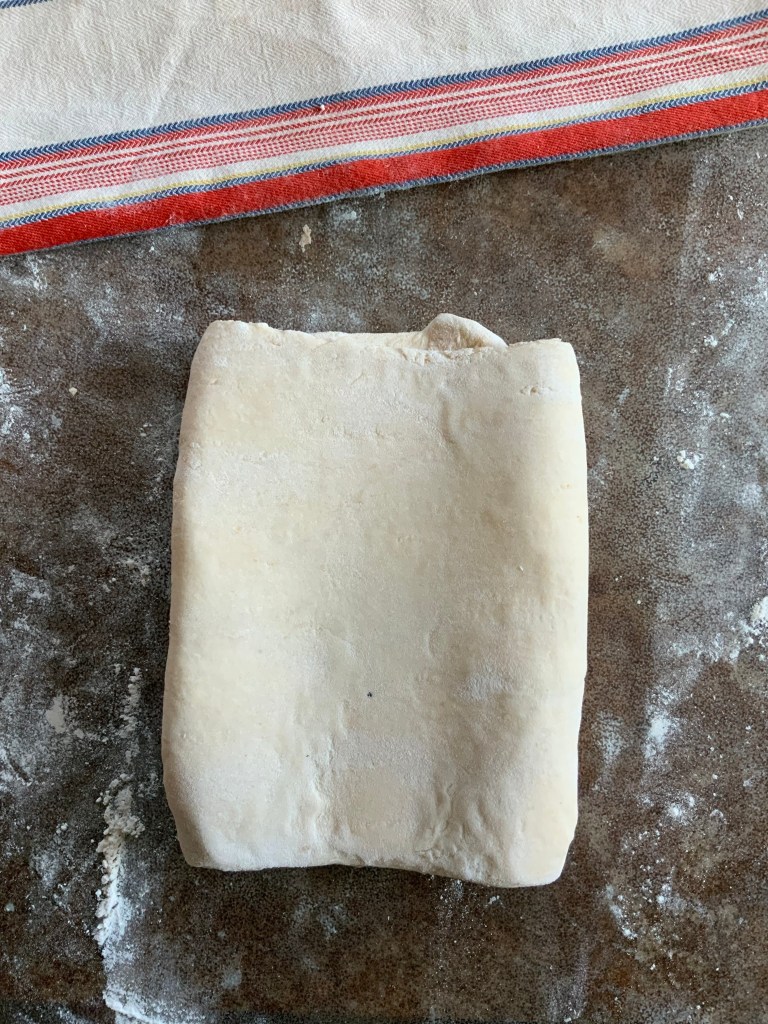
- Roll it again to the same size–a 15 cm (6-inch) by 46 cm (18-inch) rectangle. Fold again in thirds. This is Turn 2 of the First Set. Wrap the dough in plastic and chill it for 45 minutes.
The Second Set of Turns
- Repeat the process again of rolling into a rectangle and folding the rectangle into thirds. This completes Turn 1 of the Second Set.
- Turn the dough 90 degrees and again roll it out into a rectangle and fold it into thirds. This is Turn 2 of the Second Set. Wrap the dough and chill it for 45 minutes.
The Third Set of Turns
- Repeat the process again of rolling into a rectangle and folding the rectangle into thirds. This completes Turn 1 of the Third Set. With each successive roll and fold, the dough becomes smoother and can be rolled out with a firmer, more even pressure.
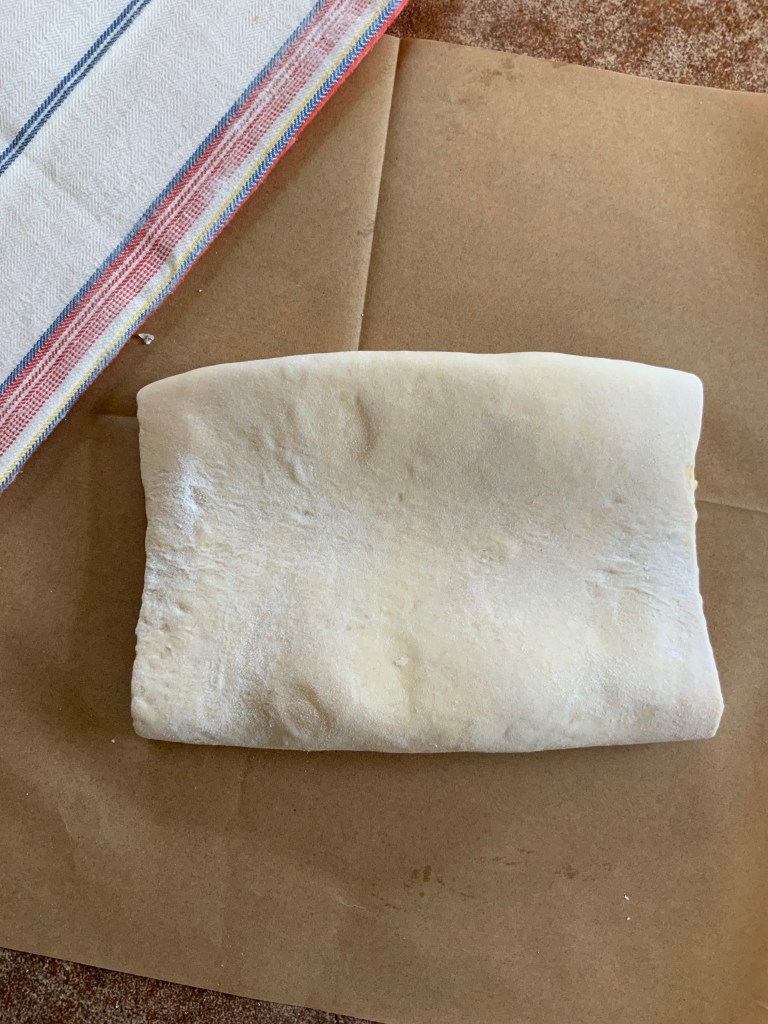
- Turn the dough 90 degrees and roll it again to the same size–a 15 cm (6-inch) by 46 cm (18-inch) rectangle. Fold again in thirds. This is Turn 2 of the Third Set. Wrap the dough in plastic and chill at least 1 hour before using it–an overnight rest in the refrigerator is even better.
Baking with the Pastry
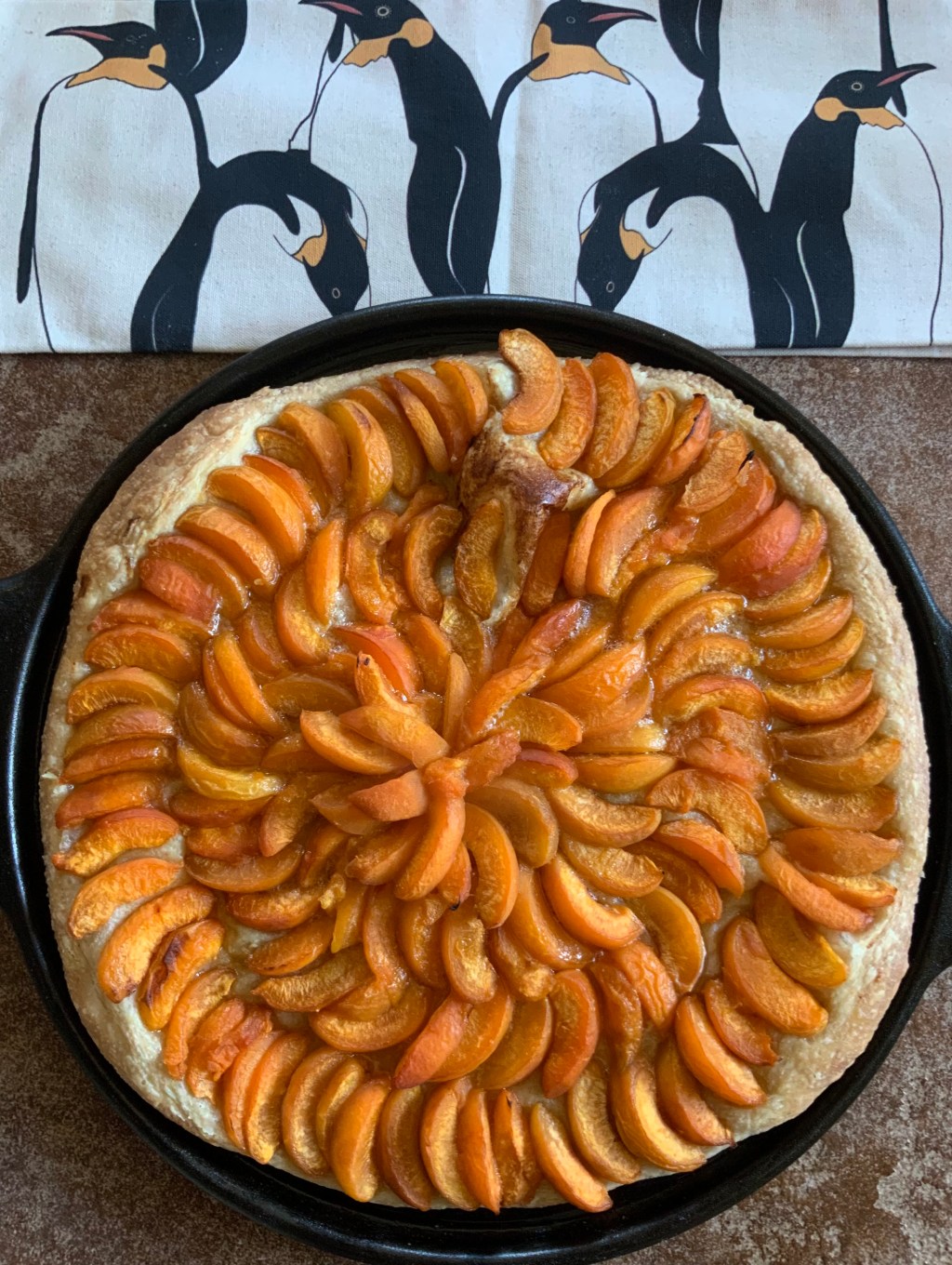
To give an idea of what may be made with this amount of dough: 1/2 of it will make 4-5 Individual Beef Wellingtons or a 14-inch Open-Faced Fruit Tart. Cut the dough in half and freeze the remainder wrapped in plastic. The dough may be kept frozen at least a month and thawed overnight in the refrigerator before baking with it.
Some guidelines: In general, handmade puff pastry is rolled out into a thin sheet for baking (.3 to .6 cm or 1/8 to 1/4 inches. A hot oven is preferable (425 F/220 C).

 thefoodlessprocessed
Leave a comment