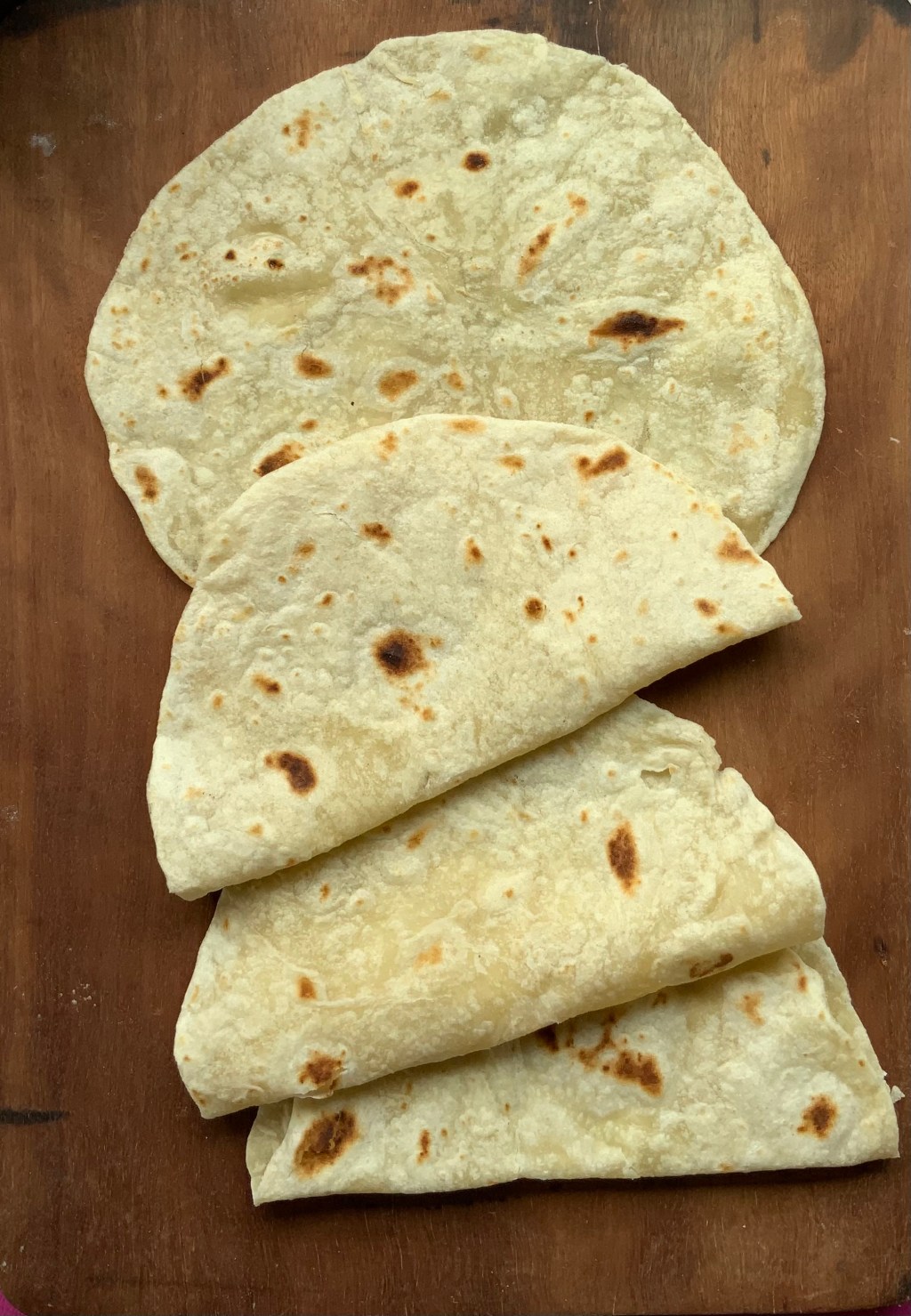
Tortillas are one of the most elemental forms of baking. The ingredients are four in number: flour, water, salt and animal fat. They contain no enrichments or leavening. After a brief mixing, the dough is divided into balls, rolled out and cooked quickly on a hot surface. In short, they are one of the most basic expessions of turning flour into bread.
Packaged tortillas are widely available, in the U.S. and in Europe. Local tortilla factories, should you live in their vicinity, provide a better alternative to the name brand varieties. But increasingly, these small makers are moving away from the simple bread made of flour, animal fat, salt and water to cheaper versions that include vegetable shortening and additives. The authentic tortilla has gone ultra-processed.
Just as the tortilla is one of the simplest of breads, it is also one of the simplest to make at home.
The four ingredients in them all have less processed options: Flour, Salt, Water, and Butter. (Lard is an alternative animal fat and another less processed option, but is not included in this version.)
Equipment
- a Mixing Bowl
- a Pastry Board and Rolling Pin
- a few Cotton Dish Towels between which to place the rolled-out tortillas before baking and after baking
- a Heavy-Bottomed Pan or Heavy Griddle: The tortillas in the photo were made in a 12-inch (30 cm) Cast Iron Skillet.
- a Turner, aka Flat, Broad Spatula
Ingredients
- 2 cups of Unenriched White All-Purpose Flour, plus flour for sprinkling on the pastry board: Either European Unenriched White Soft Wheat All-Purpose Flour or Organic Unenriched White Hard Wheat All-Purpose Flour (the American standard flour). Unless it is organic, American Unenriched White Flour may contain additives that are not listed on the label.
- 4 Tablespoons (57 g) of Salted Butter
- 1 teaspoon of Sea Salt
- about 2/3 cup (160 ml) of Bottled Spring Water. Tortillas made with soft wheat flour may not need the full amount.
Mixing the Dough
- Stir the flour and salt together in the mixing bowl.
- Cut the butter into pieces directly into the bowl and rub it into the flour until the mixture feels like fine cornmeal.
- Add the water gradually, mixing it in by hand, until a smooth, soft elastic dough forms. (A dough of either soft or hard wheat flour may require less than the full 2/3 cup (160 ml) of water.)
- If there is time, let the dough rest, covered, for 30 minutes or so. It will then be more relaxed and easier to roll out.
Rolling out the Tortillas
- Roll the dough by hand into a short, fat log and divide it into 6 or 8 roughly equal portions.
- Pinch each portion into a ball to tighten the surface, then roll it between your palms to form a smoother ball. Place the balls, as they are formed, on a towel and cover them with a second towel.
- Roll out all the balls into tortillas before beginning to bake.
- Sprinkle the pastry board with a little flour.
- Place a ball of dough on the board and roll it from the center outwards in all directions to form a thin circle of roughly 1 -2 mm. If the dough is resistant, there is no need to force it into shape at this point. It will spread out more just before baking as you stretch it out by hand. Place it between two cotton dishtowels and continue making tortillas of the remaining balls of dough and placing them between the towels. The circles may overlap on the towels but should not be stacked one on top of another. A second layer of tortillas may be placed on the top towel and covered with a third towel.
Baking the Tortillas
- If the pan or griddle is of cast iron, heat it up slowly over a medium low heat to insure that the pan or griddle is heated through.
- Before baking the first tortilla, raise the heat to medium high. The surface should be very hot so that each tortilla bakes in less than a minute. The short baking will create a soft, flexible tortilla. A round baked longer at a low heat will be crisp and stiff. Test the surface with a drop of water. The water should immediately hiss, spit and evaporate.
- Take up a tortilla and gently stretch from the middle in all directions.
- Lay it flat in the pan and begin counting at a steady pace to 20. Air bubbles may begin appearing on the surface.
- Turn the tortilla and bake on the second side, now pressing down on it here and there with the turner.
- Bake for no more than a count of 20 on the second side and less if the tortilla now begins to puff.
- The raw, ivory colour of the dough will have whitened. The surface will be mostly pale, with a yellowish tinge, but with occasional brown flecks.
- Sometimes, there will be a small charred spot where the tortilla touched the hot surface a little longer. These spots are normal and indicate that the pan was heated sufficiently. (This flecking is part of what gives fresh tortillas their characteristic look.)
- Flip the tortilla once more. Briefly press down on any raw-looking places with the turner. Transfer it to a cotton dishtowel and cover it with a second towel. The total baking time is less than a minute.
- Bake the remaining rounds in the same manner, stacking them one on top of the other between the towels.
- This will keep the tortillas soft and flexible and prevent them from drying out or cracking.
Note: A tortilla factory often will deliver fresh tortillas packaged in plastic bags sealed with a twist. The interior of the bag will be wet with the steam from the freshly-made tortillas. One might think that the moisture would make the tortillas soggy, but in fact, it is reabsorbed in the tortillas and keeps them soft and pliable.

 thefoodlessprocessed
Leave a comment