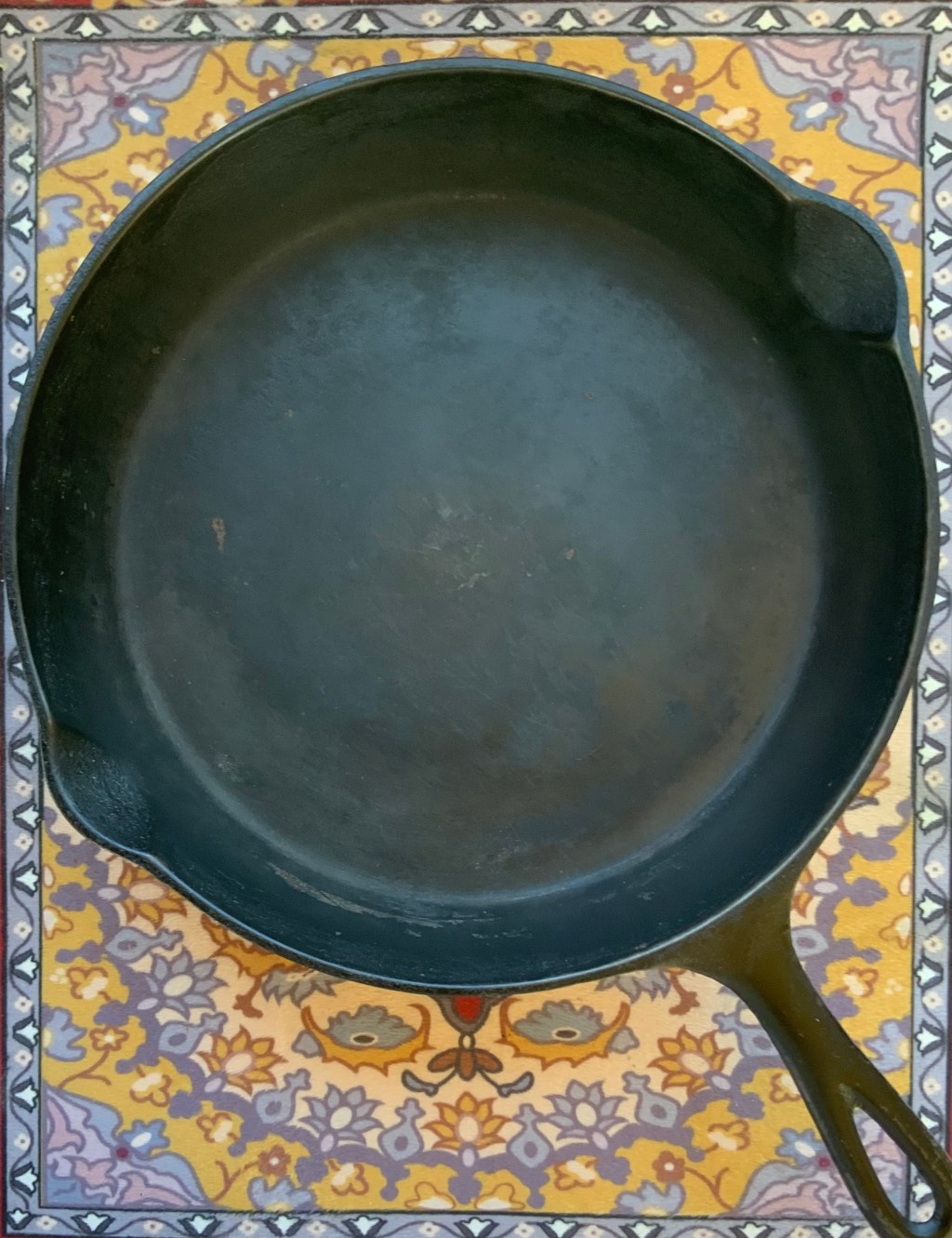
“When a French girl marries and leaves her mother’s home for her own, she always takes with her at least one sauteuse. My mother’s sauteuses had sides that flared a little and very long handles, because they had been passed down in her family from the time when most cooking was done in open fireplaces…Everyone treasured the old pans. Generations of use with fat and heat had seasoned them well, and seasoning is important in iron pans, which rust easily and do not cook so well when they are new.” (Louis Diat from Gourmet’s Basic French Cookbook (1961).
“My mother and her contemporaries were…stubbornly partial to certain utensils…It made no difference, for example, that the iron spider [a cast iron pan with feet] was heavy and unwieldy…all frying had to be done in the spider. Used as it was over a wood fire, the outside was encrusted with burned-on soot, but the inside was as smooth as the softest satin.” (Della T. Lutes from The Country Kitchen (1936).
Both these quotes are personal recollections from the late nineteenth century–one a memory of life in a small town in the heart of France, the other from a childhood in rural Michigan. Each puts the cast iron pan in an historical context that goes back to the days of open hearth cookery.
The Cast Iron Pan has endured because of its unique features. It is heavy. It heats evenly and holds the heat without constant raising and lowering of the flame. It is a naturally “non-stick” pan and and cleans easily as it becomes more seasoned with use.
Some recent versions of cast iron cookware are made lighter in weight than the traditional variety (supposedly for easier handling). But they lose a large measure of the essential quality that makes cast iron such a superior metal for heating evenly and holding heat. Cast iron of good quality withstands the high, variable temperatures of hearth and campfire as well as stovetop. Only in present day instructions for its use are there warnings that the iron may crack if exposed to very high heat. And, surely, this is a necessary precaution when the pan in lightweight.
A good new pan always will have a smooth inner finish created by sanding (aka milling)–not one that has been made non-stick through an artificial process. Cheaper pans are rough finished and can never become naturally non-sticking.
Practically every pan will come “pre-seasoned. But pre-seasoning is neither a great virtue nor an impressive selling point. All new cast iron pans, including pre-seasoned ones, should be seasoned before using them–and preferably not with vegetable oil.
It is easily done: Wash and dry the pan. Add about 1/2-inch of olive oil and heat the oil until it is very hot. Let the oil cool in the pan. Discard the oil and wipe out the pan with paper toweling.
The real, lasting seasoning occurs with repeated use. This is the seasoning that creates what Della Lutes described as an inside “smooth as the softest satin.”
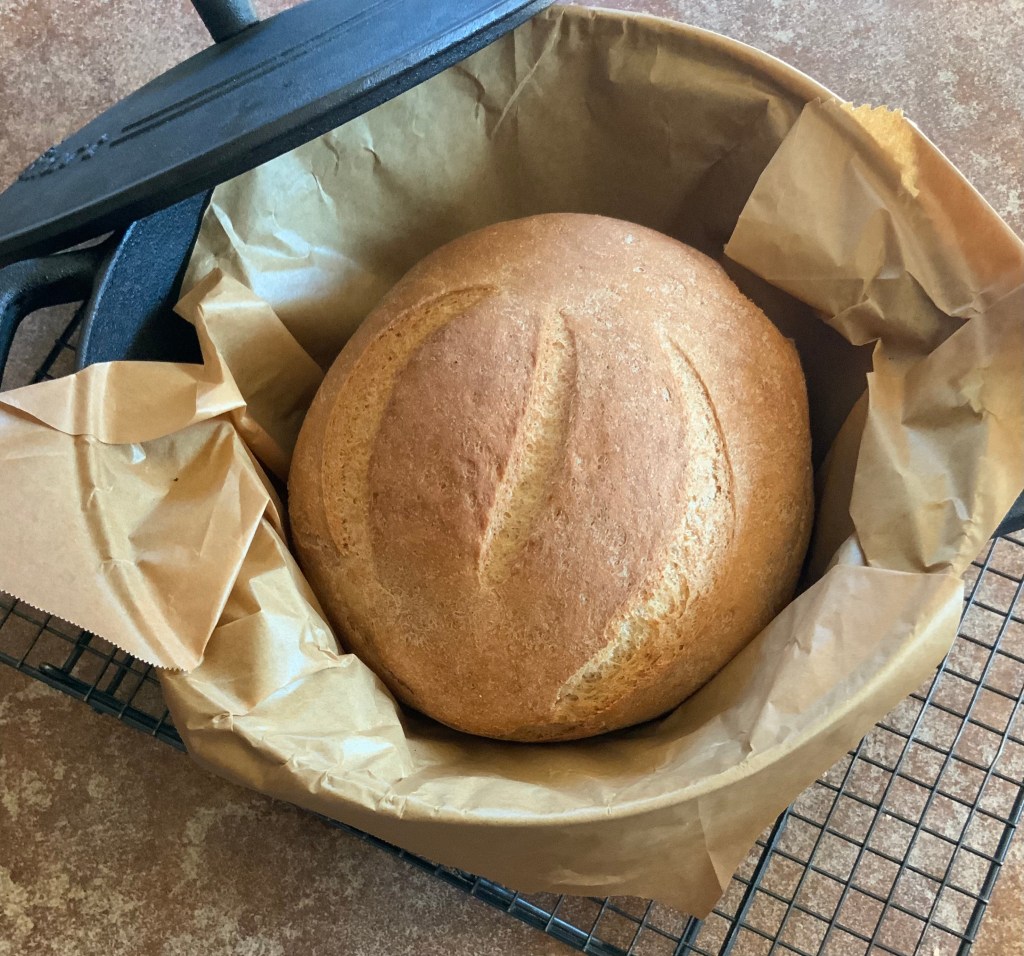
While it is true that a cast iron pan must be heavy to heat well, it will only do so if heated in the right manner…that is, slowly over very low heat. It is then an even temperature throughout, and will maintain a steady high heat for sautéing. (Although we have basically been considering its use over a flame, the pan may be used for baking as well.)
Cast iron has an additional benefit unrelated to how it cooks. For centuries it has been a source of iron, naturally imparting the mineral to the food it cooks so well to those around the table enjoying it.



Leave a comment