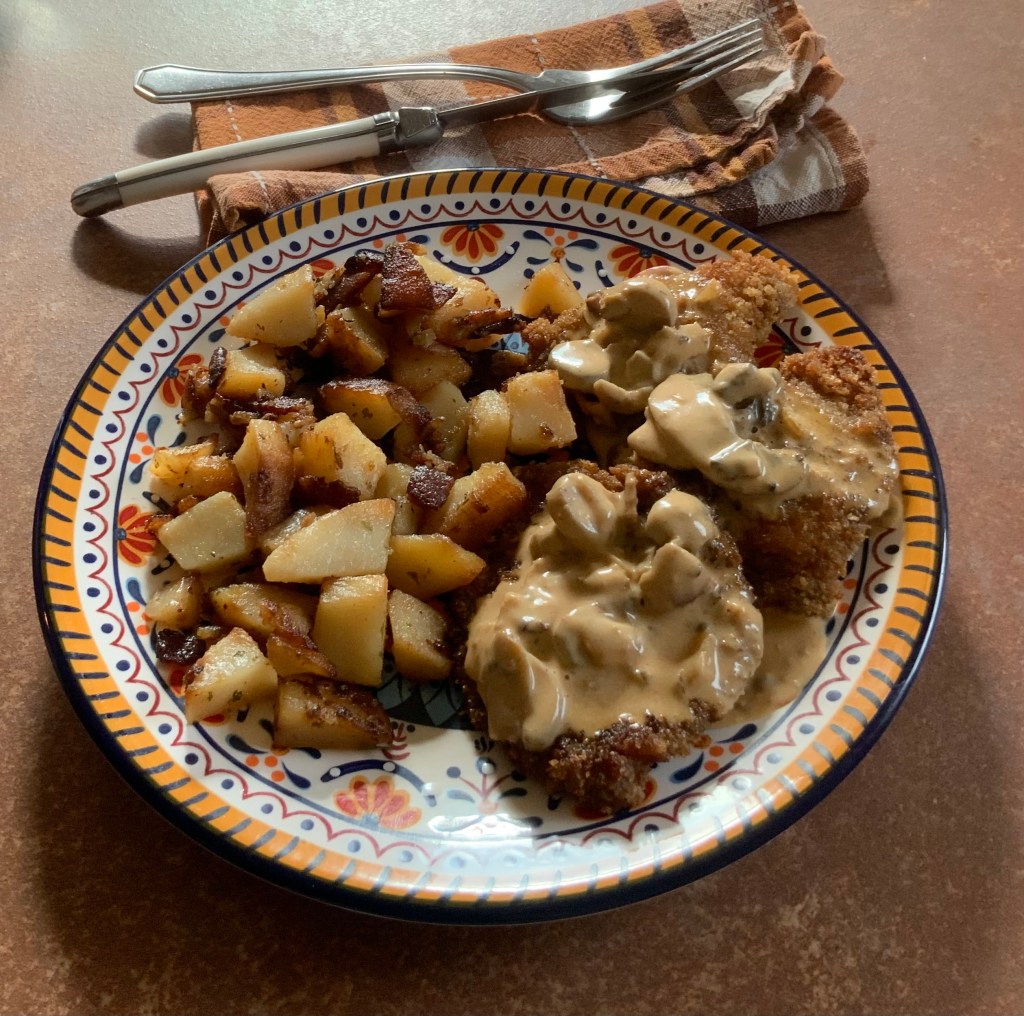
Jägerschnitzel (a Hunter style breaded cutlet) and Bratkartoffeln (a version of fried potatoes) are often served together. Several different types of meat may be used to make the cutlets. They may be made of boneless pork loin chops, cut thin and pounded to about a 1/4 inch (6mm) thickness. thefoodlessprocessed version uses pork tenderloin, sliced and pounded as for scaloppine. (See Making Scaloppine ~ with Pork Tenderloin.) Both are good options. Chicken cutlets may also be used instead of pork. (See Making Scaloppine ~ with Chicken Breasts.)
Follow these links to read about less processed ingredients options: Bacon, Breadcrumbs, Butter, Cream, Chicken Breasts, Flour, Pork Tenderloin, Parsley, Herbes de Provence, Paprika.
Jägerschnitzel
Equipment
- a Sauté Pan, such as an enameled cast iron sauteuse with a black baked-on porcelain enamel interior. Pans with a white enameled interior will not brown the meat as well.
- Utensils for making the scaloppine from a pork tenderloin or chicken breasts: a Cutting Board, a sharp Knife with a long blade, Kitchen Mallet, and Plastic Wrap.
- 3 Small Pie Pans or Rimmed Containers to hold flour, beaten egg, and bread crumbs
- a Rimmed Baking Tray lined with brown paper or paper towels, preferably large enough to hold the breaded scaloppine in a single layer
Ingredients
- at least 1 Whole Pork Tenderloin (Those of about 1 pound (454 g) are best for making scaloppine. A tenderloin of this size will make 8 to 10 scaloppine.
- Alternative: 4 Thin-Sliced, Free-Range, Air-Chilled Chicken Breasts (about 1 pound or 450 g). These will make 12 scaloppine…3 per breast.
- European White Flour, 3 Beaten Eggs and Breadcrumbs for breading the scaloppine. For making fine breadcrumbs French-style follow this link: Chapelure ~ a French way with Breadcrumbs.
- 3 Slices of Sugar-Free Bacon, cooked and broken into coarse bits
- 4 Tablespoons of Salted Butter and 3 Tablespoons of Extra-Virgin Olive Oil
- 1/4 cup Yellow Onion, finely chopped
- 1 cup of Sliced Fresh Mushrooms and Stems
- 1 cup of Dry White Wine
- 1 cup of Organic Heavy Cream
- 1 teaspoon of Sweet Paprika
- 2 or 3 teaspoons of Fresh Lemon Juice
Making the Scaloppine
- The technique for making the scaloppine with pork tenderloin is here on thefoodlessprocessed.
- Follow this link for making scaloppine with chicken breasts: Making Scaloppine ~ with Chicken Breasts.
Breading the Scaloppine
- Pour a small mound of flour into one pie pan, the beaten eggs into the second, and about a cup of chapelure into the third. Coat each scaloppine in the flour, then the beaten eggs, and then the chapelure. Set them aside in a single layer on a platter or tray.
Sautéing the Scaloppine
- Preheat the oven to 300 F (150 C). Adjust the temperature as needed if you have a convection oven. The scaloppine are kept warm in the oven while the sauce is being made.
- Heat 3 Tablespoons of the butter and 4 Tablespoons of olive oil in the pan. The butter will foam and sizzle as it melts. When the foam subsides, add as many scaloppine to the pan as will fit without crowding. Brown on one side. Slide a spatula gently under each to check if they are well browned. If a scaloppine sticks to the pan as you lift up on it, wait to turn it until it comes away easily. Brown on the second side, again checking each with a spatula to see that it does not stick to the pan before transferring it to the baking tray. Brown the rest of the scaloppine.
- Place the tray of scaloppine in the oven while making the sauce.
Making the Sauce
- Add another tablespoon< of butter to the pan. Add the onion and sliced mushrooms and sauté them until the mushrooms are golden.
- Sprinkle the mushrooms and onion with the paprika.
- Add 1 cup of white wine and reduce it over medium heat until it is nearly evaporated but not completely dry.
- Add the cream. Simmer it over low heat until it thickens. Large bubbles will appear on the surface when it is ready.
- Mix in the bacon and add 2 or 3 teaspoons of lemon juice, or to taste.
Serving
- Arrange several scaloppine on each plate and spoon some of the hot sauce over them.
Bratkartoffeln
Links for less processed options: Bacon, Butter, Herbes de Provence, Parsley.
Equipment for the Bratkartoffeln
- a Large Pot (8 quarts/7.5 liters or thereabout) and Lid
- a Large Heavy Pan with High Sides and a Lid, for example, a 12-inch (30.5 cm) Cast Iron Chicken Fryer with a 4.25 quart capacity (about 4 liters). A close European equivalent is a Sauteuse Haute, which has high sides and a long handle. It is deeper than a regular sauté pan.
- a Large Bowl
- a Cutting Board
- a Paring Knife and an All- Purpose Knife
- a Spatula/Turner
- a Flame Tamer (aka Heat Diffuser, Simmering Plate) is optional. The pot does not sit directly over the heat source and it is easier to adjust the cooking temperature. Some brands may be used on a smooth-top burner.
Ingredients for the Bratkartoffeln
- 8 Russet Potatoes. This variety of potato is brown-skinned and has a dry, floury texture. A European potato that is good for frying, mashing or baking would be the equivalent.
- about 1/2 cup of Yellow Onion, chopped (75-80 g)
- 4 slices of Sugarless Bacon, cut crosswise into lardons (small strips). European bacon tends to be cut much thinner than American bacon. The key is not the amount you use, but to use an amount that suits your taste. Speck may be substituted for bacon. Its flavour will be less pronounced.
- 4 Tablespoons of Salted Butter
- some Herbes de Provence
- a handful of Fresh Italian Flat-Leaf Parsley, chopped
- Fresh Ground Black Pepper.
Making Bratkartoffeln
- In a large pot, boil the potatoes in their skins until they are tender.
- Drain them. Put them in a large bowl and refrigerate them until they are cold.
- Peel the potatoes. Cut them into cubes and reserve them in a bowl.
- Fry the bacon in the pan until it just begins to brown, but is still quite flexible.
- Add the onion and cook, stirring it around, until the edges just begin to brown.
- Add the butter. When it is melted, add the potatoes. Mix them together with the onion and bacon. Sprinkle them with a little Herbes de Provence and grind over them some black pepper. Place the pan on the flame tamer over medium low heat. Cover the pan and cook without stirring until the bottoms of the potatoes begin to form a brown crust and come away from the pan easily.
- Turn the potatoes and brown them in the same way on the other side.
- When a crust has formed and the potatoes come away from the pan easily, turn them to brown the lighter sides. Cover again and cook without stirring to allow some more crust to form. If the bottom of the pan becomes dry and the potatoes begin to stick, add a few tablespoons of water, loosening them with a spatula. Replace the lid.
- When the potatoes are crusty and browned, mix in the parsley.




Leave a comment