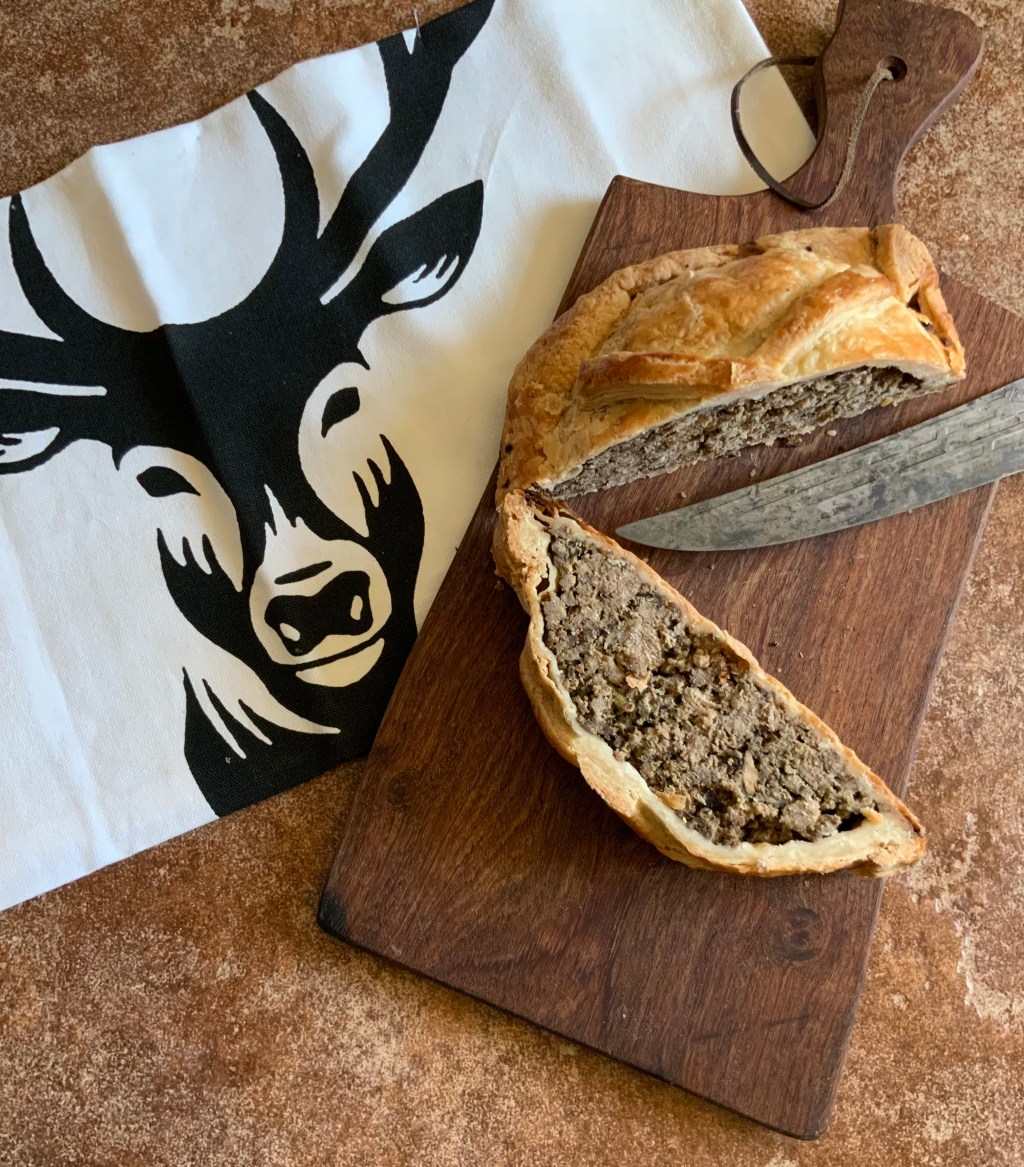
“For over 650 years, Finland formed the eastern part of the realm of Sweden. and it came within the sphere of influence of Western European culture…The diet of ordinary people was based on cereal…rye was the principal cereal…because of the climate there was little cultivation of wheat…Today bread made from wheat has become the norm, but the Finnish taste for sourdough rye and hard crisp bread goes back hundreds of years , and these continue to be found even at the most sophisticated banquets…The supply of meat was supplemented by game from the forests…it was not until the 1850s that the first cheese dairy on the Swiss model was opened…Only in eastern Finland did ordinary folk eat mushrooms…elsewhere in Finland, mushrooms were not used until, under the influence of French cuisine, the nobility, followed by members of the gentry, learned to eat them…Finnish gastronomy is part of the culinary culture of northern Europe. It is original and has respect for its own traditions. But it is also open to new influences–as it has been over the centuries” (From the introductory remarks by the editors of The Best Kitchen in Town: Finnish Haute Cuisine (2007), a collaborative work published by The Finnish Literary Society.)
This quote from an essay on Finnish food culture reflects how slow, when not forced, is the process of incorporating change into a culinary tradition, and also, how vigorous and healthy is a tradition that evolves naturally and does not cut itself off from its roots.
By 1968 when the recipe for Lihamurekepiiras upon which this one is based appeared in the chapter on Finnish cuisine in The Cooking of Scandinavia, this meat pie is described as a typical dish of the tradition. In the quote introducing this recipe, one sees that the essential features of the pie only came together into one dish in the course of centuries of Finnish food culture’s growth and adaptation to the vicissitudes of history. This is the time framework which gives traditional food systems their incomparable time-proven soundness for the quality of life of those who follow their traditional cooking practices and manners of eating.
The less processed ingredient options are described through these links: Flour, Butter, Crème Fraîche, Parsley, Venison, Milk, Bacon, Gruyère AOP, Salt.
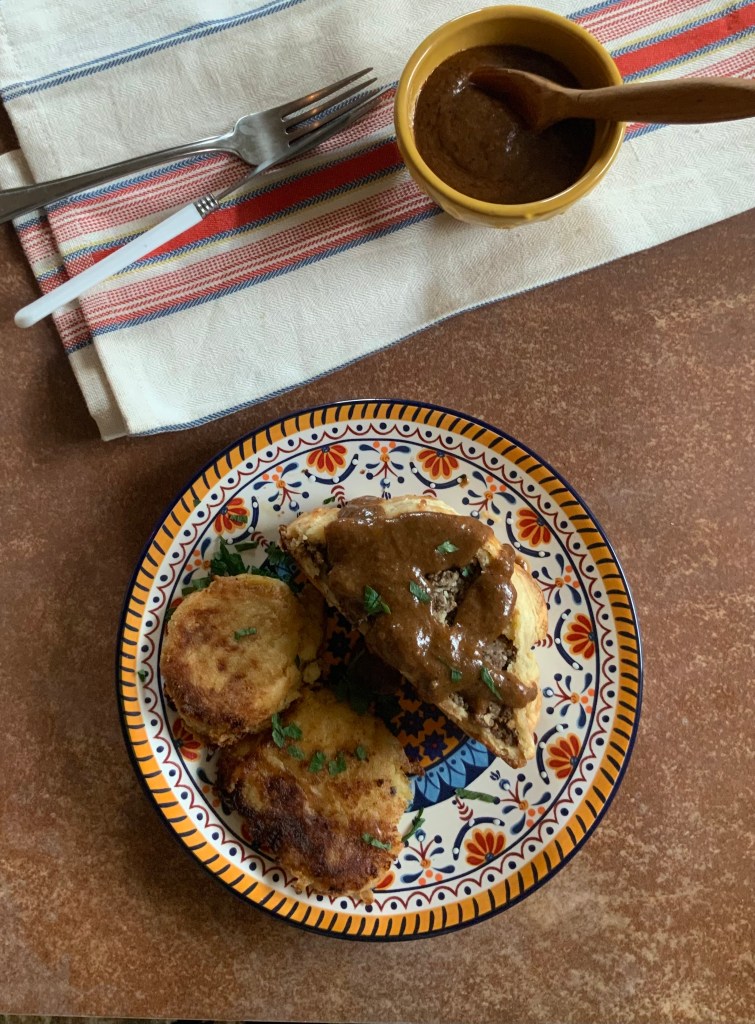
Note: This pie also may be made with ground beef or ground lamb. Sauce Espagnole is a good accompaniment to this pie made with any of the three meat options. The recipe for thefoodlessprocessed version of the sauce is here: Sauce Espagnole.
Less processed options for alternative meats for the filling are described here: Beef, Lamb.
Equipment
- a Large Heavy Pan with High Sides and a Lid. This recipe uses a 12-inch (30.5 cm) Cast Iron Chicken Fryer with a 4.25 quart capacity (about 4 liters) and a black interior. A close European equivalent is a Sauteuse Haute, which has high sides and a long handle. It is deeper than a regular sauté pan.
- a Spatula or Wooden Spoon
- a Large Mixing Bowl and a Small Bowl
- a Food Processor and Blade Attachment or a Cutting Board and All=Purpose Knife
- a Pastry Board and Rolling Pin
- a Rimmed Baking Sheet lined with Parchment Paper
- a 4-Sided Standing Grater
- a Pizza Cutter or Knife
- a Pastry Brush
- a Wooden Cutting Board or Serving Board
- Ingredients for the Pastry
- 2 and 1/4 cups of European Unenriched All-Purpose Soft Wheat Flour (270 g)
- 1 teaspoon Sea Salt
- 12 Tablespoons of Unsalted European-Style Butter (168 g)
- 1/2 cup Crème Fraîche (120 g or 4.2 ounces.)
- 1 Egg
Making the Pastry
- In the mixing bowl, combine the flour and salt. Then cut the butter into small pieces and combine it with the flour by rubbing the two together with your fingers until you feel only very fine bits of butter in the texture of the mix.
- In the small bowl, mix together the crème fraîche and the egg. Then stir this into the flour and butter mixture.
- Work the mixture with your fingers until it forms a soft, elastic ball.
- Wrap it in plastic wrap and refrigerate it for 1 hour.
Ingredients for the Meat Filling
- 4 Tablespoons of Salted Butter
- about 1/2 pound of White Mushrooms (227 g), finely chopped
- 2 pounds of Pasture=Raised Ground Venison (This pie may also be made with ground beef or ground lamb.)
- 1/4 cup of fresh Italian Flat-Leaf Parsley (about 12 g), finely chopped
- 1/3 cup of Yellow Onion (about 50 g), finely chopped
- about 1 and 1/8 cups of Gruyère AOP (100 g or 3.5 oz.), grated over the large holes of a grater
- 4 slices of Cooked Sugar-Free Bacon, (about 40 g or 1.5 oz.), finely chopped
- 1/2 cup of Whole Milk (120 ml)
- 1 Egg, beaten, and reserved in a small bowl for brushing over the pie before baking it
Making the Meat Filling
- Chop finely the mushrooms, parsley, onion and bacon, either in a food processor fitted with the blade attachment or by hand.
- Melt the butter in the pan. Sauté the onion, mushrooms, and bacon together until the liquid from the mushrooms evaporates and the mushrooms begin to lightly brown. Add the ground meat and cook until it loses its raw colour, breaking it up with a spatula or wooden spoon.
- Transfer the meat mixture to a large bowl. Stir in the cheese and the parsley. Add the milk a little at a time, allowing each addition to combine before adding more. The meat mixture will absorb the milk more completely as it cools. Cool the mixture to a temperature comfortable to handle before forming the pie.
Forming and Baking the Pie
Gas or Convection Oven: thefoodlessprocessed uses a gas oven. The conversions from Fahrenheit to Celsius do not attempt to adjust for differences between baking in a gas or convection oven. I have no experience using a convection oven, and leave adjustments to the better judgement of you who do have.
- Preheat the oven to 375 F (190 C). Place the parchment-lined pan near the pastry board, along with the small bowl of beaten egg.
- Divide the dough into two roughly equal parts.
- Roll half of the dough out on a floured pastry board into a rectangle of 7 inches by 14 inches (about 18 cm by 36 cm). Trim the edges with a pizza cutter or knife and transfer the rectangle to the parchment-lined pan. Reserve any scraps of dough.
- Roll out the second half of the dough into a rectangle of between 8 and 9 inches by 14 inches (between 20 and 23 cm by 36 cm). Trim the edges of the second rectangle and add the scraps to the reserved ones.
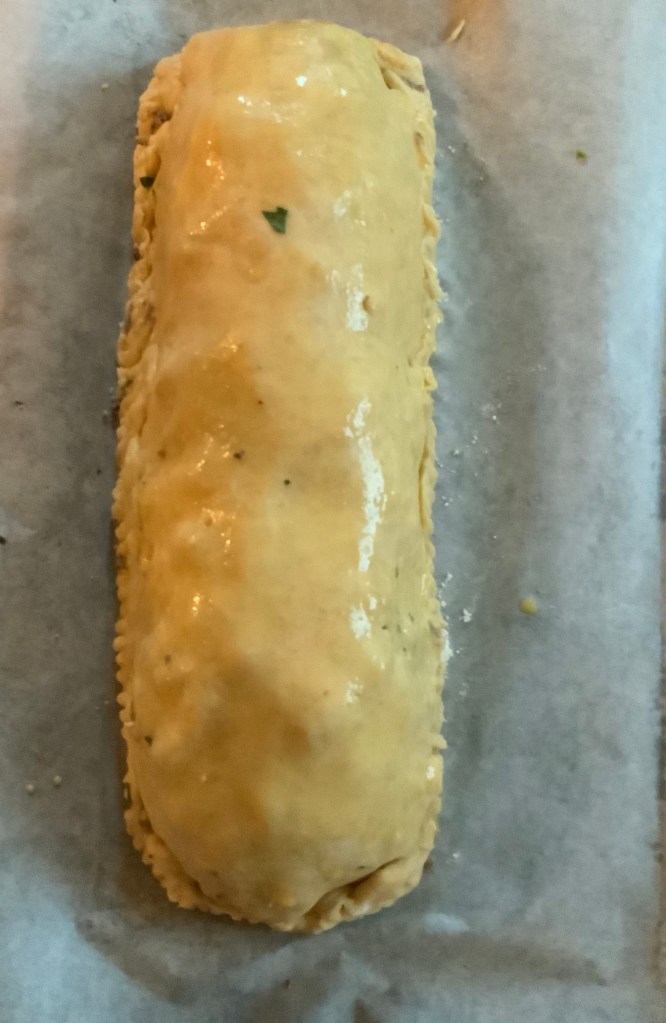
- Gather the meat mixture into a ball and place it in the middle of the rectangle of dough on the pan. Shape the meat into a loaf extending down the length of the rectangle, leaving about a 1-inch (2.5 cm) margin of pastry all around the loaf. With your finger or a pastry brush, smooth a little beaten egg all around the border.
- Cover the loaf with the second rectangle of dough and press the edges of the two rectangles together. Crimp the edges with a fork to seal the pie.
- With your fingers or a pastry brush, lightly brush the top of the loaf with the beaten egg.
- Combine the reserved scraps of dough and roll them out into a thin rectangle. With a pizza cutter or knife, cut the rectangle into long, narrow strips and trim the strips to fit over the top of the pie. (This is decorative and does not require exact cutting.)
- Combine the reserved scraps of dough and roll them out into a thin rectangle. With a pizza cutter or knife, cut the rectangle into long, narrow strips and trim the strips to fit over the top of the pie. (This is decorative and does not require exact cutting.)
- Crisscross the strips down the length of the pie and smooth a little beaten egg over the strips.
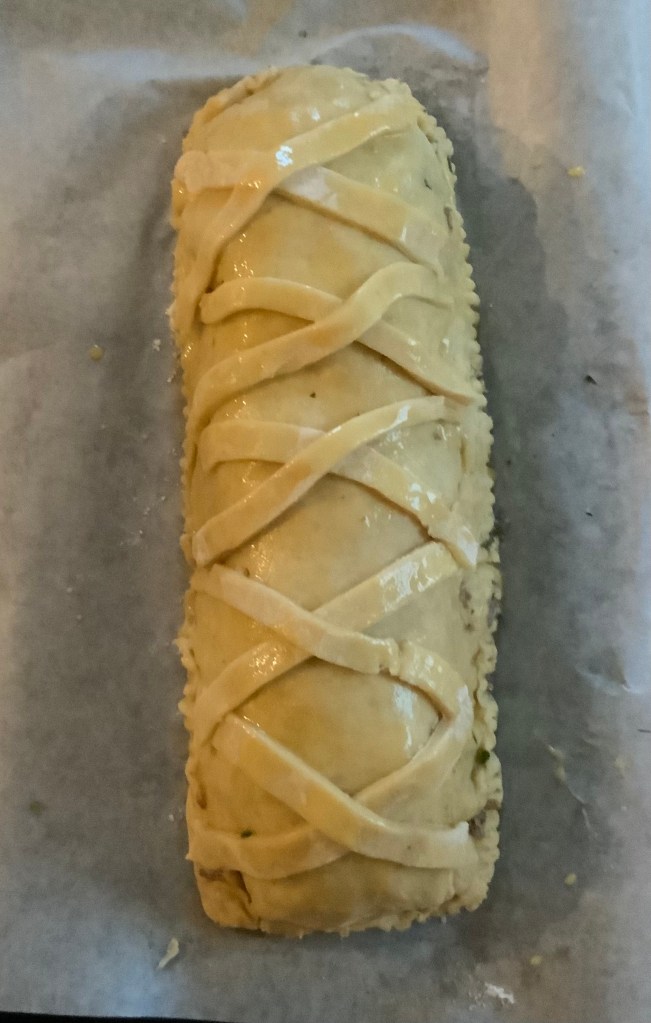
- Bake the pie on the center rack of the oven for 45 minutes or until golden.
- Transfer the pie to a cutting or serving board by placing the board next to the pan and shifting the pie, still on the parchment to the board. Then slip the parchment out from under the pie.
Complimentary Combinations
Finnish Venison Meat Pie
Sauce Espagnole

 thefoodlessprocessed
Leave a comment