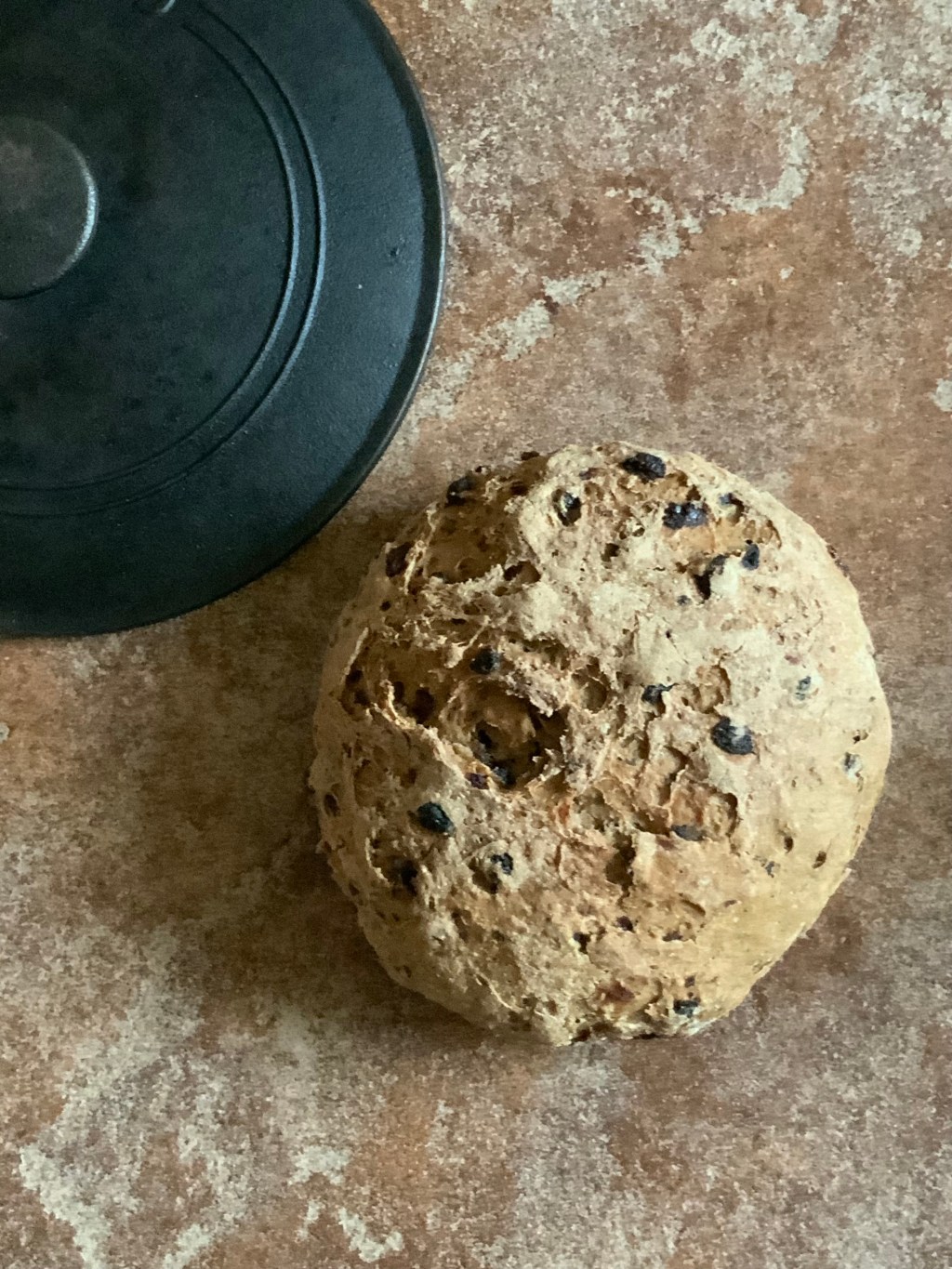
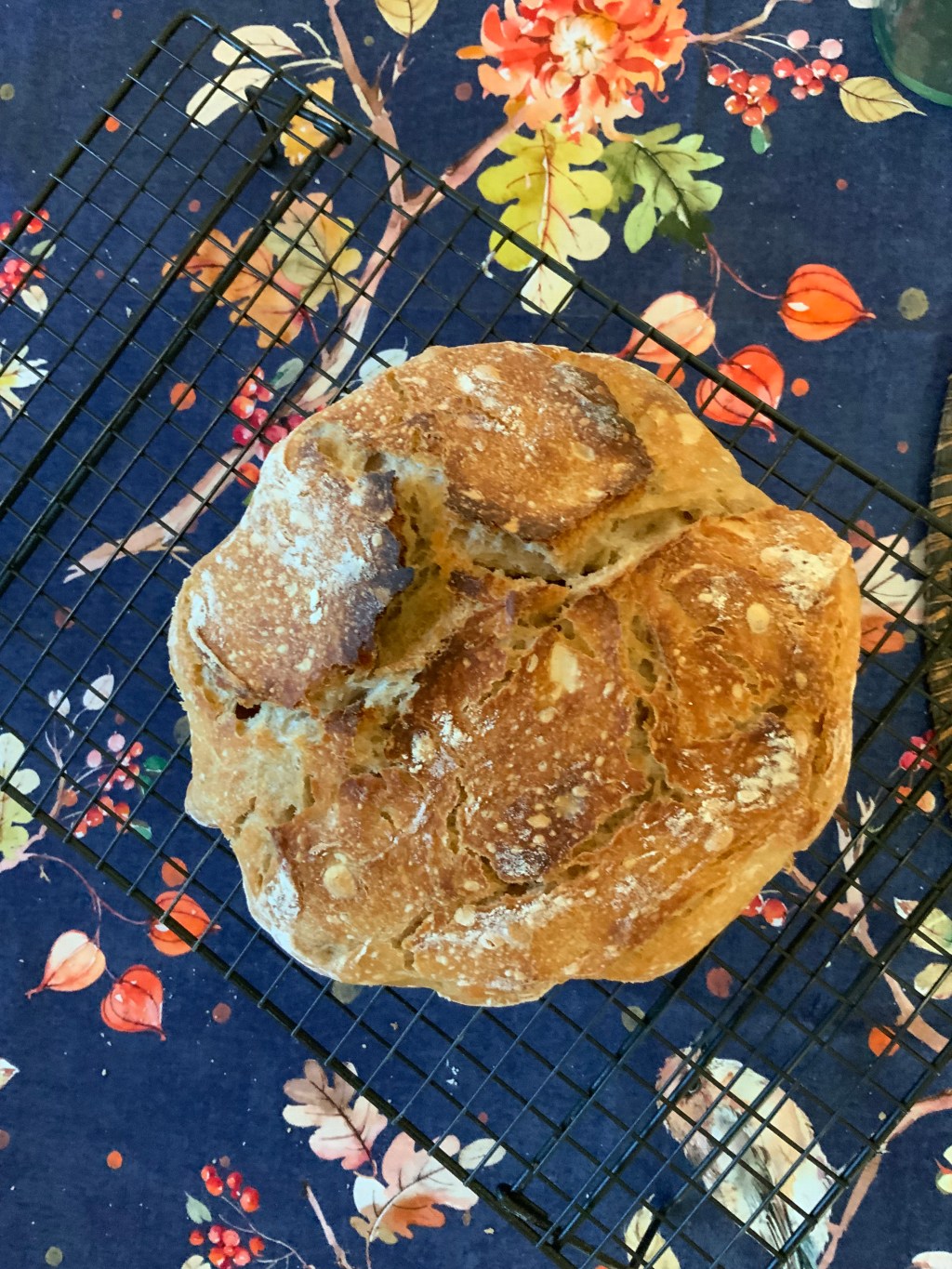
Maslin Bread combines rye with whole wheat flour. Raisin Rye mixes rye and white flours. Trying breads with different combinations of flours highlights the distinguishing characteristics of each flour–what they contribute to the flavour and texture of a loaf. In this case, the sugars in rye give the bread a crispy crust and a solid body. The white flour lightens the density.
This is a soft, heavy dough. To prevent it from spreading out and losing its shape, it is baked in a cast iron Dutch oven. This baking technique was used in an earlier thefoodlessprocessed post: Country White Bread.
Options for less processed ingredients are described via these links: Butter, Sherry, Raisins, White Flour, Rye Flour, Salt, Water.
Equipment
- a Digital Scale
- a Cast Iron Dutch Oven
- a Small Bowl to soak the raisins
- A Large Mixing Bowl for the dough’s first rise
- Parchment Paper
- a Pastry Board
- a Standing Mixer and Paddle Attachment for kneading the dough. It may be done by hand instead.
Ingredients
- 150 g of Organic Raisins
- Spanish Dry Sherry
- 200 g of Organic Stone Ground Rye Flour
- 300 g of European Unenriched All-Purpose Soft Wheat White Flour or substitute Organic Unenriched White All-Purpose Hard Wheat Flour. (American white flour is usually a hard wheat variety.)
- 340 ml Bottled Spring Water
- 10 g of Salt
- 7 g of SAF-Instant Yeast
- a little Salted Butter
Preparing the Raisins
- Put the raisins in a small bowl and add the sherry. Let them soak for an hour or so. Drain them. Set them aside. Reserve the sherry for another use, such as an addition to braised meat or vegetables.
Mixing the Dough and the First Rise
- In a large bowl, combine the rye and white flours, the salt, and the yeast.
- Gradually mix in the water and add the raisins.
- Knead the dough until it pulls away from the sides of the bowl, but is still sticky. Place it in a lightly buttered bowl. Cover it and let it rest for 30 minutes.
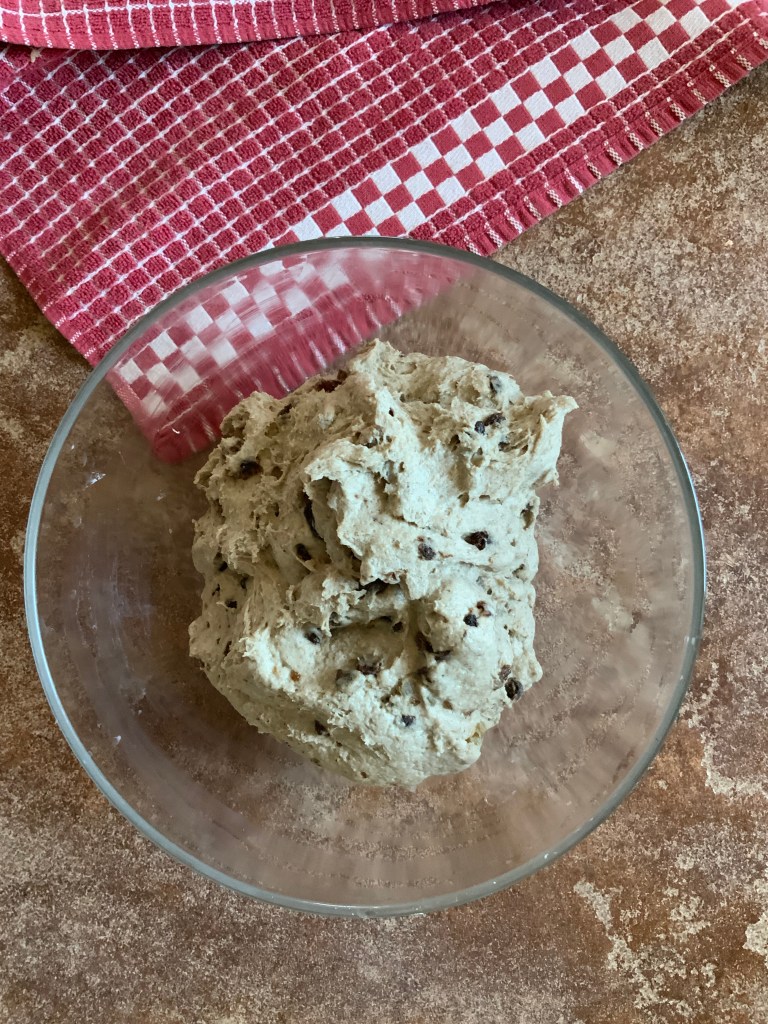
- Turn the dough out onto a lightly floured pastry board and knead it a little until it can be formed into a smooth ball.
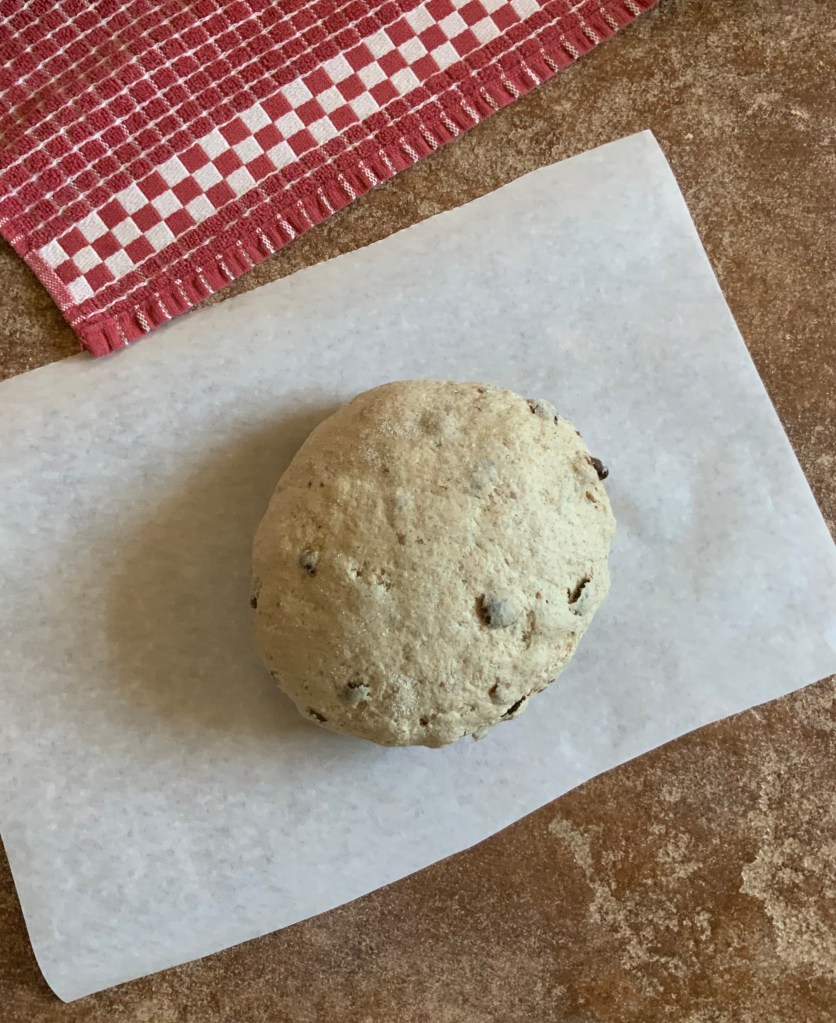
- Return it to the bowl. Cover and leave it to double in size.
Preparing the Parchment-lined bowl for a Second Rise
- Cut off a large sheet of parchment paper. The exact size is unimportant, but it should be large enough to come up beyond the sides of both the large mixing bowl or the Dutch oven.
- Then fold this rectangle to form a rough triangle. Fold it again into a smaller triangle.
- Place the narrow point of the triangle down in the center of the large mixing bowl and unfold the paper into the bowl, pressing the pleats out and moulding the paper to fit the bowl. Place the smaller mixing bowl down onto the paper and fold the edges of the paper down around the sides of the large bowl.
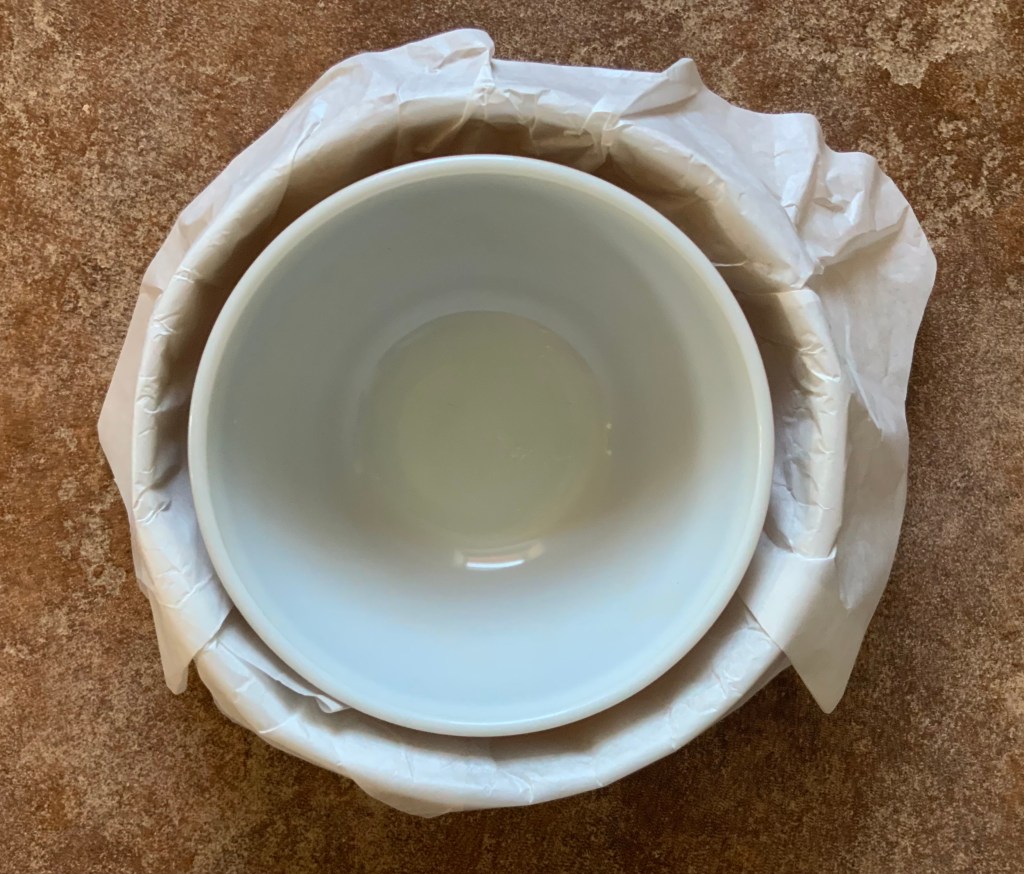
- Remove the smaller bowl.
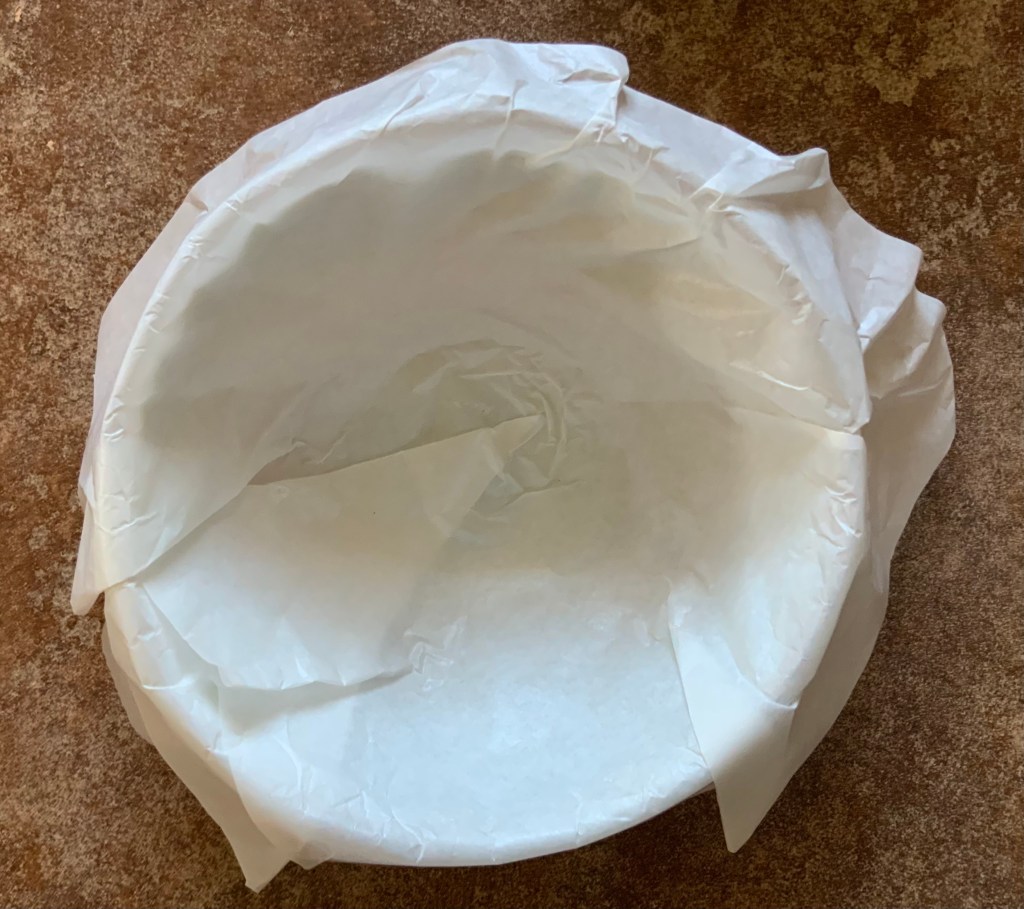
Forming the loaf for the second rise
Forming a loaf in the style of a traditional French boule means rounding the dough into a tight ball, creating surface tension across the top. Here is a YouTube video that thefoodlessprocessed has found useful on how to create surface tension from the site Bake with Jack.
- Form the dough into a smooth, tight round and place it in the parchment-lined bowl. Cover it and set it to rise until it doubles again.
Baking the bread
Gas or Convection Oven: thefoodlessprocessed uses a gas oven. The conversions from Fahrenheit to Celsius do not attempt to adjust for differences between baking in a gas or convection oven. I have no experience using a convection oven, and leave adjustments to the better judgement of you who do have.
Dutch oven baking: The bread is first baked with the lid on. The steam held in the oven keeps the outer crust soft and the baking bread can fully expand. The outer crust completely bakes once the lid is removed.
- Preheat the oven to 220 C (425 F). Place the lid on the Dutch oven and preheat it on the middle rack for 30 minutes.
- When the oven is preheated, remove the Dutch oven. set the lid to one side and transfer the raised dough to the Dutch oven by lifting it up by the edges of the parchment and lowering it down, parchment and all, into the oven. Replace the lid and return the Dutch oven to the oven.
- Bake the bread with the lid on for 20 minutes.
- Remove the lid and continue baking the bread for 25 minutes longer.
- Transfer the bread to a rack to cool, either lifting it out, still in the parchment or flipping it on end with a long spatula and removing only the loaf.
******
“To tell if a loaf is done, tap it on the underside, and it will sound hollow and dry; the dull thump of a loaf that is still moist in the middle is quite different.” Dorothy Hartley from Food in England (1954).
“If you want a loaf to have a crisp crust, dry it quickly in a hot place; if you want a soft crust, wrap it in a blanket while warm.” Dorothy Hartley from Food in England (1954).



Leave a comment