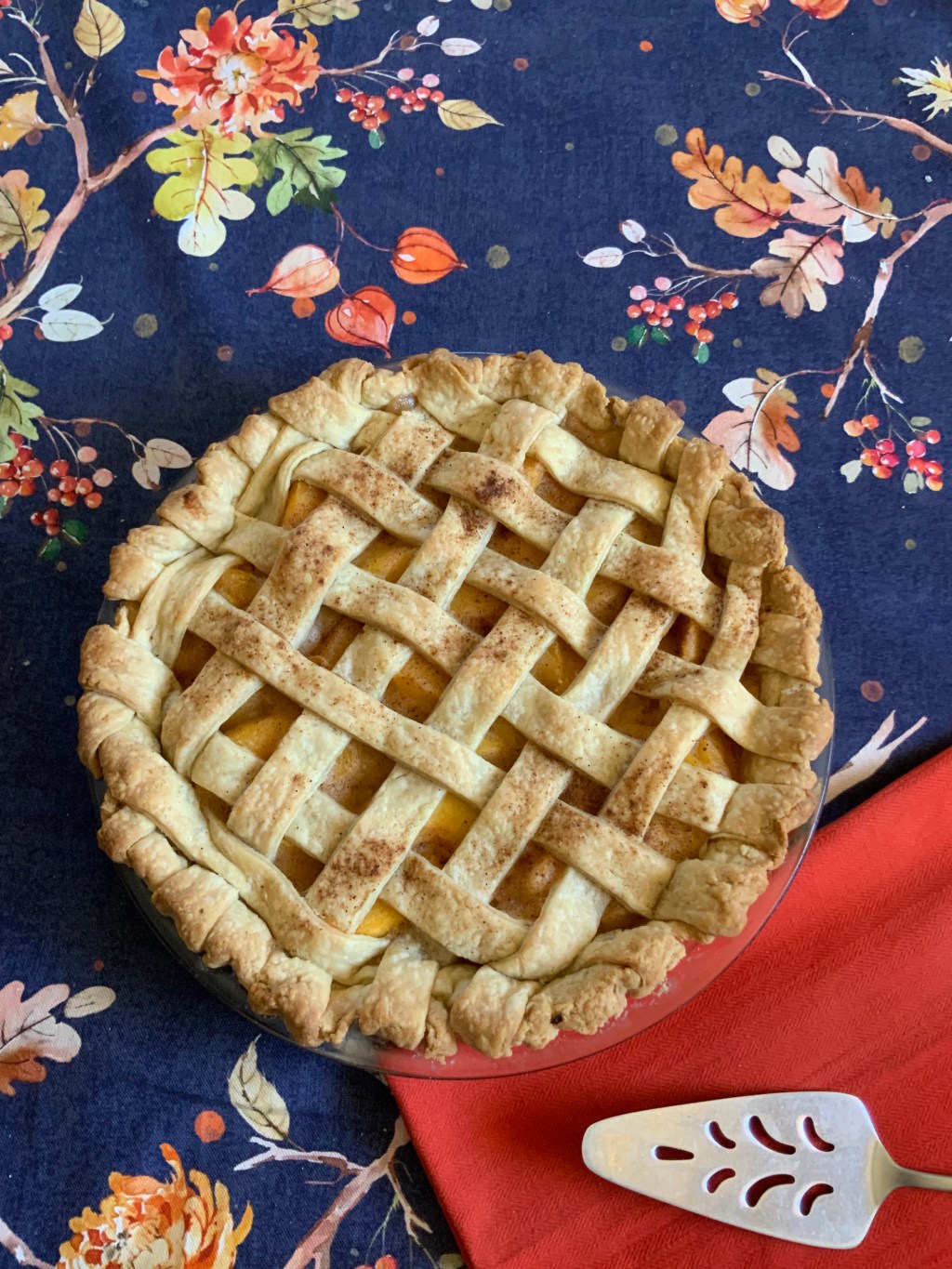
Here is yet another traditional American pie: fresh peach. The peaches available in stores are often underripe. They are picked before they’re ripe because ripe peaches are highly perishable. They also bruise easily and do not transport well. However, store peaches may be successfully ripened at home. This recipe begins with a description of a way of doing it.
Read about less-processed ingredient options through these links: Apple Juice, Apple Juice Concentrate, Butter, Cinnamon, Flour, Fresh Fruit, Nutmeg, Potato Starch, Salt, Water.
Ripening Peaches at Home
- Place the peaches in a brown paper bag along with a banana. Fold down the top of the bag and leave the fruit at room temperature to ripen. (Bananas give off ethylene gas as they ripen and the peaches respond to the gas by softening and sweetening faster. A paper bag concentrates the ethylene near the fruit, but still allows air to circulate.)
- Check the peaches daily. They are ripened when: 1) They smell like peaches. 2) They give a little when pressed lightly. 3) A thin metal skewer pushed into the fruit does not meet a crunchy core.
Peeling and Slicing Fresh Peaches
- Cut an ‘X’ in the base of each peach.
- If the peaches are not going to be cooked, have a bowl of ice water ready to cool them.
- Bring a pot of water to a boil. Blanch the peaches for a minute or two until the skin shows signs of softening and loosening.
- If the peaches are going to be cooked right away, there is no need to cool them in ice water. Peel them with a paring knife. The skin will come away in strips easily.
- Since the peaches are now ripe and soft, rather than attempt to pit them, cut down vertically to the pit and make slices all around it.
Making the Pie
Equipment for the Pastry and Filling
- A Large Mixing Bowl and a Small Mixing Bowl
- a Pastry Board
- a Rolling Pin
- a Pizza Cutter
- a Traditional American Slant-Sided Pie Pan with a 10-inch (25.5 cm) Diameter Base
- a Large, Heavy-Bottomed Saucepan
- a Flame Tamer (aka Heat Diffuser, Simmering Plate) is optional. The pot does not sit directly over the heat source. The filling can cook slowly and evenly and is less likely to scorch. Some brands may be used on smooth-top burners.
- a Whisk
- a Bowl in which to cool the filling
- Kitchen Scissors
- a Rimmed Baking Pan lined with a sheet of Parchment Paper
Ingredients
- 1 and 1/2 recipes of thefoodlessprocessed: Alsatian Short Crust Pastry.
- 4 pounds (about 1.80 kg) of Fresh Peaches: This amount will give you about 2 pounds (almost 1 kg) of sliced fruit, after peeling and slicing and taking into account the likelihood that a couple of peaches will look fine but are spoiled inside.
- 3/4 cup (177 ml) total homemade Apple Juice Concentrate from thefoodlessprocessed recipe divided into two parts of 1/2 cup (128 ml) and 1/4 cup (60 ml)
- 1 teaspoon of Fresh Lemon Juice
- 3 Tablespoons of Unmodified Potato Starch
- 1 Egg, beaten
- 3 Tablespoons (57 g) of Organic European style Unsalted Butter
- 1/2 teaspoon Organic Ground Cinnamomum Verum (aka Organic Ceylon Cinnamon)
- 1/4 teaspoon Organic Ground Nutmeg or Freshly Grated Nutmeg
Making the Filling
- Peel and slice the peaches. A method for both is described above.
- Add the fruit and 1/4 cup (60 ml) of apple juice concentrate and the lemon juice to the saucepan and coat the fruit with the juices.
- In the small bowl, mix together 1/2 cup (128ml) of apple juice concentrate and the 3 Tablespoons of potato starch.
- Add this mixture and 3 Tablespoons (42 g) of Organic European style Butter to the saucepan of fruit and place the pan on the flame tamer.
- Cook over low heat, stirring, until the filling thickens.
- Remove from the heat.
- Whisk together the egg, the cinnamon and the nutmeg.
- Whisk them into the filling.
- Transfer the filling to a bowl and cool it.
Assembling the Pie and Baking
Gas or Convection Oven: thefoodlessprocessed uses a gas oven. The conversions from Fahrenheit to Celsius do not attempt to adjust for differences between baking in a gas or convection oven. I have no experience using a convection oven, and leave adjustments to the better judgement of you who do have.
- Preheat the oven to 400 F (200 C).
- Roll about 2/3 of the dough out on a lightly floured pastry board. Roll from the center out in all directions to form a circle that will fit in the pie pan with a generous overhang.
- Transfer the dough to the pie pan: Place the pie pan next to the board. Roll the dough loosely around the pin, towards you, until only about half the dough hangs down from the pin. Drape the unrolled portion over the edge of the pan nearest you and unroll the remainder out away from you, covering the pan.
- Press the dough down into the pan and up the sides. Cut the overhang with kitchen scissors to meet the outer edge of the pie pan.
- Roll out the remaining dough into a circle of similar size to the first one. With a pizza cutter, cut the round into 1/2-inch strips (strips a little wider than 1 cm).
- Pour the cooled filling into the pastry-lined pan.
- Weave the lattice crust. Lay half of the pastry strips horizontally across the pie filling 1-inch (about 2 cm) apart. Place a long strip vertically down through the center of the pie, and weave it over and under the horizontal strips, gently folding back every other horizontal strip and placing the vertical strip beneath it. Work out from the center, placing the vertical strips about 1-inch (2 cm) apart and weaving each one over and under in the same way as you did the first one. (Note: If the long center vertical strip crosses over the corresponding long horizontal one in the center of the pie, then the vertical strips on either side of it will cross under the long horizontal one.)
- Trim the lattice and the bottom crust to the same size: to the rim of the pie pan, Roll the ends of the lattice strips and the edge of the bottom crust together inwards to form a raised border inside the edge of the pan. Crimp them together.
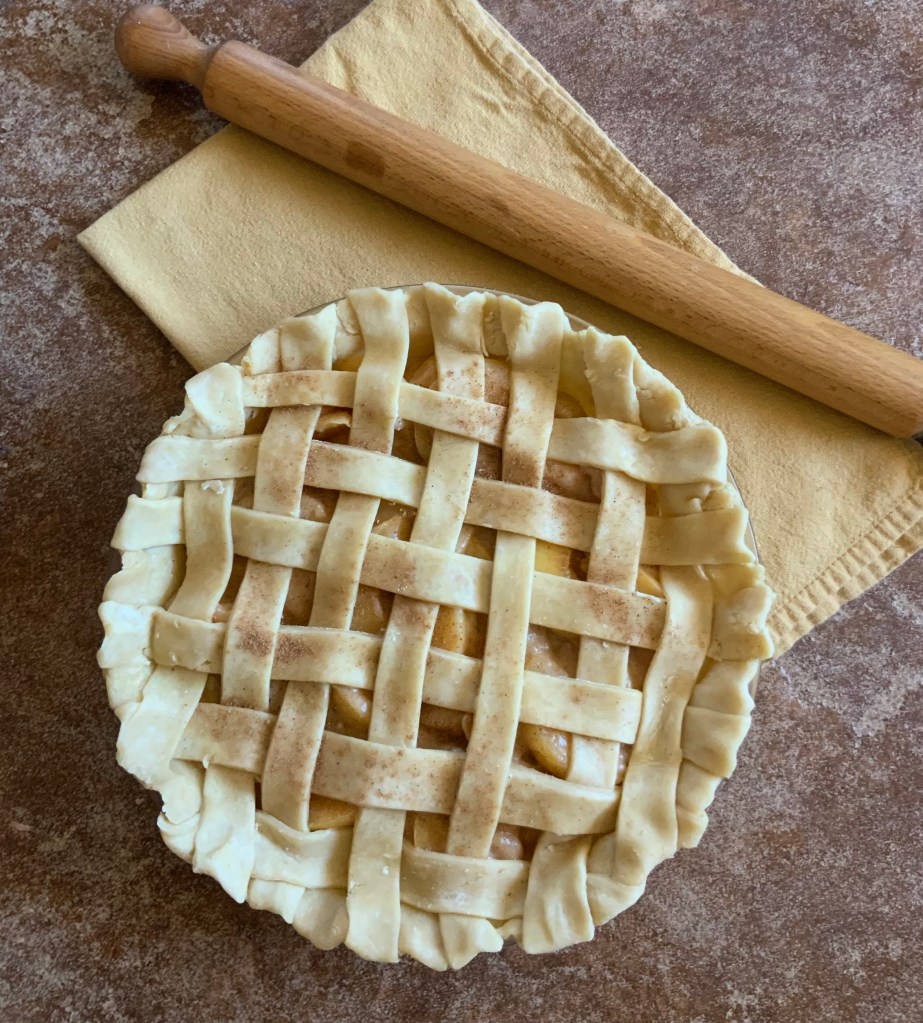
- Sprinkle the top with nutmeg.
- Place the pie on the rimmed pan lined with parchment and bake it on the lower middle rack until it is golden. The estimated baking time is 40 minutes.



Leave a comment