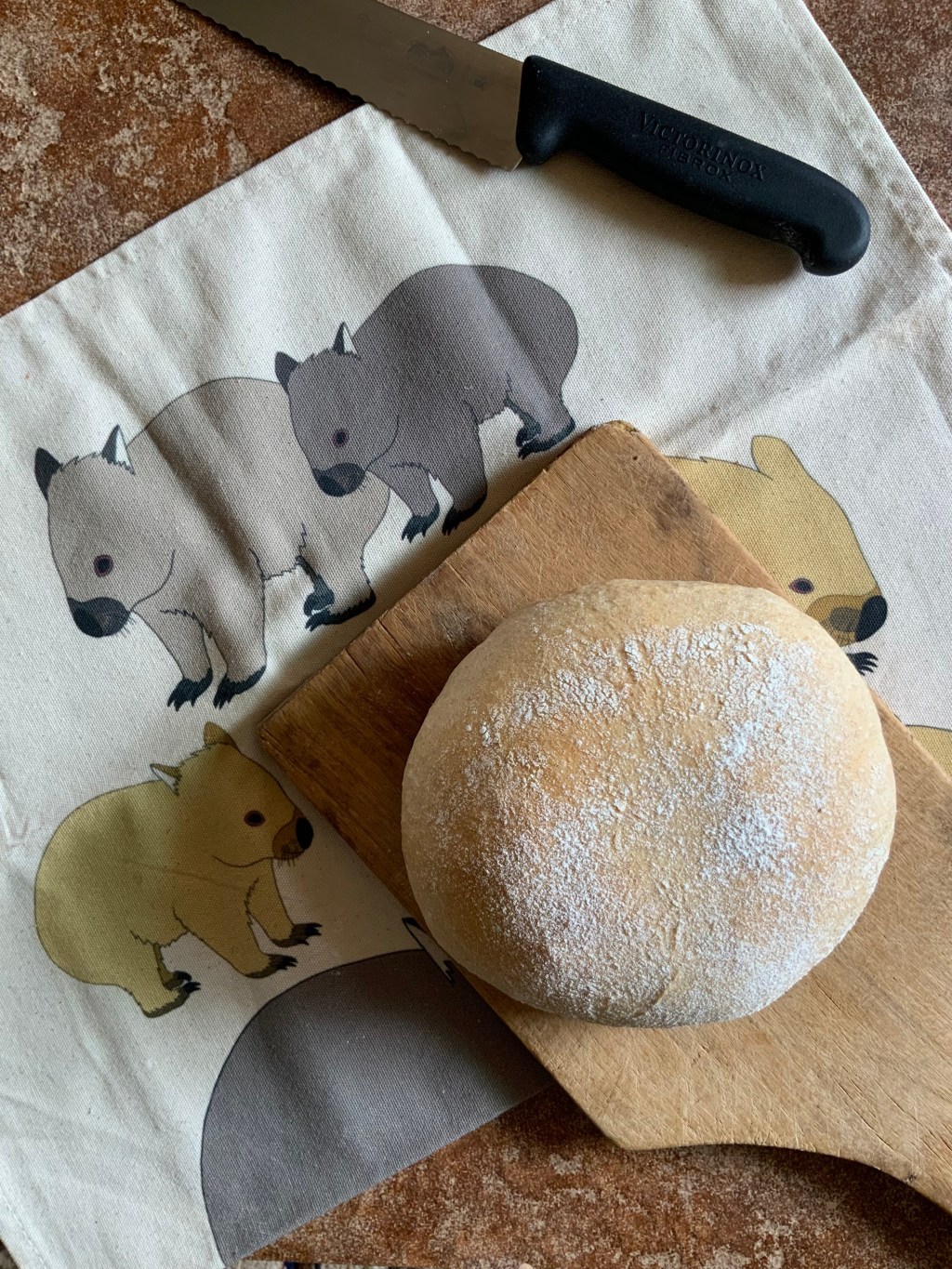
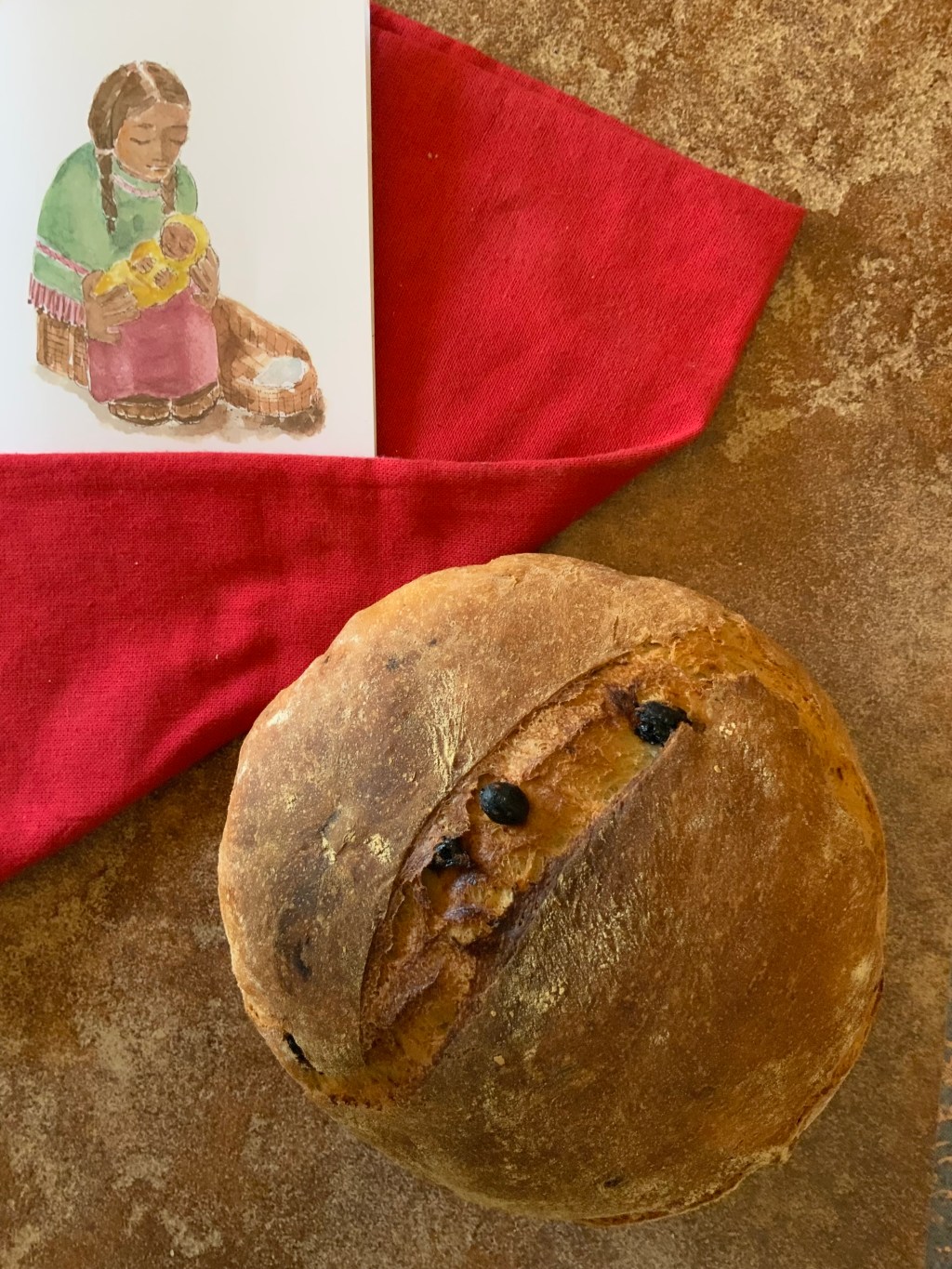
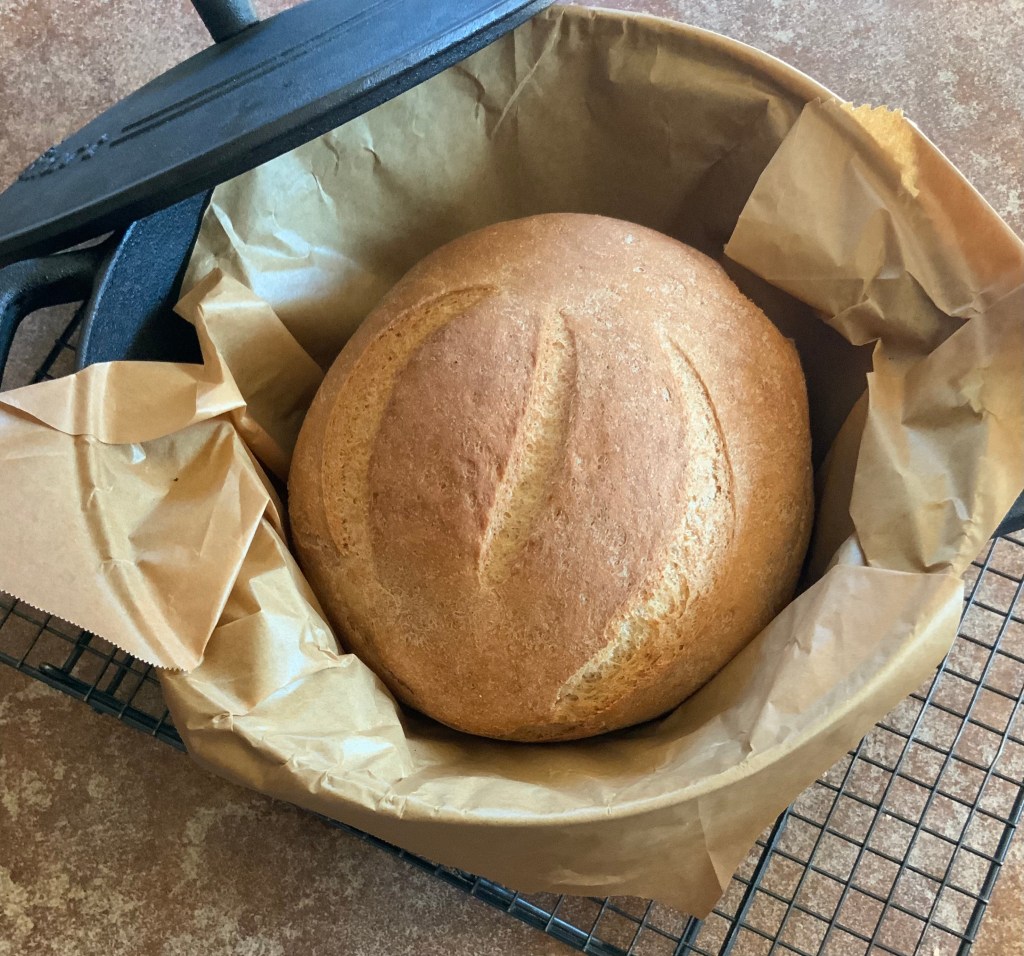
English farmhouse loaf recipes vary, some calling only for water while others, including this one, add some milk as well. The addition of milk can help the bread stay soft longer. But, unlike a soft, fine-textured, sandwich bread, a farmhouse loaf has a dense, chewy texture and a firm crust. Typically formed into a loaf and baked in a tin, the boule shape adapts the loaf for baking in a Dutch oven.
With the exception of the yeast, there are less processed options for all the ingredients: Water, Salt, White Flour, Whole Wheat Flour, Honey, Butter, Milk.
Equipment
- a Digital Scale
- a Dutch Oven
- a Standing Mixer and Paddle Attachment (Alternatively, the dough may be mixed and kneaded by hand.)
- a Small Bowl for proofing the yeast
- a Large Bowl, lightly buttered, for the first rise
- a Large Bowl, lined with Parchment Paper, for the second rise: How to line the bowl is described below.
- a Pastry Board
- a Small Sieve for dusting flour on the baked loaf
Ingredients
This recipe is based on a European one using metric measurements. The U.S. measurements are approximate. Using a digital scale will avoid having to use approximate measurements.
- 3 g of SAF Instant Yeast (about 1 teaspoon)
- a dab of Organic Unfiltered Honey
- 135 ml of Bottled Spring Water (a bit over 1/2 cup)
- 20 ml of Whole Milk (about 2 Tablespoons)
- 12 g of European-Style Unsalted Butter, softened (a bit less than 1 Tablespoon)
- 212 g of Unenriched European All-Purpose White Flour (about 1 and 2/3 cups) or substitute with Organic Unenriched All-Purpose Hard Wheat Flour. Hard Wheat Flour is the typical American variety.
- 37 g of Stoneground Whole Wheat Flour (about 1/3 cup)
- 4 g of Sea Salt (about 3/4 teaspoon)
Making the Dough
- In a small bowl, add the yeast and honey. Measure the water in a liquid measuring cup and from the total amount, take about 30 ml (1/8 cup) and add it to the yeast. Set the mixture aside to proof. It will become foamy.
- Add to the mixing bowl the white and whole wheat flours, the salt and the butter.
- Add the milk and water and mix. Let the mixture stand for about 15 minutes to allow the flours to absorb the liquid.
- Add the proofed yeast.
- Knead to a stretchy and slightly sticky dough. A slightly sticky dough will feel sticky but will not cling to your hand.
First Rise
- Place the dough in the buttered bowl. Cover it with a large bowl or plastic wrap and leave it to rise until doubled in size.
Lining the Bowl for the Second Rise
- Cut off a large sheet of parchment paper. The exact size is unimportant, but it should be large enough to come up beyond the sides of both the large mixing bowl or the Dutch oven.
- Then fold this rectangle to form a rough triangle. Fold it again into a smaller triangle.
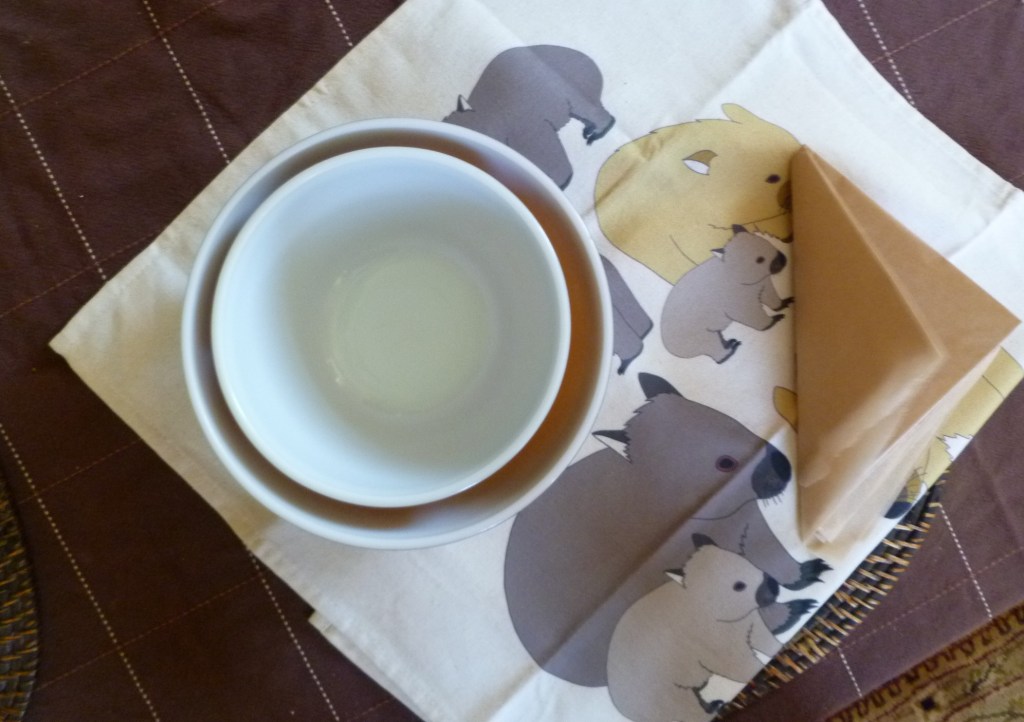
- Place the narrow point of the triangle down in the center of the large mixing bowl and unfold the paper into the bowl, pressing the pleats out and moulding the paper to fit the bowl. Place the smaller mixing bowl down onto the paper and fold the pointed edges of the paper down around the sides of the large bowl.
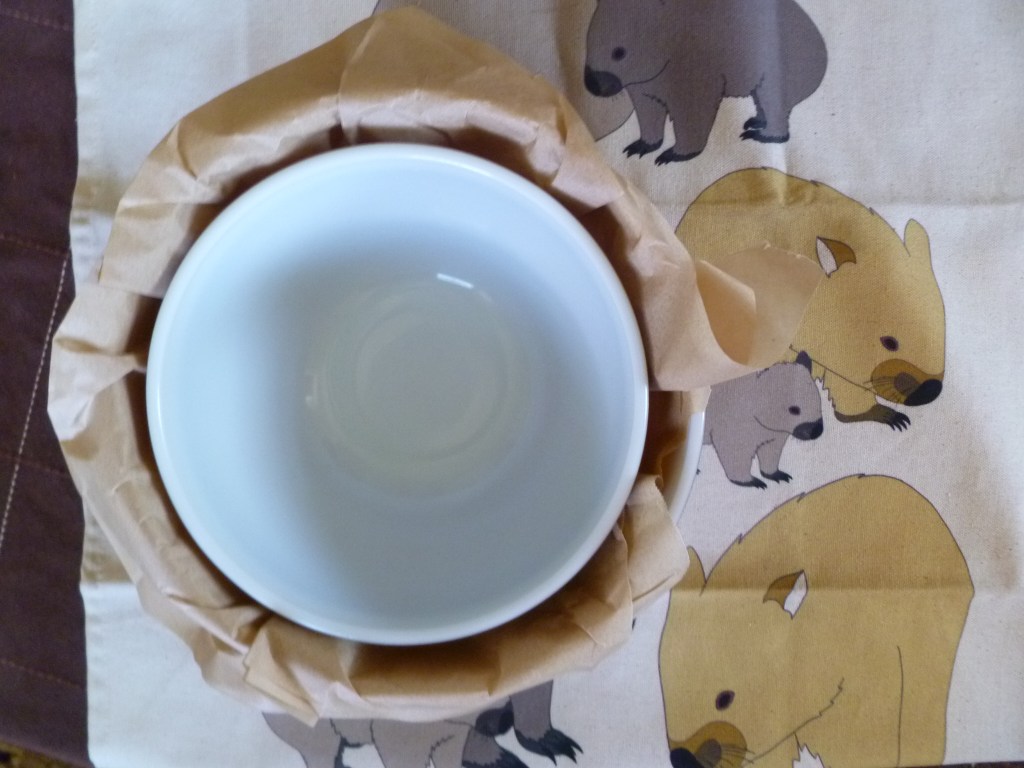
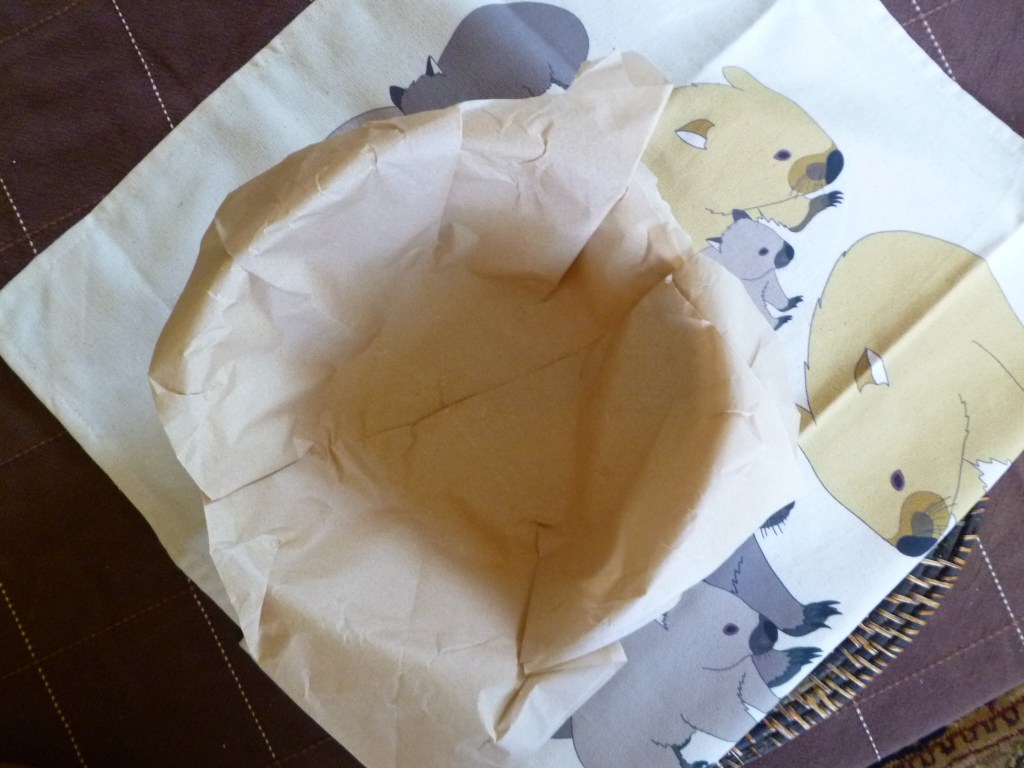
- Remove the smaller bowl. The dough will be left to rise once more in this lined bowl.
Forming the Boule
The loaf is formed in the style of a traditional French “boule”, which means rounding the dough into a tight ball, creating surface tension across the top. Here is a YouTube video that thefoodlessprocessed has found useful on how to create surface tension from the site Bake with Jack.
- Place the round in the parchment-lined bowl, cover it and set it to rise until it doubles again.
Baking the Loaf
Gas or Convection Oven: thefoodlessprocessed uses a gas oven. The conversions from Fahrenheit to Celsius do not attempt to adjust for differences between baking in a gas or convection oven. I have no experience using a convection oven, and leave adjustments to the better judgement of you who do have.
- Place the Dutch oven, covered, on the middle rack of the oven and preheat it for 30 minutes at 400 F (200 C).
- When the boule is risen, remove the preheated Dutch oven, set the lid aside, and place the boule down in the Dutch oven by lifting it up by the sides of the parchment and, still in its parchment nest, placing it down in the Dutch oven. Replace the lid and return the Dutch oven to the middle rack.
- Bake for 15 minutes.
- Remove the lid from the Dutch oven. Reduce the heat to 375 F (180 C). Continue baking, uncovered for 15 minutes more.
- Remove the Dutch oven from the oven. Transfer the loaf to a rack and, with a small sieve, dust flour over the top of it.



Leave a comment