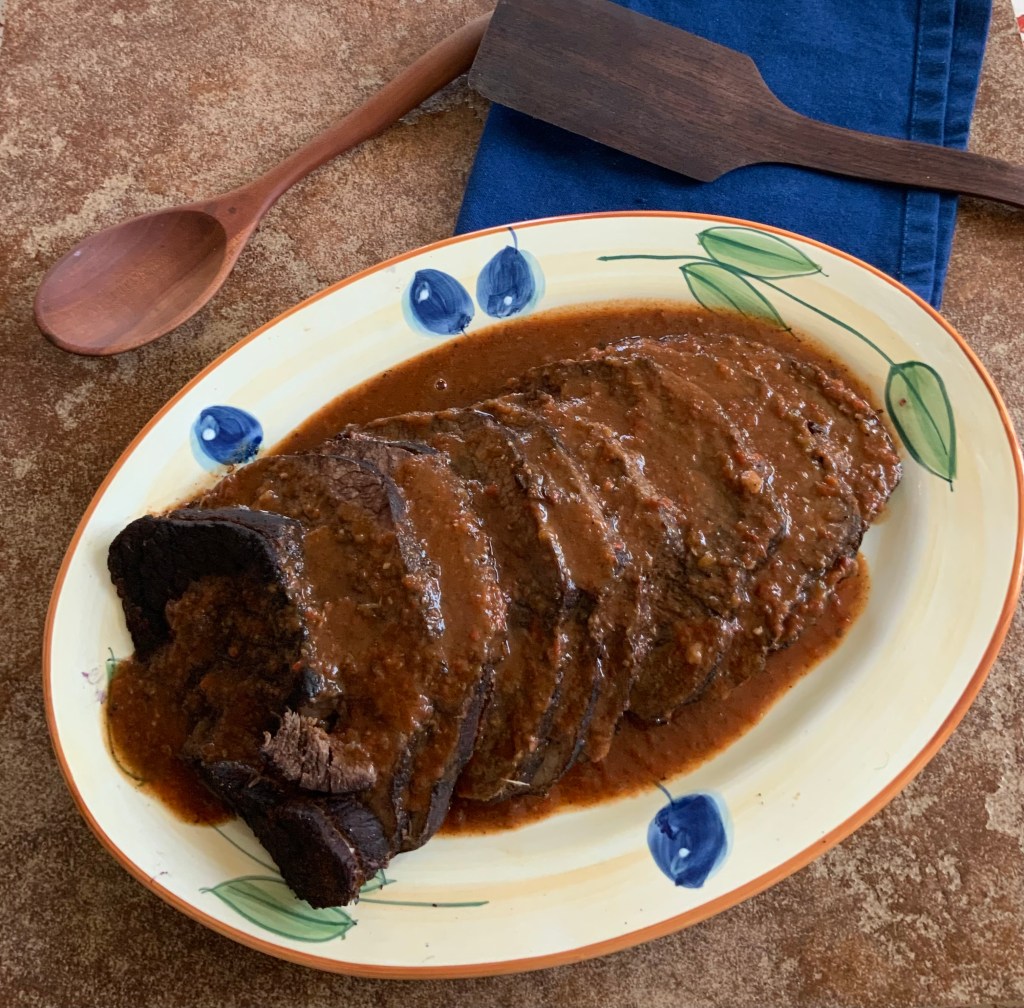
“Most of our beef was made into dishes that take the long cooking which helps to make meat tender. Long cooking, of course, does not necessarily insure a delicious result: the cooking must also be gentle or else the meat is apt to become stringy…my mother and grandmother…always watched the pot to make sure that it simmered so gently that it hardly bubbled.” (Louis Diat from French Cooking for Americans (1946).
Very gentle simmering is an essential feature of braising that results in a roast that is moist and flavorful, but still holds its shape and can be sliced without falling apart. An additional technique that works alongside it is larding. Larding changes both the cooking behavior and final texture of a roast. Little strips of pork fat (bacon in the case of this recipe) are pushed deep into the meat. The fat melts slowly during cooking, basting the meat from within. The fibers of the meat remain moist and the fat helps keep them from tightening too quickly and becoming tough. Larding is not difficult to do and a simple method is offered in thefoodlessprocessed post: Larding.
This braised beef round is made with a bottom round of beef, a lean, firm boneless cut that turns into a tender, savoury braised roast when cooked slowly with larding.
Less processed ingredient options include the following: Beef, Bacon, Butter, Olive Oil, Orange Peel, Vegetables, Fresh Thyme, Sweet Paprika, Homemade Vegetable Stock, Fresh Tomatoes, Tomato Paste.
Equipment for the Braised Beef and Sauce
- a Large Heavy Pan with High Sides and a Lid. This recipe is made with a 12-inch (30.5 cm) Cast Iron Chicken Fryer with a 4.25 quart capacity (about 4 liters). A close European equivalent is a Sauteuse Haute, which has high sides and a long handle. It is deeper than a regular sauté pan.
- a Deep, Heavy-Bottomed Pot of about 5-quart capacity. thefoodlessprocessed uses an Oval Enameled Cast Iron Dutch Oven of a 5.5 quart (about 6.25 liter) capacity.
- a Slotted Spoon
- a Spatula
- a Flame Tamer (aka Heat Diffuser, Simmering Plate) is optional. The pot does not sit directly over the heat source. This is especially useful when cooking in enameled cast iron, which should be used only over a low flame. Some versions of flame tamers are compatible with a smooth-top burner.
- a Food Mill set with a Medium-Hole Disc
- a Large Bowl for making the Sauce
- a Little Bowl in which to make the beurre manié
- a Whisk
Equipment for Larding
How to lard is described in this post: Larding.
- a Boning Knife or any Knife with a narrow, sharp, and slightly flexible blade
- a Rod-Style Knife Sharpener
Ingredient for Larding
- 2 Strips of Sugarless Bacon cut into Lardons (strips about 1/4-inch (2.5 cm) wide). Place 12 of the lardons in the freezer briefly to partially freeze while you prepare the ingredients for the roast. Use the rest of the lardons in the recipe below. The strips for larding are easier to slip into the roast when they are less flexible.
Ingredients for the Roast
- a Tied Bottom Round Roast. The one in the photo weighs about 4 pounds (about 1.8 kg). It has a GAP 4 rating, Pasture-Centered.
- Hungarian Sweet Paprika
- about 5 oz. of Organic Yellow Onion, (or enough to loosely fill a 1-cup measuring cup) cut in chunks (about 140 g). An exact measure is not important.
- 1 Medium-Sized Organic Green Papper, cut in chunks
- 1 Medium-Sized Organic Sweet Red Pepper, cut in chunks
- 6 Whole Garlic Cloves
- 2 Fresh Organic Heirloom Tomatoes of any size, cut in chunks
- the Remaining Thin Strips of Sugarless Bacon not used for Larding
- 3 Tablespoons of Extra-Virgin Olive Oil
- 2 Tablespoons of Salted Butter (about 28 g)
- 4 cups of Dry Red Wine (about 950 ml) or round down to 1 (750 ml) bottle of Dry Red Wine and add some extra Vegetable Stock
- 2 cups of Homemade Vegetable Stock. The foodlessprocessed recipe is here: Vegetable Stock.
- a Sprig of Organic Fresh Thyme
- Freshly Ground Black Pepper
- a Thin Slice of Organic Orange Peel
- 2 Tablespoons of Tomato Paste
- Optional: 1/4 teaspoon of Cayenne or Hot Red Chilli Pepper
- Beurre Manié: 2 Tablespoons (about 28 g) of Softened European-style Unsalted Butter and 2 Tablespoons of European Unenriched All-Purpose Soft-Wheat White Flour, creamed together with the back of a spoon in a small bowl. Unenriched All-Purpose Hard Wheat White Flour may be substituted. This is the standard American flour.
Making the Roast
- Lard the roast. Instructions are here: Larding.
- Rub the roast all over with paprika.
- Heat the olive oil and butter in the pan. As the foam from the butter subsides, add the roast and brown it on all sides. Transfer it to the pot for braising.
- Add the reserved lardons of bacon to the pan and cook them, stirring them about, until they begin to brown at the edges. With a slotted spoon, transfer them to the pot.
- Add the chunks of onion, peppers and garlic cloves and cook them, stirring occasionally to soften them. When the onion begins to lightly colour at the edges, use a slotted spoon to transfer all the vegetables to the pot.
- Add the fresh tomato chunks to the pan. When they begin to soften, tranfer them to the pot with a slotted spoon.
- Deglaze the pan with a cup (237 ml) of the red wine, scraping up the browned bits on the bottom of the pan with a spatula. Pour the contents of the pan into the pot and add the additional 3 cups (710 ml) of wine to the pot (or the remainder of the bottle of wine plus enough vegetable stock to measure 3 cups of liquid total).
- Grind fresh black pepper over the roast and add the sprig of fresh thyme.
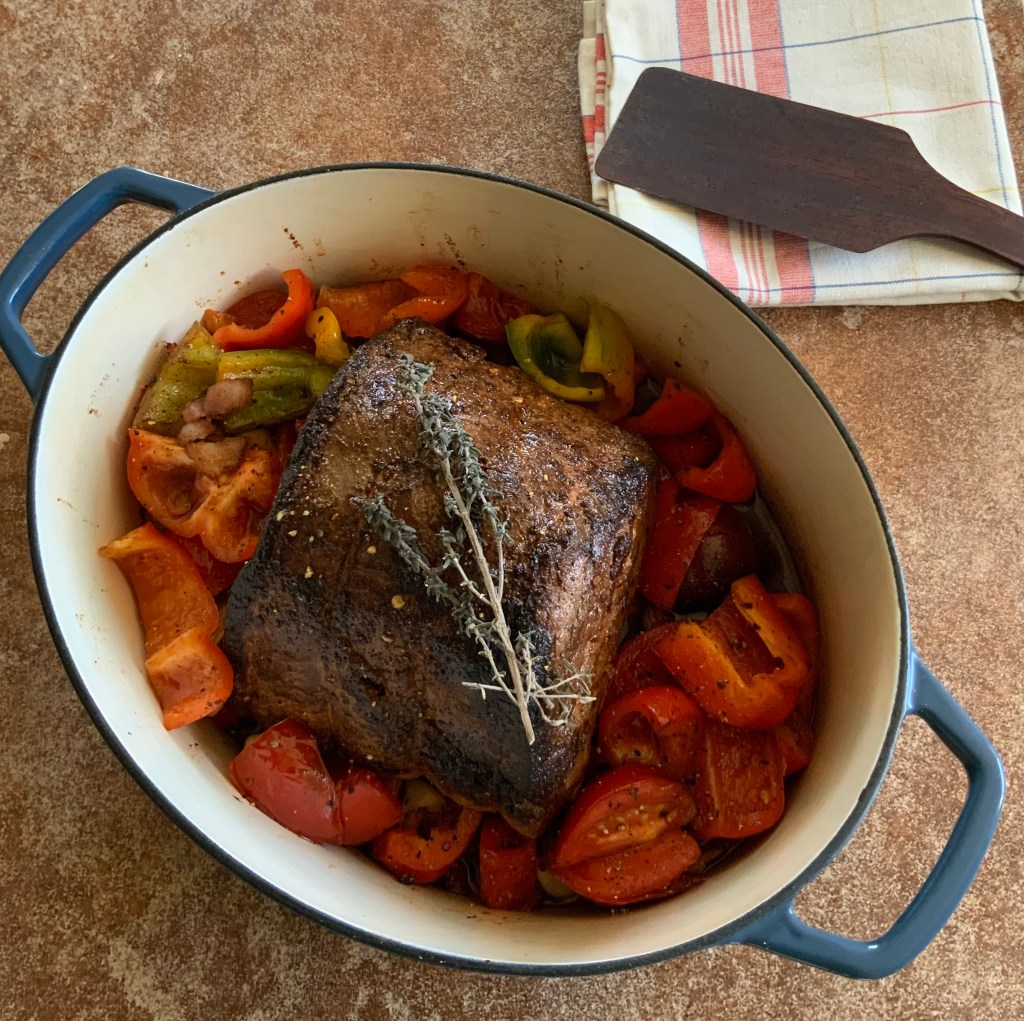
- Pour the vegetable stock around the roast. The liquid will come about two-thirds of the way up the roast.
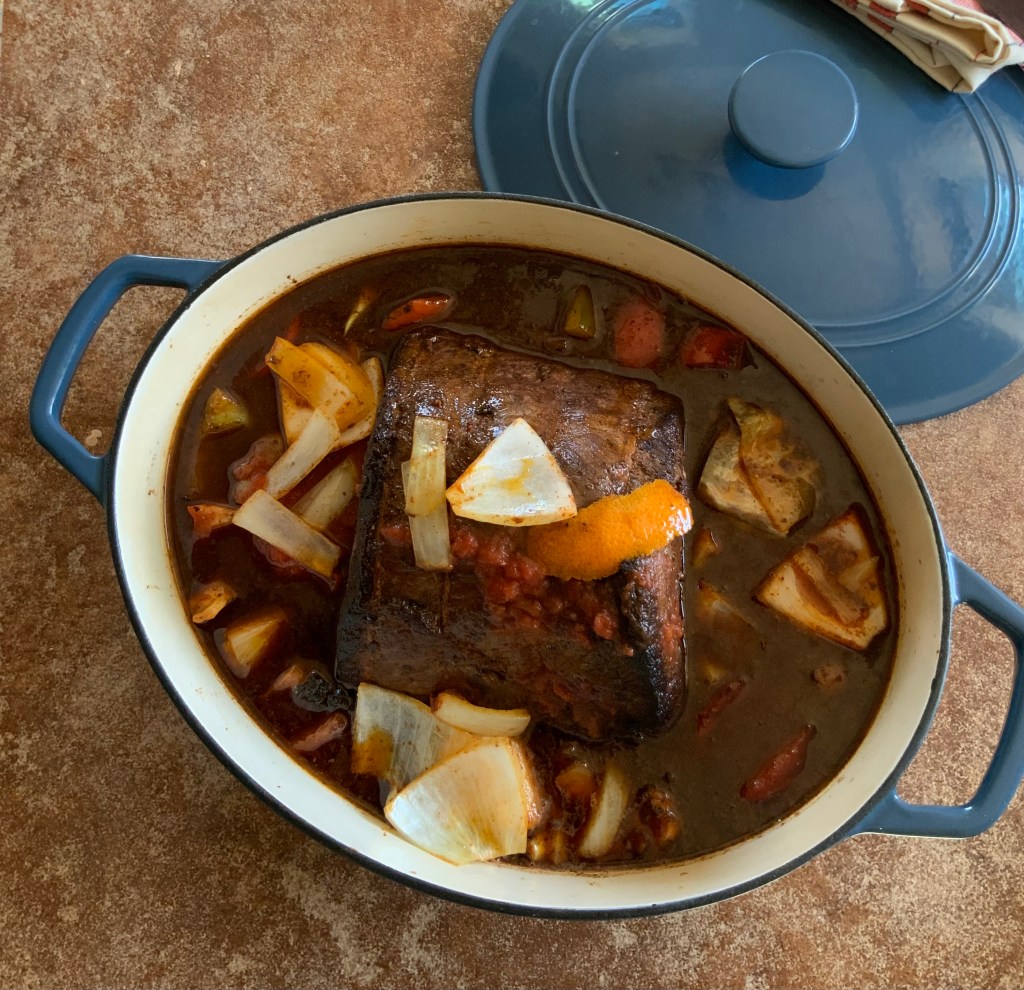
- Add the strip of orange peel.
- Place the pot on the flame tamer, cover it and braise on the lowest heat. Turn the roast after 1 hour and after each additional hour while braising it.
- Braise the roast until it feels tender when pierced with a fork. 4 to 5 hours is a good estimate. The roast in the photograph braised for 4 hours. Timing depends on the roast.
Making the Sauce
- Remove the roast to a cutting board and cover it with foil.
- Place the food mill over a large bowl. Transfer a portion of the braised vegetables and liquid to the mill and run them through the mill into the bowl. Continue until all is passed through the mill and return the purée to the pot. The pepper and tomato skins will be left behind in the mill and the resulting purée will be smooth but lightly textured.
- Place the pot on the flame tamer and bring the purée to a simmer.
- Whisk in the tomato paste.
- Add the cayenne or hot chilli pepper.
- Whisk in the beurre manié a little at a time and continue simmering just long enough for it to thicken the sauce.
- Slice the roast. Return it to the sauce for a few minutes to reheat or, if you are not serving the roast right away, turn off the heat, leave the sliced roast in the sauce, cover the pot, and gently reheat the braised roast in the sauce just before serving.

 thefoodlessprocessed
Leave a comment