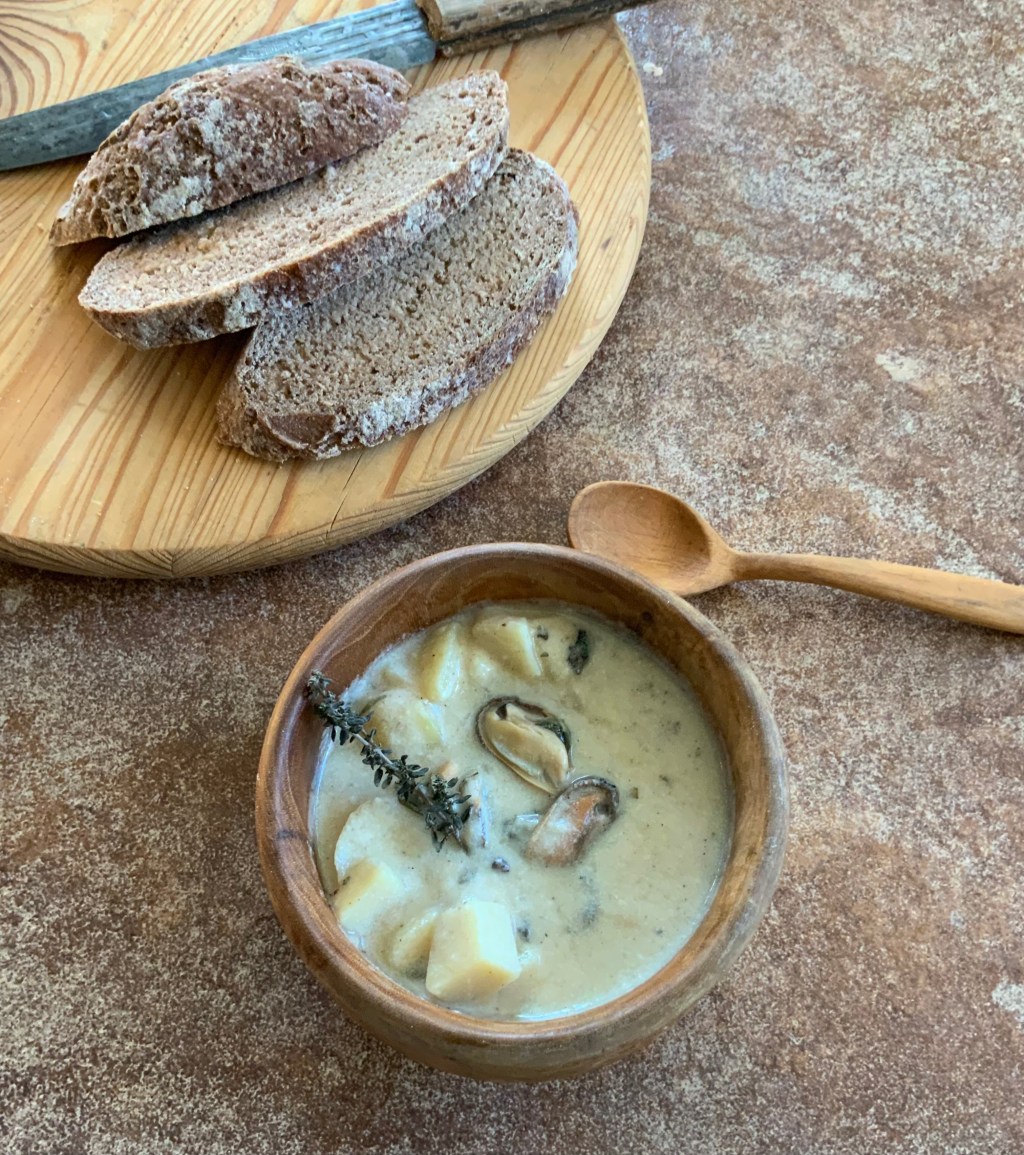
Moules marinière chowder blends elements from two coastal culinary traditions: the American regional cuisine of New England and the French provincial cookery of Brittany.
Descriptions of less processed ingredient options are through these links: Flour, Vegetables, Bacon, Butter, Milk, and Thyme.
Equipment
- a Large Pot with a Lid: for example, 8 quarts/7.5 liters or thereabout
- a Medium-Sized Pot with a Heavy Bottom and a Lid
- a Slotted Spoon
- a Large Mesh Strainer and a Large Bowl
- a Small Bowl (to hold the mussels as they are shelled)
- a Cutting Board and All-Purpose Kitchen Knife
- a Whisk or Wooden Spoon
- a Flame Tamer (aka Heat Diffuser, Simmering Plate) is optional. The pot does not sit directly over the heat source. Some versions of flame tamers are compatible with a smooth-top burner,
Ingredients
Note on storing mussels: If the mussels are in a storage bag, place the bag down in a large bowl, leaving the top slightly open to let air in, and place in the refrigerator. Fresh mussels will keep a couple of days like this.
- 2 pounds of Fresh Mussels (or about 1 kg)
- 4 Tablespoons of Salted Butter, divided into two parts (about 60 g divided into two equal parts)
- 2 cups of Dry White Wine and perhaps a bit more (around 500 ml)
- 1/2 cup of Organic Yellow Onion, chopped and divided into two parts (roughly 75 – 80 g divided into two parts)
- 4 Organic Garlic Cloves, chopped and divided into two parts
- 2 sprigs of Fresh Thyme: Strip the leaves from the stems and divide them into two parts.
- 6 New Potatoes: cooked in a pot of gently boiling water until just tender, chilled, peeled and cut into dice
- Freshly ground Black Pepper
- 2 slices of Sugarless Bacon, fried, crumbled and reserved
- 1/4 cup of Unenriched Hard Wheat White Flour: This is the standard American variety. If Unenriched Soft Wheat White Flour is substituted, the consistency of the chowder will just be a bit less dense.
- 1 and 1/2 cups (or a little more) of Whole Milk (360 ml)
Making the Chowder
- In the large pot, melt 2 tablespoons of the butter (about 30 g) and add half the chopped onion and garlic. Cook, stirring, to soften them. Sprinkle in half the thyme.
- Add the mussels and the wine.
- Cover the pot and cook the mussels until they open–for about 10 minutes.
- Remove the mussels to a large bowl with a slotted spoon. Shell them and reserve them in the small bowl. Discard any mussels that haven’t opened and the shells.
- Place a mesh strainer over the same bowl and strain the mussel broth through it. There should be at least 2 cups of broth (around 500 ml). If there is less, add some more wine to make up the difference.
- In the medium-sized pot, melt 2 tablespoons of butter (about 30 g) and add the rest of the onion and garlic. Cook, stirring, to soften them.
- Add 1/4 cup of flour and stir to combine it with the butter and sautéed onion and garlic and allow it to cook a little, still stirring, but not to the point of browning.
- Gradually add the strained mussel broth, stirring to blend it in well. Cook for a minute or two to thicken a little. Then gradually pour in the milk, still stirring, so that the entire mixture is smoothly blended together.
- Add the mussels, bacon and potatoes, the freshly ground pepper and the remaining thyme.
- Place the pot on the flame tamer and simmer the chowder over medium low heat, covered, to thicken and lose the remaining taste of starch from the flour, and allow all the flavours and ingredients to come together. If the chowder cooks down more than desired, add a little milk.

 thefoodlessprocessed
Leave a comment