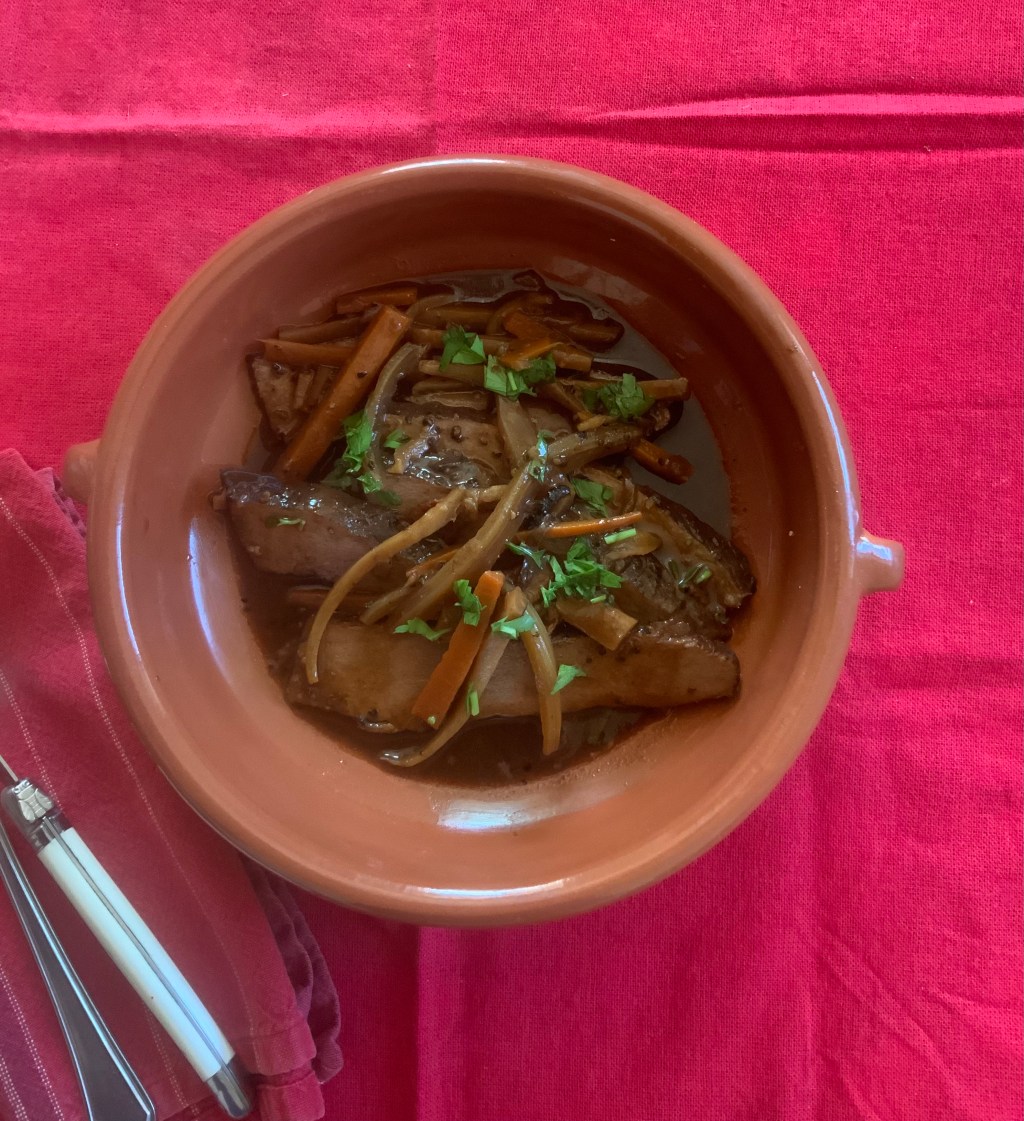
“Keep the cooking very slow,…A fatty sauce results when too rapid cooking holds the fat in the liquid. The sauce of braised food should be a rich extract of the flavors of the meat, liquid, and aromates and it should have body without being thick. Braising, although a simple method of cooking, produces fine sauces and succulent meat.” (Louis Diat from Gourmet’s Basic French Cookbook (1961).
Brisket is an American cut of beef that is well-suited to long braising and cold-weather menus. Cooking slowly, as Mr. Diat describes, will release the fat within and melt it into gelatin. This enriches the sauce that forms from the braising liquid and holds it together. Winter vegetables go very well with brisket and in this version, the meat is braised on a bed of julienned carrots, parsnips and celery.
Brisket is sometimes served at holiday gatherings. It does not require last-minute, time- sensitive attention and, depending on its size, may serve a fair number of guests. Cooling and resting the braise overnight actually improves it. This recipe describes making the brisket a day in advance and finishing it on the second day, just before serving.
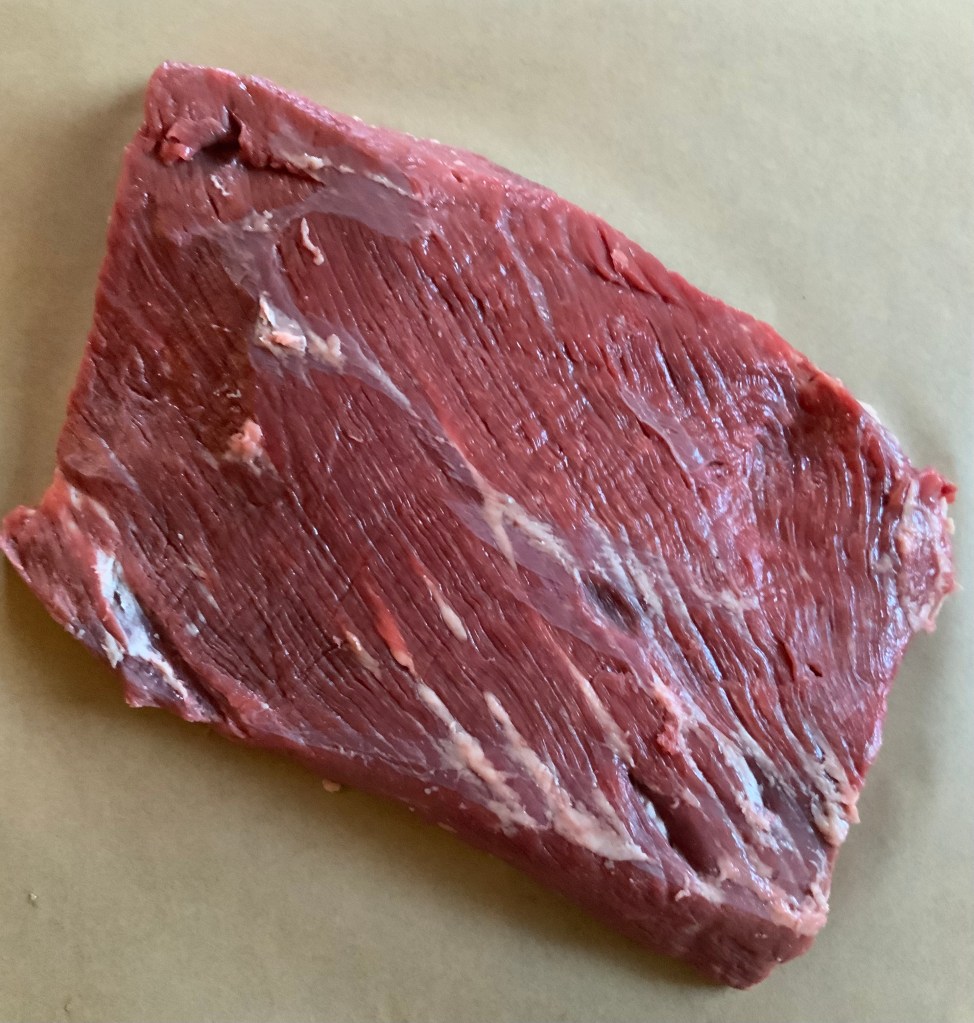
A good quality braising-brisket will have fine white flecks of fat inside the meat. It will look supple, (not hard or dry), will be of a fairly even thickness and be of a bright red colour. The flat (or first cut) is better than the point (second cut) for braising. Of the two, the flat slices better without shredding. It is leaner, but with good marbling and slow cooking, it will be very tender.
With these few criteria in mind, defer to what your eyes see and your good instinct tells you when choosing a brisket. Labels like ‘Premium’, ‘Butcher’s Cut’, and ‘Natural’ carry no authentic guarantees of quality.
These links lead to descriptions of the less processed ingredient options: Brisket, Bacon, Vegetables, Stout, Tomato Paste, Homemade Vegetable Stock, Butter, Flour, Fresh Parsley.
Equipment
- a Large Heavy Pan with High Sides and a Lid. This recipe is made with a 12-inch (30.5 cm) Cast Iron Chicken Fryer with a 4.25 quart capacity (about 4 liters). A close European equivalent is a Sauteuse Haute, which has high sides and a long handle. It is deeper than a regular sauté pan.
- a Deep, Heavy-Bottomed Pot of about 5-quart capacity: for example, an Oval Enameled Cast Iron Dutch Oven of a 5.5 quart (about 6.25 liter) capacity.
- a Flame Tamer (aka Heat Diffuser, Simmering Plate). The pot does not sit directly over the heat source. This is especially useful when cooking in enameled cast iron, which should be placed only over a low flame and when braising over very low heat. Some versions of flame tamers are compatible with a smooth-top burner.
- a Slotted Spoon
- a Container large enough to hold the brisket and vegetables overnight in the refrigerator
Equipment for Finishing and Serving
- a Small Bowl for mixing a small amount of beurre manié
- a Cutting Board and Sharp Knife for slicing the brisket
- a Bowl in which to reserve the vegetables while finishing the sauce
- the Pot in which the brisket was braised
- a Whisk
Ingredients
- a Flat-Cut Beef Brisket: A 5-pound brisket (about 2.3 kg) will serve 6 people generously.
- Coarse-Ground Black Pepper
- a 12-ounce Bottle of Stout (355 ml)
- 2 Cups of Homemade Vegetable Stock: The recipe for the stock is here on thefoodlessprocessed: Vegetable Stock.
- 5 Strips of Sugarless Bacon, cut horizontally into short strips/lardons : European Bacon is cut much thinner than American bacon, but the amount of bacon doesn’t need to be precise.
- 3 Organic Parsnips, cut into slender lengths of about 3 inches (7.5 cm). Small and medium-sized organic parsnips do not need peeling. Much of a root vegetable’s goodness and flavour is just below the skin.
- 2 or 3 Organic Carrots, cut into slender lengths of about 3 inches (7.5 cm), preferably unpeeled
- 1 stalk of Celery, cut into lengths of about 3 inches (7.5)
- 1 Tablespoon of Tomato Paste
- Beurre manié: Mixed and used on the day of serving, it is made in a small bowl by creaming together with the back of a spoon 1 Tablespoon of Unsalted European-Style Butter and 1 Tablespoon of European Soft Wheat White All-Purpose Flour. Substituting Hard Wheat White All-Purpose Flour is fine, as well. Hard wheat flour will make a slightly thicker sauce, soft wheat a bit smoother one. Here is a link to thefoodlessprocessed post: Beurre manié ~ a French way to thicken sauces.
- 3 Tablespoons of Unsalted European-Style Butter
- Fresh Parsley: chopped and used on the day of serving
Preparing the Brisket for Braising
The thick layer of fat on the outside of the brisket is called the “fat cap”. It is not useful in braising a brisket. Remove as much of it as possible by slicing under the fat with a sharp knife and lifting it as you go. Leaving a bit will be fine in order not to slice down into the meat. When the brisket is made a day in advance and chilled overnight, this fat congeals and may be lifted off in waxy pieces.
Any fat on the inside of the meat and within the meat fibers should be left. This is the type of fat that will render into the braising liquid and help create the sauce.
Making the Brisket
- Pepper both sides of the brisket liberally with coarse-ground black pepper.
- In the heavy pan, sauté the bacon strips until they begin to give off fat and brown around the edges. Transfer the strips to the Dutch oven.
- Sauté the chopped onion until the edges begin to brown and transfer them to the Dutch oven with a slotted spoon.
- Add 3 tablespoons of butter to the pan. When it is melted and no longer foaming, add the brisket and brown it on both sides. Transfer it to a platter while you sauté the julienned vegetables–again just until their edges begin to colour.
- Transfer the vegetables to the Dutch oven.
- Place the brisket on top of the vegetables.
- Deglaze the pan with the stout.
- Pour the deglazing juices over the brisket.
- Mix the tomato paste with the vegetable stock and add it to the braising liquid.
- Place the Dutch oven on the flame tamer. Cover it and braise the brisket over the lowest heat. The braising liquid should only bubble gently. After 1 and 1/2 hours, turn the brisket over and braise for another 1 and 1/2 hours.
- Check the brisket for doneness after 3 hours. It should be tender and yield when pierced with a fork but still hold together. Braise a bit longer if a fork doesn’t yet slide easily, without resistance, into the thickest part of the meat.
- Cool the brisket to room temperature. Then transfer brisket, vegetables, and the braising liquid to a container and refrigerate it overnight.
Finishing and Serving the Brisket on the Second Day
- Mix the beurre manié: 1 Tablespoon (about 14 g) of Softened European-style Unsalted Butter and 1 Tablespoon of European Unenriched All-Purpose Soft-Wheat White Flour, creamed together with the back of a spoon in a small bowl. Unenriched All-Purpose Hard Wheat White Flour (the standard American flour) may be substituted.
- Lift off the waxy pieces of fat that have congealed over the top of the braise.
- Transfer the brisket to a cutting board and the vegetables to a bowl.
- Slice the brisket.
- Pour the braising liquid into the pot used to make the braise. Heat it to a simmer.
- Lift the beurre manié onto the whisk and stir it into the braising liquid, whisking as the sauce begins to form. Continue whisking and give the sauce time to thicken. This is not a very thick sauce, but it may be adjused to a thicker consistency by adding a little more beurre manié Cover and remove the pot from the heat.
- Add the sliced brisket and vegetables to the sauce in the pot.
- Reheat it gently and thoroughly so that the brisket flavours all come together. Sprinkle the meat and vegetables with the fresh parsley and serve.

 thefoodlessprocessed
Leave a comment