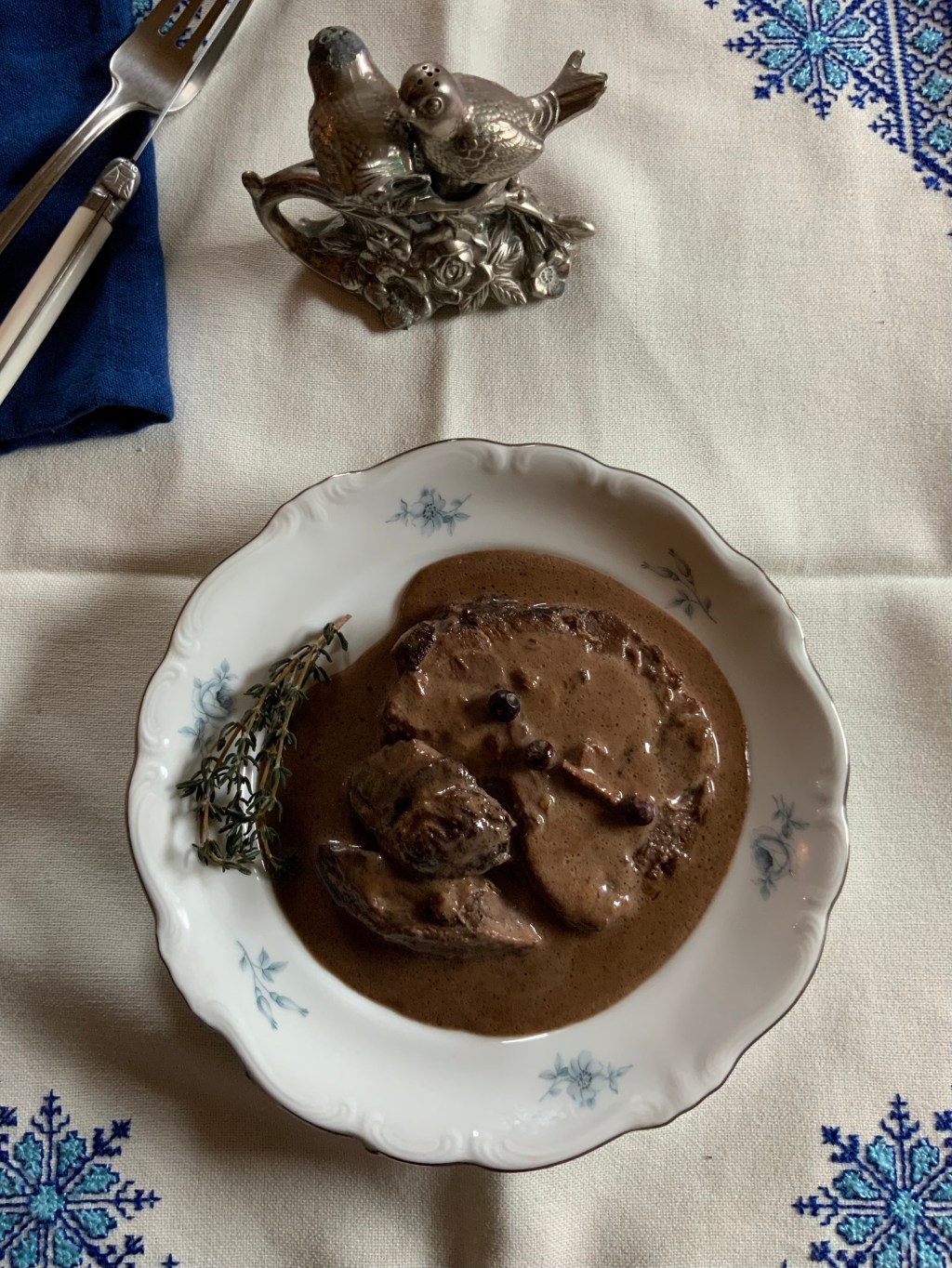
A Swiss game marinade is a mellow blend of wine, spices and aromatics. Juniper berries and black pepper will most likely be included among the spices and the marinade will then form the base of the sauce, in this case one made with coarsely-cracked black pepper and cream. Pfefferrahmsauce is made at home as well as in restaurants, evidenced by the presence on Swiss grocery shelves of small cartons of convenience versions. But the resemblance of these to a homemade one is not very pronounced.
A Swiss cream sauce often relies only on the slow reduction of the cream to thicken it. This creates a very fine sauce. In this case, however, for generosity’s sake, we use a little buerre manié to finish the sauce: it necessitates less reduction and therefore…there is more of this excellent sauce!
Here are descriptions of the less processed ingredient options: Lamb, Bacon, Butter, Cream, Flour, Vegetable Stock, Port, Juniper Berries, Fresh Thyme, and Vegetables.
Equipment
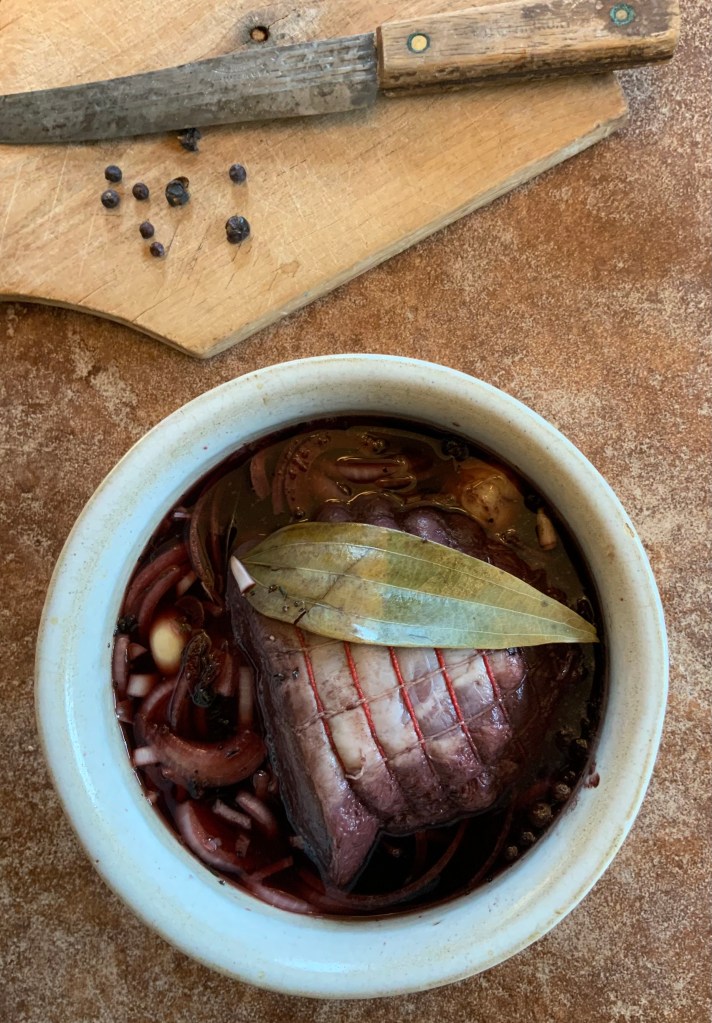
- a Bowl or other Container in which the lamb will fit snugly as it marinates: Glazed Earthenware is good for this purpose.
- a Large Heavy Pan with High Sides and a Lid. This recipe is made with a 12-inch (30.5 cm) Cast Iron Chicken Fryer with a 4.25 quart capacity (about 4 liters). A close European equivalent is a Sauteuse Haute, which has high sides and a long handle. It is deeper than a regular sauté pan.
- a Deep, Heavy-Bottomed Pot of about 5-quart capacity: for example, an Oval Enameled Cast Iron Dutch Oven of a 5.5 quart (about 6.25 liter) capacity. White enameled cast iron does not brown as well as dark cast iron. Therefore, the dark cast iron pan is used for browning and all is then transferred to the enameled Dutch oven for braising.
- a Flame Tamer (aka Heat Diffuser, Simmering Plate). The pot does not sit directly over the heat source. This is especially useful when cooking in enameled cast iron, which should be placed only over a low flame and when braising over very low heat. Some versions of flame tamers are compatible with a smooth-top burner.
- a Large Mesh Strainer and a Large Bowl over which the strainer will fit comfortably
- a Board and Carving Knife
- a Large Glass Measuring Cup or Metal Pan for cooling the braising liquid in the refrigerator
- a Whisk
Ingredients: the Lamb
- a Boneless Leg of Lamb, netted or tied: a 2-pound leg (about 1 kg) will comfortably serve 3 people. New Zealand boneless legs are small. For 6 people, 2 legs may be made, without any alteration in the ingredient proportions.
Ingredients: the Marinade
- a Standard 750-ml Bottle of Dry Red Wine or about 3 cups and perhaps a bit more for braising
- 1/2 cup (118 ml) Imported Tawny Port
- 1 Small Yellow Onion, thinly sliced
- 3 Cloves of Garlic, smashed
- 2 Bay Leaves
- the Leaves stripped from 2 Stems of Fresh Organic Thyme
- 12 Juniper Berries, crushed
- 1 Tablespoon of Red Wine Vinegar
- 1 and 1/2 Teaspoons of Coarsely- Cracked Black Pepper
Ingredients: Braising
Note on quantities of liquid ingredients: a little more wine, stock, or a combination of the two may be needed to keep the lamb in a sufficient amount of liquid as it braises.
- 2 cups (475 ml) of Homemade Vegetable Stock. Click here for the recipe: Vegetable Stock.
- 2 and 1/2 ounces of Sugarless Bacon (75 g), cut in narrow strips/lardons
- 2 Tablespoons of European-Style Unsalted Butter
Ingredients: Finishing the Sauce
- 1 and 1/2 Cups of Organic Heavy Cream
- an additional 1/2 teaspoon of Coarsely- Cracked Black Pepper
- Beurre Manié made by creaming together in a small bowl with the back of a spoon 1 Tablespoon (about 14 g) of Softened European-style Unsalted Butter and 1 Tablespoon of European Unenriched All-Purpose Soft-Wheat Flour: If Hard Wheat All-Purpose Flour (the American standard variety) is substituted, the sauce will simply be a bit thicker in texture.
- Optional: additional Stems of Fresh Thyme for a pretty garnish on each serving
Marinating the Lamb
- In the marinating container combine all the marinade ingredients. Add the lamb. Cover and marinate it for 24 hours.
Braising the Lamb
Note: Ideally, when the lamb is done, the braising liquid is refrigerated for about an hour to set the surface fat, without disturbing the gelatin that gives the sauce its body. The fat will form a crinkly thin layer that may be easily skimmed off with a spoon.
- Remove the lamb from the marinade. Place a mesh sieve over a bowl and strain the marinade into the bowl. Remove the juniper berries from the sieve and discard them. Reserve both the marinade liquid and the remaining ingredients in the sieve.
- In the heavy pan, sauté the bacon lardons just until they give off fat and brown around the edges. Transfer the lardons to the pot in which the lamb will braise.
- Add 2 tablespoons of butter to the pan and brown the leg of lamb in the bacon fat and butter. Transfer it to the pot.
- Sauté the onions from the marinade in the pan until they caramelize. Place them in the pot along with the other solid ingredients in the sieve.
- Deglaze the pan with the marinade liquid and pour it into the pot.
- Add the vegetable stock. For braising, the liquid should reach about halfway up the lamb. Add additional wine and/or stock if needed.
- Place the pot on the flame tamer, cover it, and braise on the lowest heat at a gentle simmer. The liquid should barely bubble.
- Check the braising liquid occasionally and add stock or wine to maintain the liquid at the halfway point.
- Turn the lamb after 1 and 1/2 hours and continue braising until it is quite tender when pierced with a fork. 3 hours is a reasonable estimate for the total braising time.
- Remove the lamb, wrap it tightly in foil and set it aside.
- Place the mesh strainer over a bowl once again and strain the braising liquid. Discard the solids, including the lardons.
- Pour the strained liquid into a large glass measuring cup or a thin metal container in which the liquid will cool rapidly, forming a thin, crinkly layer of fat on its surface. This congealed fat may be removed easily with a spoon.
Finishing the Sauce and Serving
- Carve the lamb in slices and reserve it.
- Return the liquid to the pot and, over the flame tamer, reduce it to about 1 and 1/2 cups (355 ml). Add an additional 1/2 teaspoon of coarsely-cracked black pepper.
- Whisk in 1 and 1/2 cups (355 ml) of heavy cream.
- Bring the sauce to a gentle bubble.
- Whisk in the beurre manié and continue simmering the sauce gently until it thickens to a smooth, velvety texture.
- Add the sliced lamb to the sauce and heat it through.
- To serve, spoon a little sauce on a plate and place slices of lamb on top of it. Spoon additional sauce over the lamb and garnish each serving with a stem of fresh thyme.

 thefoodlessprocessed
Leave a comment