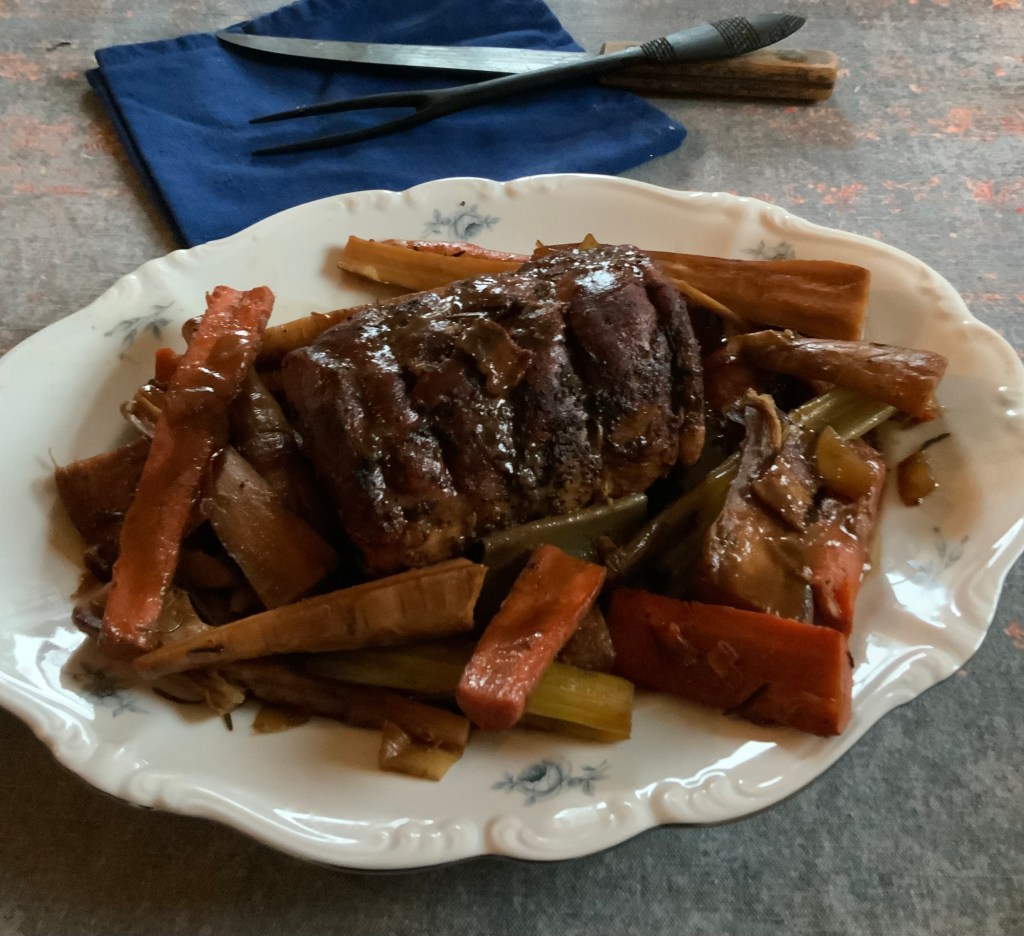
“Les petits plats qui mijotent au coin du feu” is a phrase that is used like a word and it rarely fails to garnish a conversation about food. It would be unfair to accuse those who use it… of leaning on a vain cliché, for they know it–or sense it–to be a magical formula: the incantational touchspring that unites a diverse people in a single reaction. It means “slow-cooking stews” but it symbolizes “the good life”…
Le coin du feu is the hearth that, even for those who have never known it, recalls the security of the family united before it in warmth. But the magic word in the magical phrase is mijoter. It describes the condition of near suspension in which there is, nonetheless, a whispering movement, a tiny bubble rising here and there to break a stew’s surface–and it means, at the same time, a slow ripening. The comfortable satisfaction felt upon lifting the lid and glancing at a stew’s surface–the sense that, merely because a liquid’s surface is sustained at precisely the right point of hardly perceptible movement, all is well, the stew’s progress out of one’s hands and its success assured–is familiar to all cooks.” Richard Olney from Simple French Cooking (1974).
What is true of a stew is equally true of a braised roast. Applying the technique of mijoter creates tender meat and a rich sauce.
Although pork is now bred much leaner than it once was, gentle simmering can go far toward counterbalancing its tendency to dry out in a braise. The meat thermometer is generally recommended as the surest safeguard against overcooking lean pork. Applied to braising a pork loin, this would mean that the meat is cooked for a relatively short time–only until the thermometer registers a certain degree of doneness. A pork loin cooked just to doneness, has not undergone the full transformation we normally associate with braising. Descriptively, it is neither truly tender nor truly firm. It may slice well; it will be a bit moist, yet is neither rich in juices nor truly tender.
An alternative to measuring by a specific temperature is to judge the result at the table, that is, the overall goodness in eating. Instead of trying to prevent moisture loss, expect it as part of the design of the dish. Assume that the juices leaving the pork will become part of the sauce and return to the meat on the plate. Rich flavour is not the meat alone, but the meat plus the sauce. The long, gentle style of cooking known as mijoter will, by design, cook the pork to a degree of tenderness that is technically too well done by the “thermometer standard”, but by the “table standard” it will be tender, will slice successfully without breaking down into bits and pieces, and the meat and sauce together will be full of flavour.
The less processed ingredient options are found through these links; Pork Loin, Bacon, Butter, Flour, Thyme, Rosemary, Juniper Berries, Vegetables, Stout, Vegetable Stock, and Port.
Equipment
- a Large Heavy Pan with High Sides and a Lid. This recipe is made with a 12-inch (30.5 cm) Cast Iron Chicken Fryer with a 4.25 quart capacity (about 4 liters). A close European equivalent is a Sauteuse Haute, which has high sides and a long handle. It is deeper than a regular sauté pan.
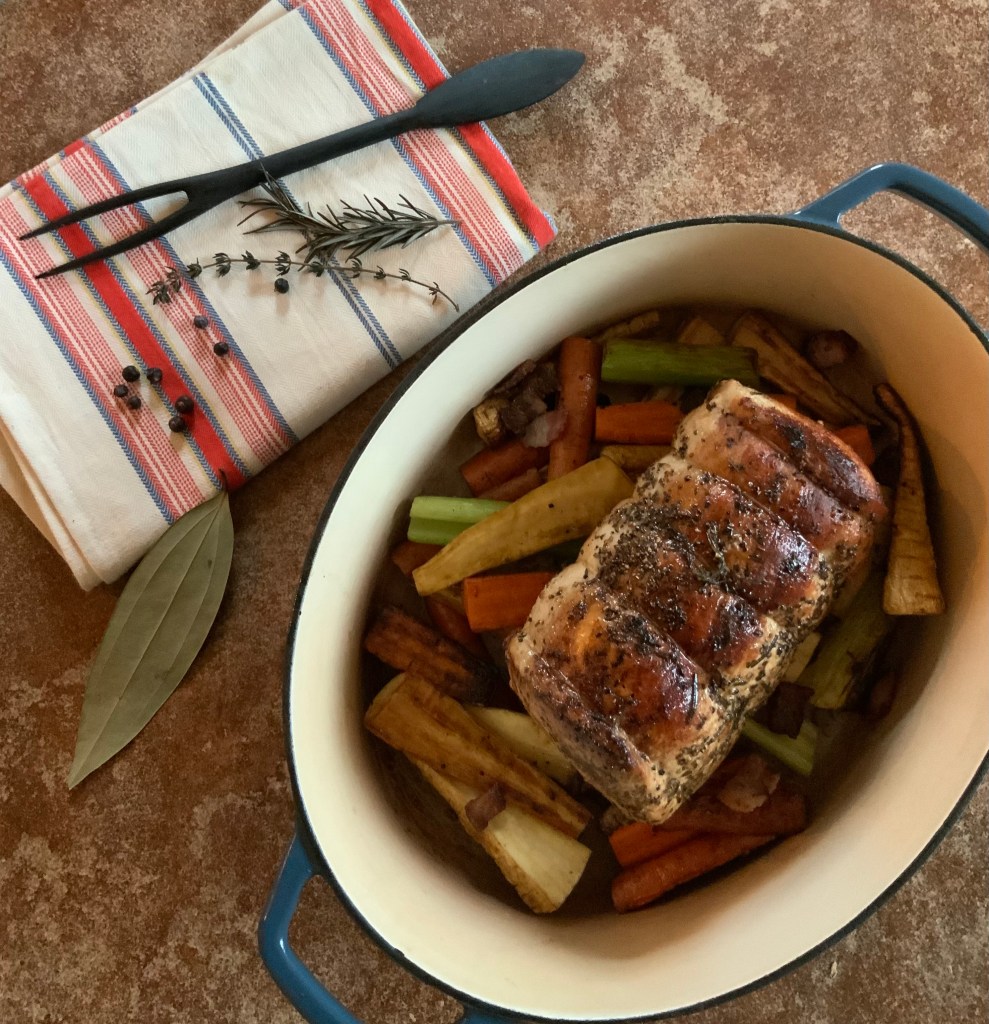
- a Deep, Heavy-Bottomed Pot of about 5-quart capacity: for example, an Oval Enameled Cast Iron Dutch Oven of a 5.5 quart (about 6.25 liter) capacity. White enameled cast iron does not brown as well as dark cast iron. Therefore, the dark cast iron pan is used for browning and all is then transferred to the enameled Dutch oven for braising.
- a Flame Tamer (aka Heat Diffuser, Simmering Plate). The pot does not sit directly over the heat source. This is especially useful when cooking in enameled cast iron, which should be placed only over a low flame and when braising over very low heat. Some versions of flame tamers are compatible with a smooth-top burner.
- a Slotted Spoon and Broad Turner/Spatula
- a Skewer or Carving Fork to test the pork for doneness
- a Large Mesh Strainer and a Large Bowl over which the strainer will fit comfortably
- a Board, a Kitchen Knife, and Carving Knife
- a Large Glass Measuring Cup or Metal Pot or Pan for cooling the braising liquid in the refrigerator
- a Whisk
Ingredients: Braising
Note: See also the ingredients below for finishing the sauce.
- a 2.2 (1kg) pork loin roast, tied at intervals
- 2 slices (about 50 g) of Sugarless Bacon, cut in narrow strips/lardons
- 2 Cloves of Garlic, peeled and lightly crushed
- 2.5 ounces (70 g) of Yellow Onion, sliced in small wedges: This is about half of a medium-sized onion.
- 2 stems of Organic Fresh Thyme
- 2 sprigs of Organic Fresh Rosemary
- 1 teaspoon of Coarse Black Pepper
- 1 teaspoon of Juniper Berries, crushed lightly
- 1 Bay Leaf
- 3 Organic Carrots, unpeeled, topped and tailed, split lengthwise and cut into large chunks
- 3 Medium-Sized Organic Parsnips, unpeeled, topped and tailed, split lengthwise
- 2 Stalks of Organic Celery, cut into large chunks
- 2 14-ounce Bottles of Dry Stout (without adjuncts): The term “adjuncts” refers to other grains (such as corn, rice or wheat) and sugars (for example, sugar, honey, or molasses).
- 2 and 1/2 ounces of Sugarless Bacon (75 g), cut in narrow strips/lardons
- 2 Tablespoons of European-Style Unsalted Butter
- 6 cups (475 ml) of Homemade Vegetable Stock. Click here for the recipe: Vegetable Stock. Note: The amount of stock will depend on how high the pork sits on top of the vegetables and the size of the pot. 6 cups is a very generous estimate.
Ingredients: Finishing the Sauce
- Beurre Manié made by creaming together in a small bowl with the back of a spoon 1 Tablespoon (about 14 g) of Softened European-style Unsalted Butter and 1 Tablespoon of European Unenriched All-Purpose Soft-Wheat Flour: If Hard Wheat All-Purpose Flour (the American standard variety) is substituted, the sauce will simply be a bit thicker in texture. The special qualities of beurre manié as a thickener are described in thefoodlessprocessed post: Beurre Manié
- Optional: 1/8 cup (30 ml) of Imported Tawny Port: The Port may be added to the braising liquid at the end, when making the sauce, if you wish to diminish the stout’s bitterness.
Preparing the Pork Roast and Vegetables for Braising
- Strip the leaves from one stem of the thyme and one sprig of the rosemary and chop them finely. Add 1 teaspoon of coarse black pepper and mix them all together well. Roll the pork loin in the mixture.
- Add the lardons to the heavy pan and sauté them until they begin to render their fat. Add the 2 tablespoons of butter to the pan and when it has melted, brown the pork well on all sides in the fat. Remove and reserve any lardons that become crisp.
- Set aside the roast on a plate. Add the onions, garlic, carrots, parsnips and celery to the pan and brown them all. Transfer them to the braising pot.
- Set the pork loin on top of the vegetables.
- Deglaze the pan with the stout and pour around the pork and over the vegetables.
- Add vegetable stock. The total amount of liquid should come halfway up the pork.
- Add any lardons that were removed from the pan early, the remaining stem of thyme and sprig of rosemary, the bay leaf, and the juniper berries.
Braising the Pork and Vegetables
- Cover the braising pot and place it on the flame tamer. Adjust the heat to a very low level. The braising liquid should bubble lightly and sluggishly.
- Check the liquid occasionally. Maintain it at about halfway up the pork by adding a little stock if necessary. Since the pork releases juices, additional liquid may not be needed.
- Turn the roast after 1 and 1/2 hours. The total braising time will probably be around 3 hours or perhaps a very little more.
- Check for tenderness by piercing the roast through, from top to bottom, with a skewer or a carving fork.
- As the pork nears the point of doneness, the fork or skewer will meet with some resistance, although the tendency towards tenderness will be increasingly apparent with subsequent testing. The interval is brief between this level of tenderness and complete tenderness. Check frequently, for the meat moves from firm/tender to perfectly tender in a short time.
- Once the roast is tender throughout, remove the pot from the heat. Shift the roast to a plate and wrap it tightly in foil.
- Remove the vegetables very carefully to a plate with the help of a slotted spoon and a large turner/spatula. Cover them with foil. Set aside both roast and vegetables until you are ready to make the sauce and combine roast, vegetables and sauce together.
- Strain the braising liquid through a mesh strainer placed over a large bowl. Pick out the juniper berries, rosemary and thyme stems from the solids left behind in the strainer and add any others (such as the lardons or bits of onion and garlic) to the reserved vegetables.
- Pour the braising liquid into a large glass measuring cup or metal pot or pan. There should be about 2 cups. Refrigerate it until the fat sets on the surface in a crinkly layer.
Finishing the Sauce and Preparing the Roast and Vegetables for Serving
Note: The braising liquid may be reduced to a sauce without adding the beurre manié. However, by that method there will be less sauce and a good amount of sauce is essential to thoroughly combine with the pork and give it the right braised texture and taste.
- Remove the layer of fat from the braising liquid. It will separate and come off easily.
- Taste the braising liquid. If the stout taste is too bitter for your liking, add about 1/8 cup (30 ml) of Imported Tawny Port. The exact amount depends on personal preference–begin with the small amount of Port and add a little more after it is combined and heated in the sauce to make any further adjustment.
- Pour the liquid back into the braising pot. Place the pot on the flame tamer again and heat the liquid to a brisk simmer.
- With a whisk, add the beurre manié in several increments, allowing each amount to combine with the simmering sauce before adding more. The sauce will be a light reduction and pour freely. Remove the pot from the heat.
- Carefully return the vegetables to the pot, crowding them to one side to leave room for the sliced pork.
- Place the pork on the board for carving. Remove the strings and carve it into thick slices. Place the slices back in the pot, down in the sauce, alongside the vegetables.
- Place the pot back on the flame tamer and heat the pork, vegetables and sauce together at a steady simmer.
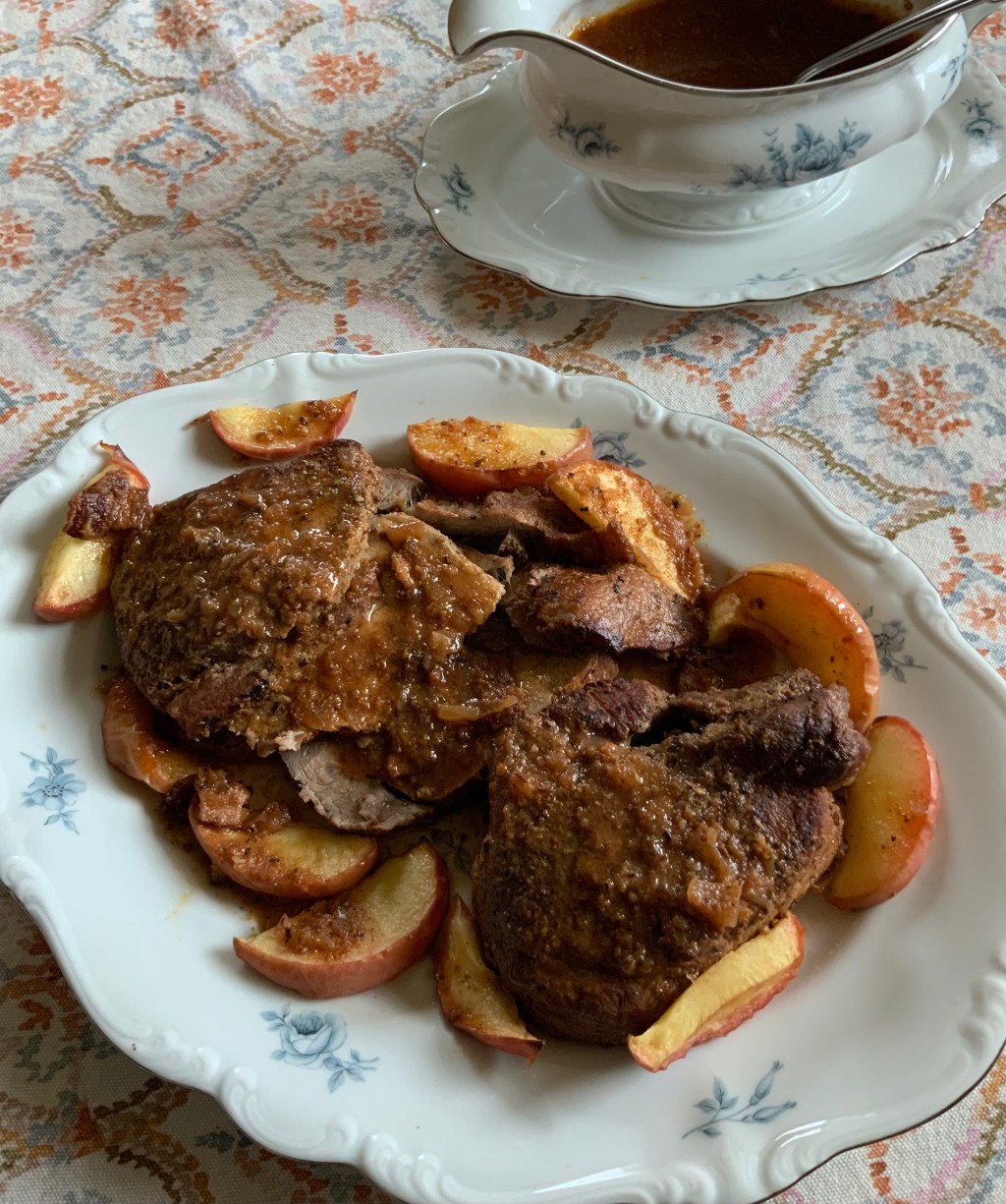
- When the braise is heated through and all its parts combined, arrange slices of pork, vegetables and sauce on individual plates.



Leave a comment