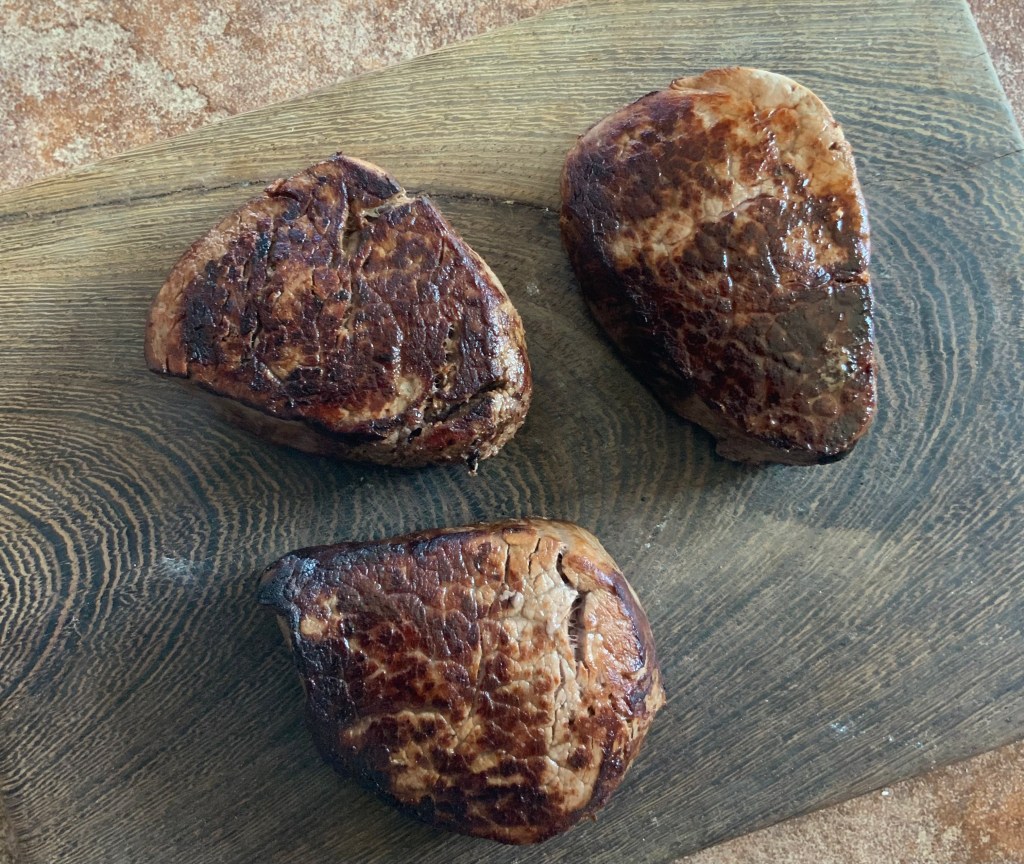
“MAILLARD REACTION: A chemical reaction occurring when amino acids and sugars are heated…[it] plays an important part in many cooking processes, affecting both taste and colour…[and explains] the formation of the crust on bread and roasts and the aroma of roasted coffee.” from Larousse Gastronomique (2009 edition).
“Medieval people had just this way of holding firmly on to the wrong end of the right stick.” Dorothy Hartley from Food in England (1954). Her remark refers to the soundness of many medieval cooking methods, even though the explanations for them were mistaken.
“Béchamel must not be overcooked or it will have an unpleasant ‘floury taste’ (the scientific explanation for this I cannot give).” Richard Olney from Simple French Food (1974).
In cooking, one may know from experience that something works, without knowing why. Searing meat has been variously explained as a way to keep juices in and to lock in flavour, when in fact it does neither of these. The technique actually creates a browned surface where the meat’s flavour is concentrated. A firm grasp of the scientific details of why this occurs may be interesting, but is secondary to understanding that, regardless of the reasons, browning the meat will improve it and knowing how to do it.
The purpose of searing and the method depend on the meat being prepared. For a steak, browning is not preparatory to cooking, as it is with a roast or braise. Searing and finishing occur in one continuous process. In a dry pan over intense heat, searing creates the brown crust of deep beef flavour and this is immediately followed by a brief finishing to doneness at a reduced temperature.
Filet steaks firm up smoothly and evenly as they cook. Touch is a reliable indicator of doneness, once one learns to use it and to trust in one’s sense of feel. My misreads have most often been a result of hesitating to trust touch when its message differed from the timing chart or a thermometer–an example of clinging to a theory unjustified by results.
The less processed ingredients are: Filet Steak, Olive Oil, and Water.
Equipment
- a Sauté Pan: Either one of cast iron or an enameled cast iron sauteuse with a black baked-on porcelain enamel interior is a good choice. Both are excellent for pan-searing steaks. After preheating, they hold heat well and distribute it evenly. Cast iron pans with a white enameled interior will not brown as well. You may read more about the unique qualities of The Cast Iron Pan here on thefoodlessprocessed.
- a Timer, preferably one that will time seconds as well as minutes or a Watch with a second hand
- a Heatproof Plate for resting the steaks once they are done and some foil
Ingredients
- Filet Steaks weighing 8 ounces (225-230 g) and 1/2-inch thick (about 1.3 cm): 1 for each person. These filet steaks are center cut with a level-4 Global Animal Welfare rating: Pasture Centered.
- a very little Extra-Virgin Olive Oil
- about 1/2 cup (118 ml ) of Bottled Spring Water and possibly a bit more
Step One: Searing
Note: Preheat the oven to 350 F (around 170 or 180 C). Resting the steaks, lightly covered on a heatproof plate on the back of the stovetop of a warm oven will prevent them from cooling while you finish a sauce or any other last minute preparations for serving.
- Preheat the pan. If the pan is cast iron or enameled cast iron, heat it slowly over medium low heat. It will become quite hot and hold the heat well, if heated slowly.
- Dampen a paper towel with a little olive oil and run it over the bottom of the pan. The surface of the pan should remain dry, with only a little oil to film it.
- Just before adding the steaks, increase the heat to a medium high level to ensure the pan remains very hot. Place the steaks in the pan and sear them on one side, without lifting or turning them, for 4 minutes. Turn and sear on the second side for 4 minutes. If the pan smokes, reduce the heat a very little. Searing the steaks for 4 minutes on each side will create a deep brown crust.
Step Two: Finishing to Doneness
- Reduce the heat to a medium-low level to bring them to the stage of doneness you prefer and turn the steaks back onto their first side.
- If you wish to finish the steaks to rare, set the timer for 1 minute and cook the steaks on the first side.
- Turn them and cook on the second side for 1 minute.
- For any degree of doneness beyond rare, set the timer for 1 and 1/2 minutes and cook the steaks on each side.
Step Three: Begin Checking for Doneness
After cooking both sides for 1 or 1 and 1/2 minutes, begin checking the degree of doneness by pressing in the center of a steak with your finger. The gradations of firmness in a pillow may be a helpful analogy.
- Rare: soft, very yielding and only slightly springy
- Medium-rare: still soft, but now definitely springy with some feel of resistance
- Medium: perceptibly firmer than at medium rare, and less give
- Medium-well: firm, and hardly any feel of spring
- Well-done: basically firm
A steak cooked for only an additional 1 and 1/2 minutes per side will likely feel and be medium-rare. For a higher level of doneness, turn the steaks back to the first side and cook for an additional 1 minute, turn, and cook for an additional 1 minute on the second side. Test for doneness again. Beyond Medium the steaks will begin to cook faster. 30 second cooking times on each side between tests for doneness will help prevent cooking beyond the degree you want.
Resting the Steaks
- Turn off the heat from under the pan.
- Transfer the steaks to a heatproof plate, cover them lightly with aluminum foil, and place them at the back of the stovetop, where the rising heat from the preheated oven will keep them warm.
- Deglaze the pan with about 1/2 cup of water. If the liquid evaporates, add some more water until you have a small amount of juice to pour over each steak as you serve them.
A recipe for filet steaks and Café de Paris butter is here on thefoodlessprocessed: Filet Mignon with Café de Paris Butter

 thefoodlessprocessed
Leave a comment