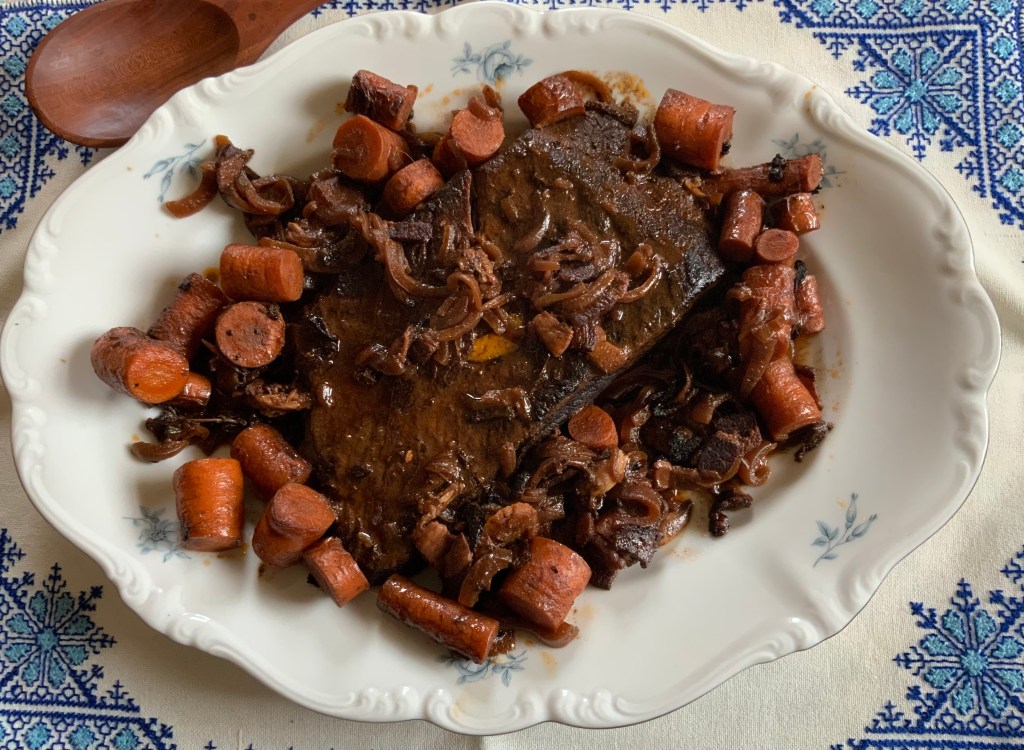
“Most cookbooks teach by giving separate instructions for each kind of food. However, that is not the way a French chef is trained…He first learns the cookery methods that apply to all foods, and then concentrates on discovering the advantages and limitations of each method for specific foods…If, for instance, you associate a tightly covered casserole and “aromates,” such as carrots and onions, with braising, you are on your way to knowing how to braise anything at all.
The end result of learning the basic cookery methods and how they apply to various foods is that you develop versatility and flexibility obtainable in no other way. You come to understand recipes far more quickly and easily–the very reading of them can be a pleasure–and you become, also, less dependent on them. And this kind of assurance is, I believe, a test of a good cook.” Louis Diat from Gourmet’s Basic French Cookbook (1961).
Beef brisket, an American and British cut, is broadly similar to the French poitrine de boeuf. More importantly, they are braised in essentially the same way, that is: seared, combined with aromatic vegetables, herbs and spices, only partially covered in a braising liquid and simmered very slowly either on top of the stove or in the oven at a very low temperature. Therefore, should you encounter an intriguing French recipe for poitrine de bœuf (and that cut is unavailable), beef brisket will make a fine substitute.
The less processed ingredients for this braise are: Brisket, Bacon, Vegetables, Tomato Paste, Homemade Vegetable Stock, Butter, Flour, Fresh Thyme and Orange Peel.
A timing note: The meat marinates overnight in the refrigerator or for up to two days.
Equipment
- a shallow Glass or Ceramic Dish: The Ceramic Baking Dish in the photo measures 8″ x 8″ (about 20 cm x 20 cm).
- a Large Heavy Pan with High Sides and a Lid. This recipe is made with a 12-inch (30.5 cm) Cast Iron Chicken Fryer with a 4.25 quart capacity (about 4 liters). A close European equivalent is a Sauteuse Haute, which has high sides and a long handle. It is deeper than a regular sauté pan.
- a Deep, Heavy-Bottomed Pot of about 5-quart capacity: for example, an Oval Enameled Cast Iron Dutch Oven of a 5.5 quart (about 6.25 liter) capacity. White enameled cast iron does not brown as well as dark cast iron. Therefore, the dark cast iron pan is used for browning and all is then transferred to the enameled Dutch oven for braising.
- a Large Liquid Measuring Cup
- a Small Pot and a Whisk for finishing the braising sauce
- a Small Mixing Bowl and Wooden Spoon for making the beurre manié
- a Carving Board and Sharp Knife
The Brisket
Note: A discussion of brisket cuts may be found in the introduction to the post: Stout-Braised Beef Brisket with Julienne Vegetables.
- a 2 lb (1 kg) Flat-cut Brisket, trimmed of as much external fat as possible and liberally sprinkled with Coarse Black Pepper
Ingredients for the Marinade
- 2 cups (475 ml) of Dry Red Wine
- 1 teaspoon of Black Peppercorns
- 2 Bay Leaves
- 2 stems of Fresh Organic Thyme
- 1 Organic Carrot, unpeeled and cut in chunks
- Several Celery Leaves
- 2 Slices of Onion, halved and then quartered
- 4 Cloves of Garlic, smashed
Marinating the Brisket
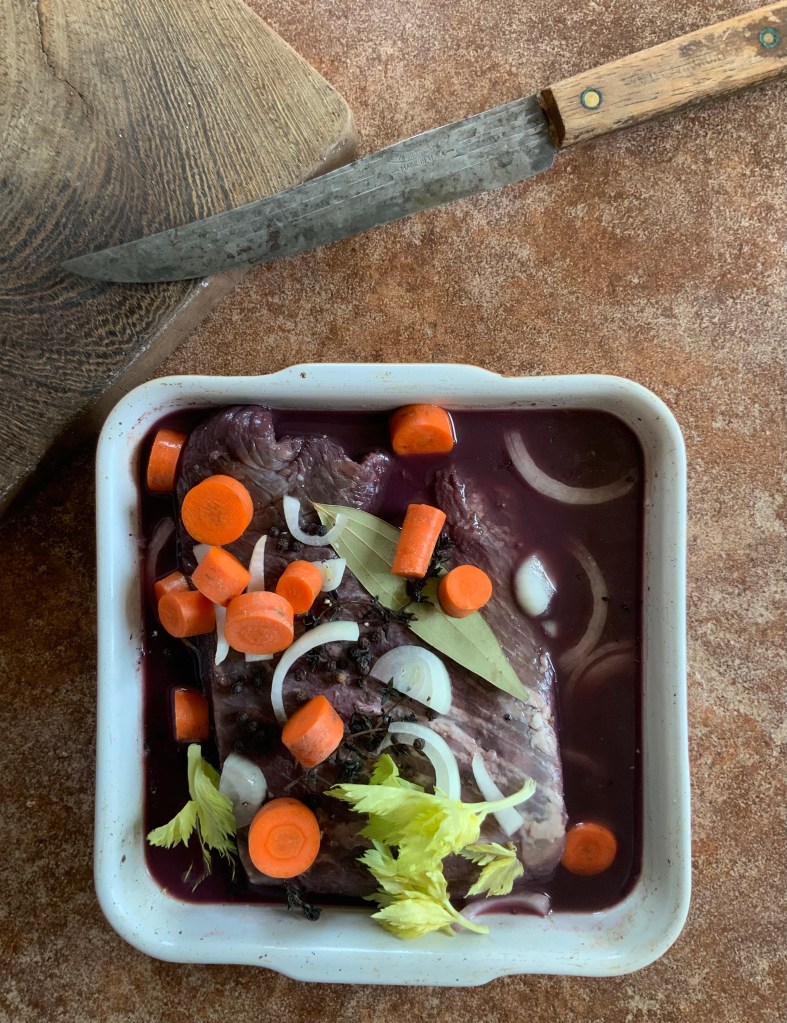
- Place the brisket in the dish. Add all the ingredients for the marinade.
- Cover the dish and marinate the brisket in the refrigerator overnight or for up to two days.
Ingredients for the Braise
- the marinated Brisket
- the Vegetables, Thyme and Bay Leaves from the Marinade: Only the peppercorns are strained out and the celery leaves removed.
- the Liquid from the Marinade, strained into a measuring cup or bowl: There will be about 2 cups (475 ml) but the amount need not be exact.
- 4 Organic Carrots, unpeeled and cut in chunks
- 1 Onion, sliced thinly
- 120 g (about 1/4pound or 4 oz) of Sugarless Bacon cut into thin strips (lardons)
- 3 Tablespoons of Organic Unsalted European-style Butter
- 2 Tablespoons of Organic Tomato Paste
- a slice of Organic Orange Peel
- the Leaves stripped from two additional stems of Organic Fresh Thyme
- an additional 325 ml (1 and 1/3 cups) of Dry Red Wine, more or less: The exact amount will depend on the size of the braising pot. Wine is added to reach halfway up the brisket.
- Homemade Vegetable Stock: The exact amount will depend on how much liquid remains in the pot at the end of the braising time. The recipe for making homemade stock is here: Vegetable Stock.
- Beurre Manié made by creaming together in a small bowl with the back of a spoon 1 Tablespoon (about 14 g) of Softened European-style Unsalted Butter and 1 Tablespoon of European Unenriched All-Purpose Soft-Wheat Flour: If Hard Wheat Unenriched All-Purpose Flour (the American standard variety) is substituted, the sauce will simply have a somewhat thicker texture. The special qualities of beurre manié as a thickener are described in thefoodlessprocessed post: Beurre Manié
Preparing the Braise
- Add the lardons to the pan and sauté them until they begin to render fat and brown on the edges.
- Add the carrots, onion, and garlic from the marinade, as well as the fresh onions and carrots and cook them slowly with the lardons until they caramelize. Transfer vegetables and lardons to the braising pot.
- Add the butter to the pan and sear the brisket slowly until both sides are a deep brown.
- Place the browned brisket on top of the vegetables in the pot.
- Add the tomato paste to the pan and cook it, stirring, until its colour deepens to a brick red (a matter of a minute or two).
- Add the strained liquid from the marinade to the paste and deglaze the pan, stirring to combine the liquid with the browned residue on the bottom of the pan.
- Pour the deglazing liquid into the pot.
- Add wine to come about halfway up the brisket. The amount will depend on the size of the braising pot. 325 ml brought the liquid up to the halfway point on the meat in the oval cast iron Dutch oven.
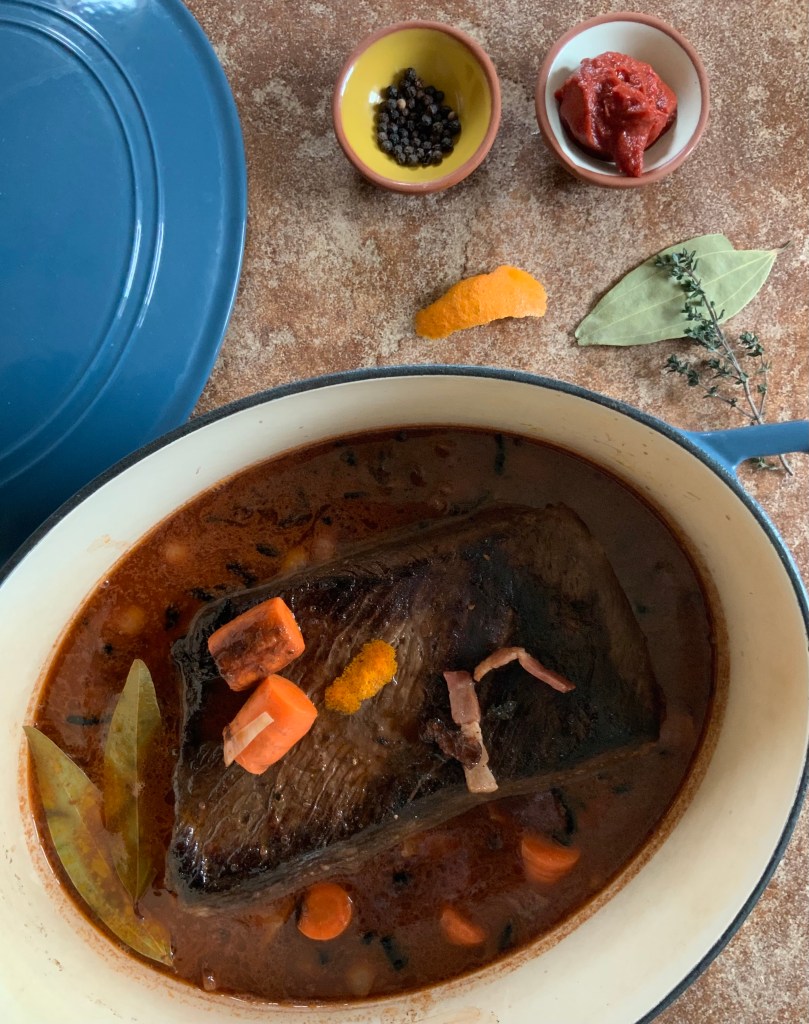
- Add to the braising pot the bay leaves and stems of thyme from the marinade, as well as the leaves stripped from 2 additional stems of organic fresh thyme and the orange peel.
Braising the Brisket
Gas or Convection Oven: thefoodlessprocessed uses a gas oven. The conversions from Fahrenheit to Celsius do not attempt to adjust for differences between baking in a gas or convection oven. I have no experience using a convection oven, and leave adjustments to the better judgement of you who do have.
- Preheat the oven to 250 F/120 C.
- Cover the pot with aluminium foil and place the lid over it.
- Place the pot on the lower middle rack of the oven.
- Braise for 2 hours, then check the level of braising liquid. Add some wine if it has reduced below the brisket. Then turn the meat and continue braising it. The probable total braising time is 4 and 1/2 to 5 and 1/2 hours.
- Check for doneness at 30-minute intervals after 4 and 1/2 hours by piercing the brisket with a fork. When the fork meets no resistance, the brisket is done.
Finishing the Braise
- Once the brisket is done, wrap it in foil and set it aside on a plate.
- Pour the braising liquid into a large measuring cup, leaving the vegetables in the pot. A bit of the braising liquid will remain with the vegetables.
- If it is needed, add vegetable stock or wine to bring the level of the liquid to 2 cups.
- Refrigerate the measuring cup of braising liquid until the fat congeals into a waxy orange layer over the surface. Refrigerating the braising liquid will give the brisket time to rest before carving.
- Peel off and discard the fat.
- Pour the braising liquid into a small pot.
- Prepare the beurre manié and place it nearby.
- Carve the brisket into long slices against the grain and transfer the slices back to the braising pot.
- Heat the braising liquid over medium heat and whisk in the beurre manié until it is completely combined.
- Without waiting for the sauce to thicken, pour it over the meat and vegetables. Place the pot on the flame tamer and reheat it gently, partially covered, until the sauce is lightly thickened and the brisket and vegetables are hot.

 thefoodlessprocessed
Leave a comment