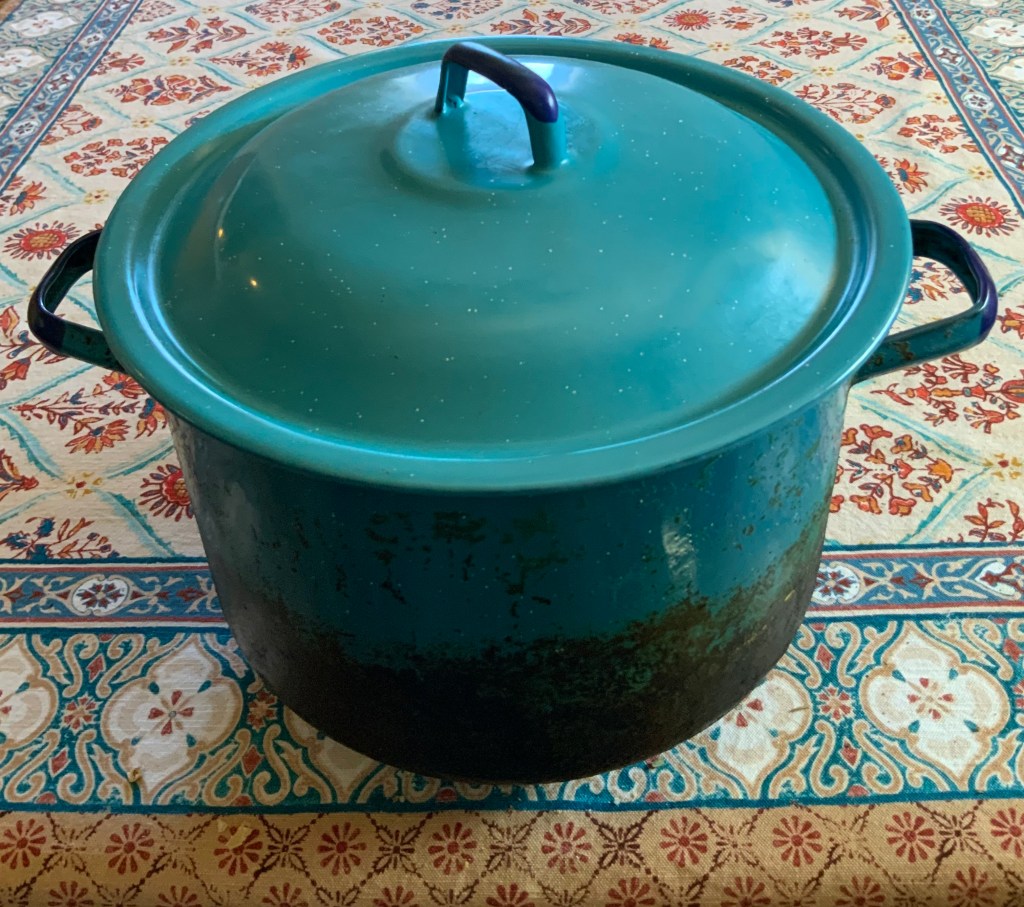
“When it came to doughnuts my father was quite content with my mother’s product…He had to have them fried in a certain iron kettle, huge, heavy and unwieldy. Unknown to him my mother…bought a lightweight, clean-looking kettle of granite [i.e. a dark, speckled enamelware referred to as granite because of its appearance]. When, however, he…saw the cakes sizzling about in this alien pot, he threw what is vulgarly known as a fit.
Who in tunket, he stormed, ever heard of such a thing as using anything but an iron kittle for fried-cakes? He picked up one of the cakes perfect in contour, light as a thistle, golden brown in color, bit into it with pursed lips, and threw it down with a contemptuous verdict.
Not fit to eat! What could she expect, coming out of that liver-colored contraption? Where was the kittle?” Della T. Lutes from The Country Kitchen (1936).
Some may have clung to cast iron as the only proper vessel for deep-frying, but enamelware gained steadily in popularity among Americans from the late nineteenth and into the twentieth century and increasingly supplanted the heavy iron pot. Enamelware vessels are still popular ‘deep fryers’ today, although no longer, typically, in Western-style kitchens. (I learned enamelware deep-frying while we were living in Francophone Africa.)
But for many years Western-style kitchens did prefer enamelware for deep-frying and for very sound reasons. It heats quickly (and cools quickly should the oil overheat) and easily maintains a stable oil temperature while frying. Its smooth surface is non-reactive so that oil may be reused repeatedly and the pot is very easy to clean. More than a century of use has demonstrated that it poses no health risks for high-temperature cooking. Also, the depth of an enamel pot diminishes the risk of oil splashes and burns, while the deeper volume of oil will fry larger batches.
Cooks who deep fry in enamelware rely on simple visual cues to determine when the oil is hot enough to begin cooking. When deep-frying with olive oil, visual cues are more reliable than the standard deep-frying temperature range, since olive oil reaches its optimal frying temperature at a lower point than other oils.
Making french fries in a simple enamelware canning pot is a clear way to learn the visual cues that characterize the low-tech deep-frying method. Deep-frying becomes a dependable skill, independent of devices. This method develops the more intuitive, experienced-based aspects of one’s cooking.
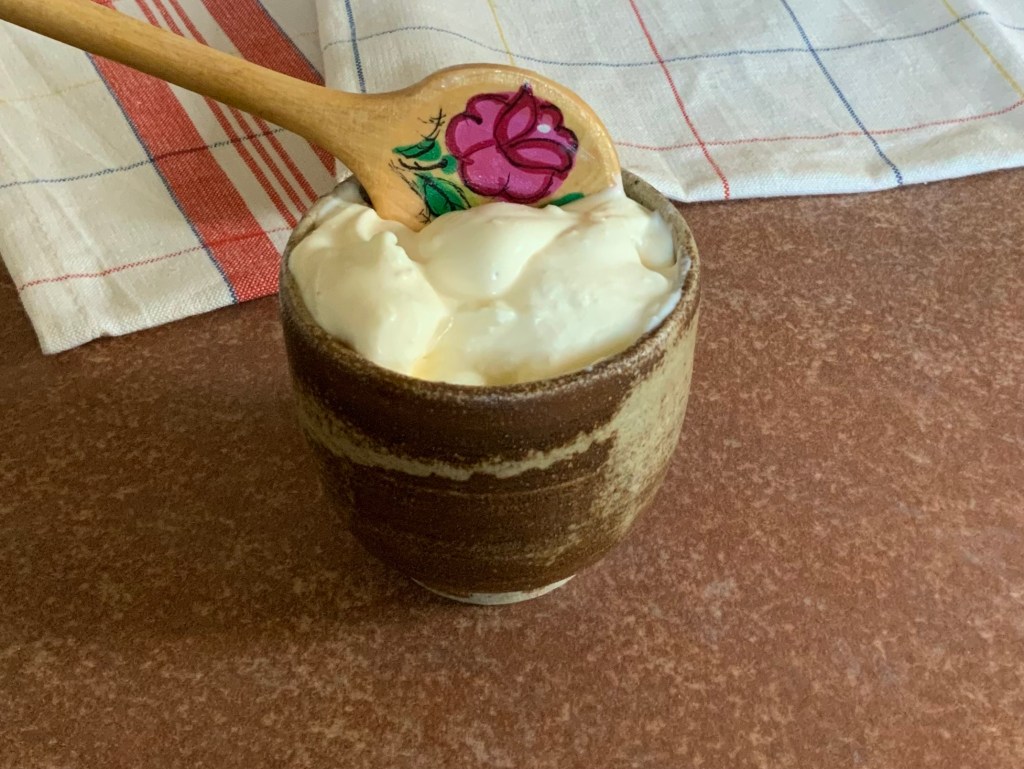
Here, then, for an introduction to low-tech deep-frying is: Pommes frites, aïoli ou sauce tartare~ French fries, aïoli or tartar sauce.



Leave a comment