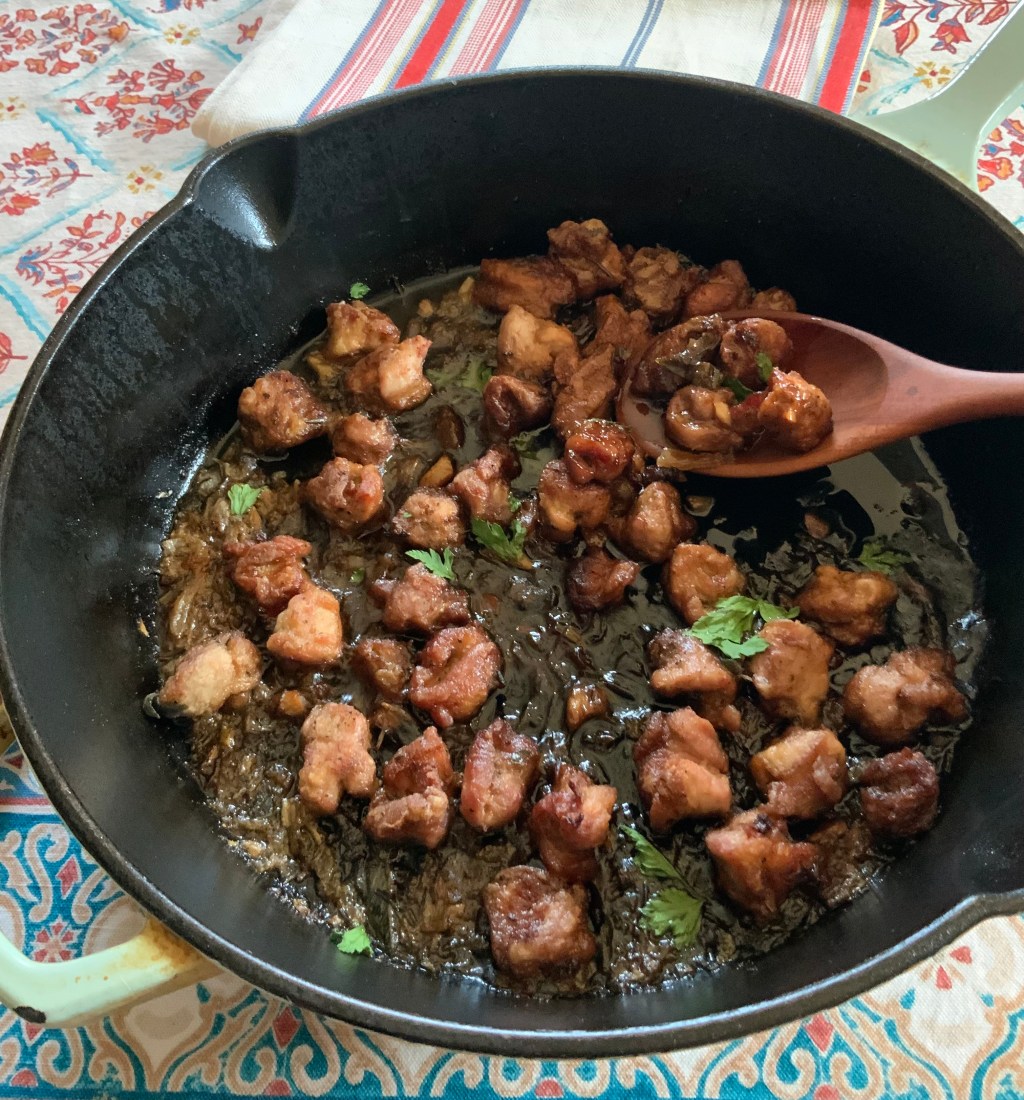
Annodate is a technique for preparing delicate slices of meat—such as veal, pork tenderloin, or chicken breast—by loosely knotting them before cooking. Despite the name, the slices are not tied into true knots—they are slackly looped to form a compact shape for braising and sautéing.
In this thicker, more compact shape, these types of meat do not tear, break up or dry out. It is a clever way to give these delicate cuts enough cooking time to become tender without falling apart.
Applying a second braising technique–the long, gentle style of cooking known as mijoter–also helps bring the knots to the point where they are both tender and deeply flavoured by the wine and herbs.
The little knots show how a familiar ingredient, prepared in a new way, takes on a new character. This version of the little knots describes making them with pork tenderloin.
Only a very light reduction of braising liquid coats the finished knots. A suggested Complimentary Combination is Fettuccine Alfredo or any pasta with a significant amount of sauce.
Follow any of these links for descriptions of the less processed ingredient options: Pork Tenderloin, Imported Italian Dry Marsala, Vegetable Stock, Lemon, Fresh Sage, Fresh Rosemary, Italian Flat-Leaf Parsley, Garlic, Onion, Butter, Olive Oil, and White Flour.
Equipment
- Knife and Cutting Boad
- a Large Heavy Pan with High Sides and a Lid. This recipe is made in a 12-inch (30.5 cm) Cast Iron Chicken Fryer with a 4.25 quart capacity (about 4 liters). A close European equivalent is a Sauteuse Haute, which has high sides and a long handle. It is deeper than a regular sauté pan.
- a Small Pot in which to clarify the butter
- a Pie Pan or other Rimmed Pan for flouring the knots and a Parchment-lined Rimmed Pan to hold the floured knots before browning them
- a Flame Tamer (aka Heat Diffuser, Simmering Plate). The pan does not sit directly over the heat source. Some versions of flame tamers are compatible with a smooth-top burner.
Ingredients
Double the amounts of the ingredients for two 1-pound pork tenderloins serving 4.
- a 1-Pound (454 g) Pork Tenderloin: This amount will serve 2 generously. For a recipe serving 4 or 5, two 1-Pound tenderloins are a better alternative than one larger tenderloin. Larger tenderloins tend to be less firm and will be more difficult to “knot”.
- Unenriched European All-Purpose Soft Wheat White Flour or Organic Unenriched All-Purpose Hard Wheat White Flour: hard wheat flour is the standard American variety.
- 1 and 1/2 cups (360 ml) of Imported Italian DOP Dry Marsala, plus a more if necessary to complete braising the knots until tender
- 1/2 cup (120 ml) of Homemade Vegetable Stock: The recipe for the stock is here: Vegetable Stock.
- 1 Tablespoon of Lemon Juice
- 1 Tablespoon of Fresh Sage Leaves, 1 Tablespoon of Fresh Romemary Leaves, 2 Cloves of Garlic and 1 small Onion (about 1/2 cup or 80 g): all chopped fine together.
- 5 Tablespoons (70 g) of Unsalted European-Style Butter, clarified: Clarifying butter is described below: For browning more than two batches of knots prepare about 10 Tablespoons (113 g) of clarified butter.
- 5 Tablespoons (75 ml) of Extra-Virgin Olive Oil, and additional olive oil for browning more than two batches of knots.
- some chopped Italian Flat-Leaf Parsley Leaves to finish
Clarifying the Butter
A milky sediment separates out of melted butter. The sediment scorches easily, but once removed, the clarified butter will heat to a high temperature without burning.
- Heat the butter in the small pot until a froth bubbles up. Skim off the froth. Pour off the clear yellow butter into a bowl, leaving the sediment behind. Discard the sediment. Leave the butter in the pot and set aside.
Preparing Tenderloin for the Knots
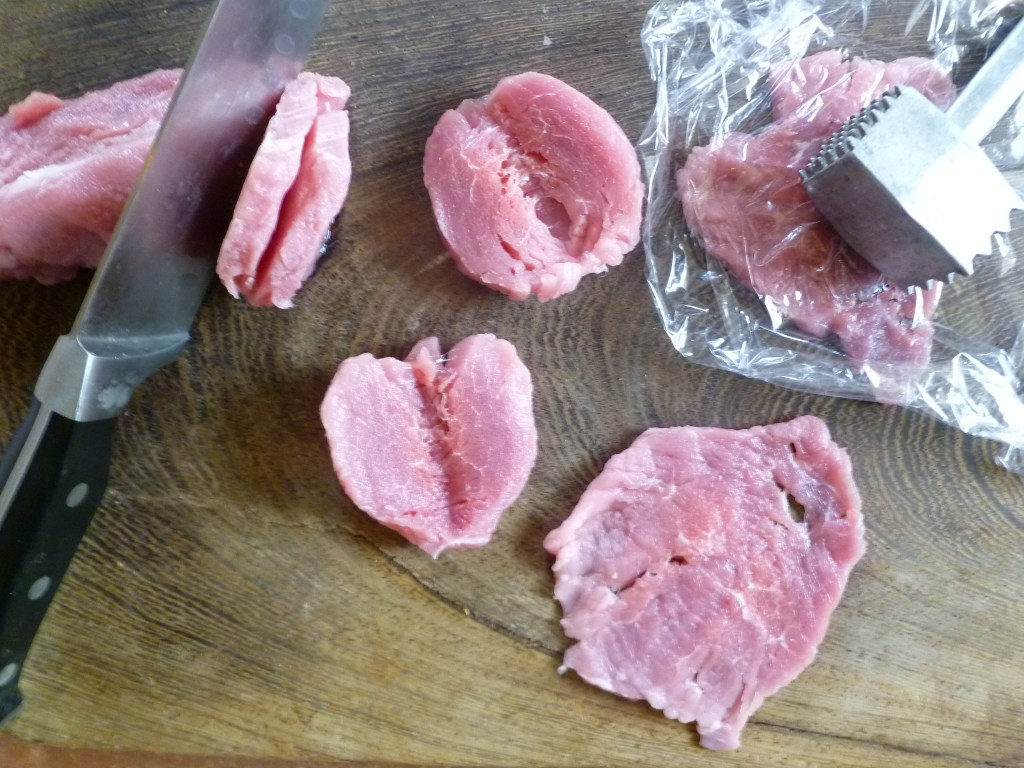
- Cut the tenderloin as though for scaloppine but pound them out gently only to about a 1/4-inch thickness (1.5 cm). This is thicker than a scaloppine. The description of how to cut and butterfly the tenderloin slices for pounding is found through this link: Making Scaloppine ~ with Pork Tenderloin …or look at the picture below:
Forming Knots
The standard method described here for making the knots with pork makes it less likely that they will come uncoiled as they braise. However, the strips may instead be coiled around on themselves, floured, and left for a half hour to give the flour time to adhere well. The flour acts as an adhesive and the strips won’t uncoil even though they are not ‘tied’ in the typical way.
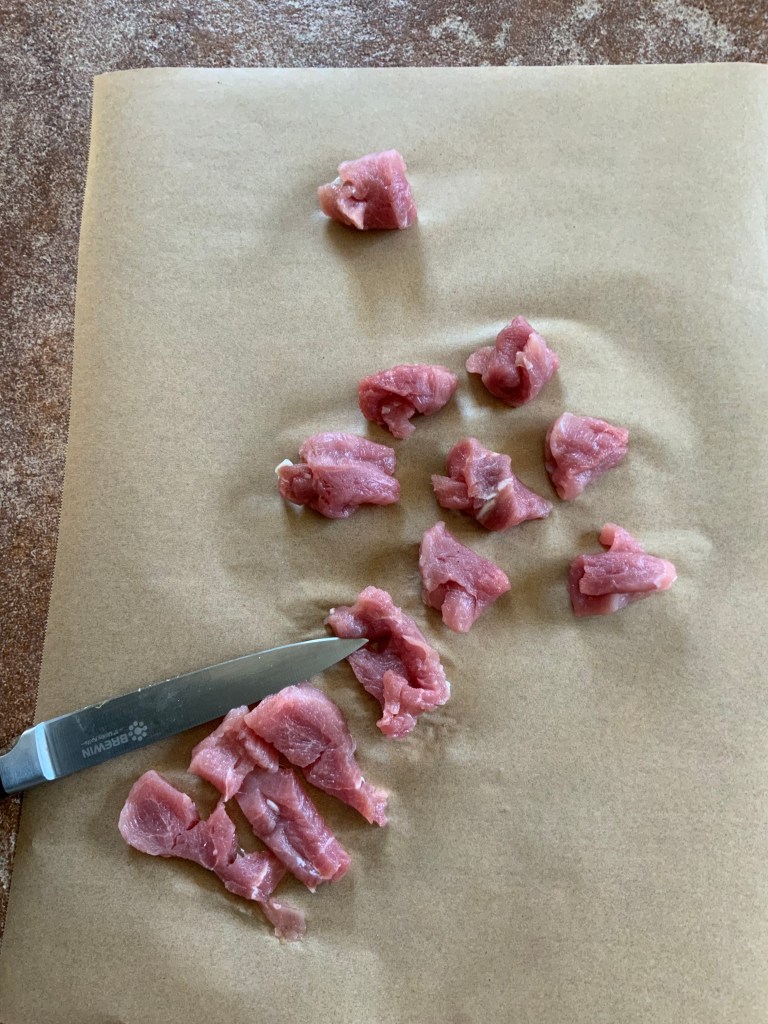
- Cut each pork cutlet into 3 strips, each roughly 3/4 of an inch in width. Cut the middle strip so that the butterfly fold runs down the centre. The two side pieces will be slightly ragged one side.
- With the point of a knife, pierce a strip off-center toward the broader end of the strip.
- Bring the narrower end of the strip up and poke it into the hole. There is no need to pull the end on through. You are not making a true “knot”–only bringing one end up and tucking it into the hole. Some strips may be too delicate to actually secure in the hole–simply coil these around on themselves. Flouring them will hold them in place.
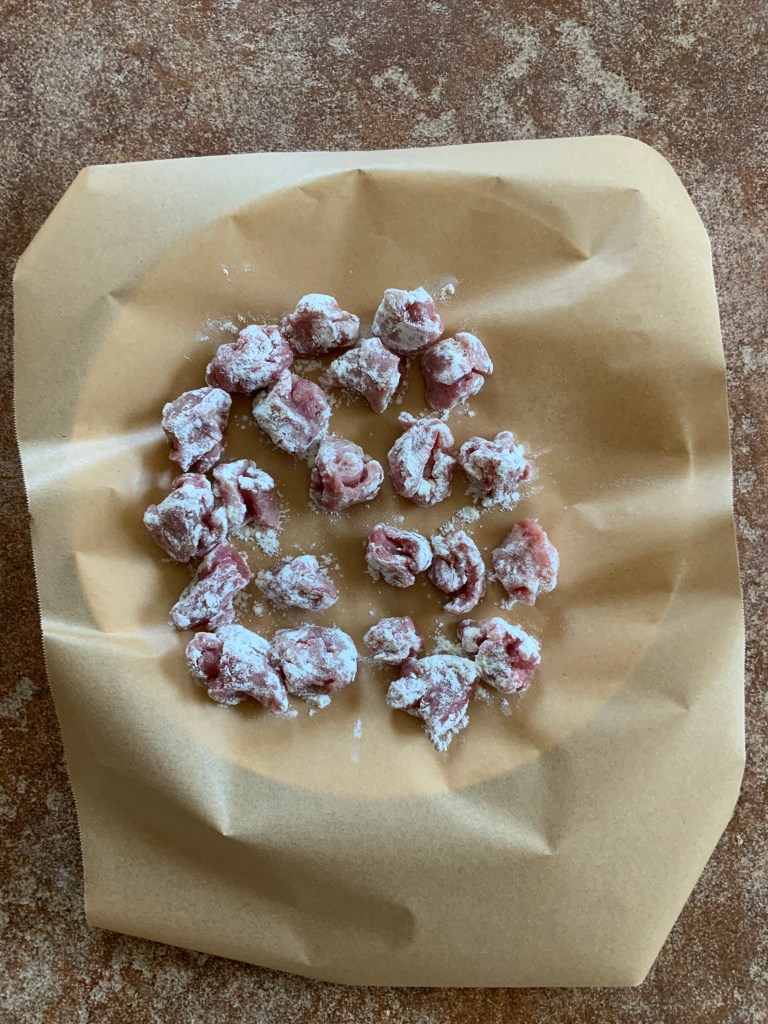
- Pour some flour into a pie pan or other rimmed pan and lightly flour the knots. Transfer the floured knots to a pan. If a knot is very loose or tends to come apart, smooth and roll the ends of the strip to cross over each other as you flour it. The flour will seal the strip in a ‘knot shape’.
- Rest the knots for about 30 minutes to let the coating settle.
Sautéing and Braising
- Preheat the pan slowly. Add 3 tablespoons of the clarified butter and 3 tablespoons of olive oil. Add a portion of the knots–as many as will fit comfortably in the pan without crowding. Brown them over medium low heat. When the first side has browned deeply and lifts away easily, turn and brown until the second side, too, is nicely coloured and does not stick to the pan. Transfer them temporarily to a plate.
- Add 1 tablespoon of clarified butter and 1 tablespoon of olive oil and brown another set of knots in the same manner. Repeat, if necessary, until all the knots are browned and transferred to the plate.
- Add a tablespoon each of clarified butter and olive oil and the chopped sage, rosemary, garlic and onion. Sauté them until the edges of the onion begin to brown.
- Add the Marsala and deglaze the pan, scraping the bottom of the pan smooth with a spatula.
- Return the knots to the pan and add the vegetable stock. The liquid should not completely cover the knots. Use less stock if the size of the pan brings the liquid to a level that covers the knots.
- Place the pan on the flame tamer and braise the knots, partially covered, on the lowest heat. The braise is a mijoté i.e., the liquid should bubble only very gently here and there.Check the tenderness of the knots and the liquid level after about 30 minutes. Add a little Marsala if the braising liquid has evaporated and the knots are not yet tender when pierced with a skewer. (The skewer should go through with no resistance.)
- The estimated braising time is 1 and 1/2 hours. The knots will be tender and the braising liquid will be reduced to a small pool in which the knots are glazed with the braising reduction. When the knots are done, add the lemon juice. Sprinkle the knots with parsley just before serving. If the knots are not to be served right away, partially cover them and, just before serving, add a little Marsala and reheat them on the flame tamer over the lowest heat.


 thefoodlessprocessed
Leave a comment