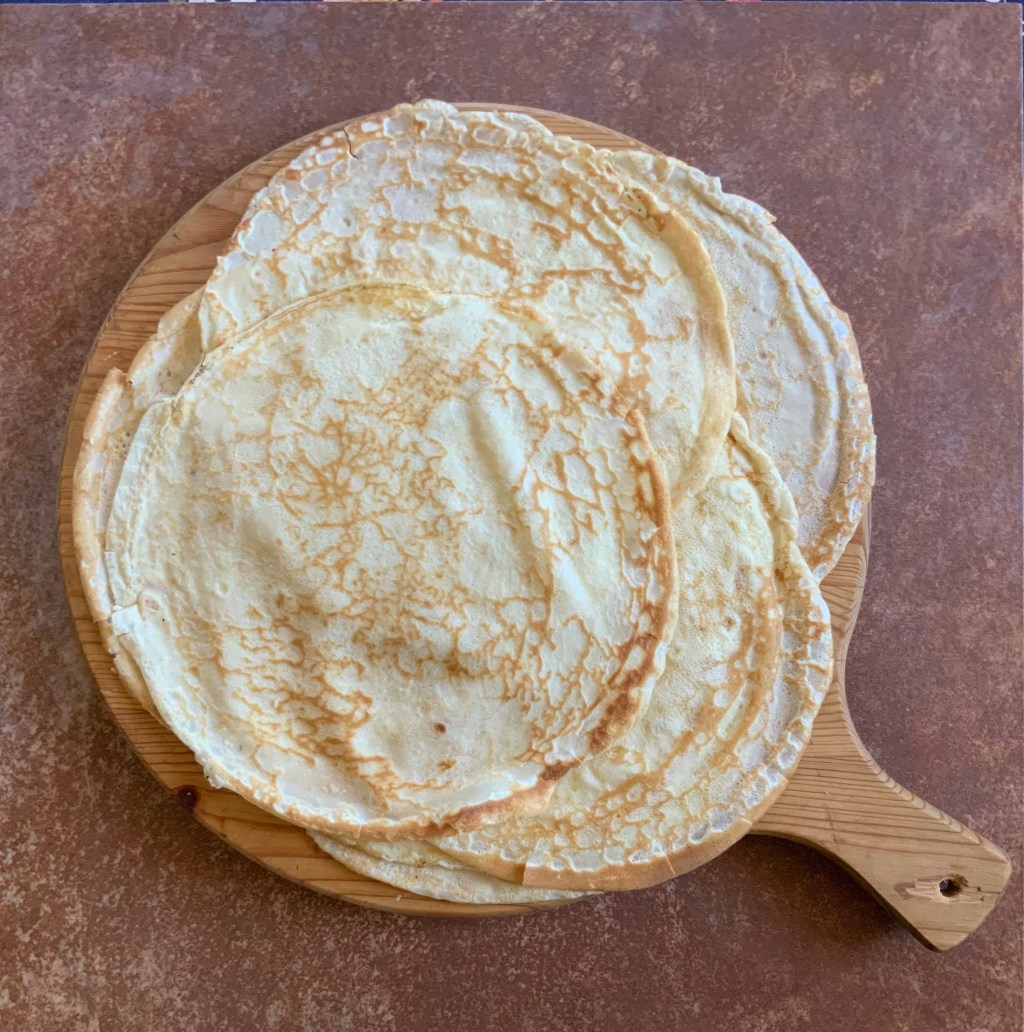
Because crêpes (aka crespelle) lend themselves to an exceptionally wide variety of preparations, both savoury and sweet, making them may be regarded as a fundamental culinary skill. It is a straightforward technique and brings reliably good results with practice.
Two elements are essential: a good crêpe pan—flat-bottomed with shallow, sloping sides—and maintaining a consistently high heat from the first crêpe to the last. A flat spatula (aka palette knife) with a thin turning edge is also useful.
This is a minimalist’s version of crêpe-making. The batter contains only the four essentials: flour, milk, eggs and salt. Both mixing the batter and making the crêpes are completed in just a few steps. A little olive oil, rather than butter, is wiped over the surface of the pan with a paper towel. Olive oil more easily keeps the pan at a high temperature without scorching.
The number of crêpes the recipe makes depends on the size of the pan and, of course, there are the occasional mishaps—a portion that sticks, a tear in the turning–that may ruin a crêpe-in-the-making. Fortunately, crêpe batter is not a finicky mixture and proportions may be adjusted to allow for chance and equipment variations. (If children are standing watch in your kitchen, they will be only too happy to deal with a discard. )
The less processed options for these crêpes are: Flour, Milk, Salt and Olive Oil.
Note: The recipe may be made with either European unenriched white all-purpose soft wheat flour or organic unenriched white all-purpose hard wheat flour. Hard wheat flour is the standard American variety.
Equipment
- a Crêpe Pan: The crêpes in the photo were made in a pan with a 9-inch (23 cm) diameter base.
- a Flat Spatula (aka palette knife) with a thin turning edge
- a Large Mixing Bowl
- a Whisk or a Hand Mixer
- a Small Plate to hold Olive Oil and Paper Toweling
- a 1/3 cup (80 ml) Measuring Cup: If your pan is smaller than the 9-inch (23 cm) pan used here, use a smaller measure of batter for each crêpe.
- a Large Plate and 2 Cotton Kitchen Towels: As they are made, the crêpes are turned out onto a towel spread over a plate, stacked one atop another, and covered with a second towel.
- a Small Plate for olive oil and Paper Toweling for oiling the pan
- another Small Plate on which to rest the measuring cup
Ingredients
Note: The recipe makes 8 or 9 large crêpes in a pan with a 9-inch (23 cm) diameter base.
- 1 and 1/3 cups (315 ml) of Minimally Processed Whole Milk plus a but more to add once the batter has sat and absorbed the flour completely. (See the note below in Mixing the batter.)
- 1 cup (125 g hard/120-125 g soft) of Unenriched All-Purpose White Flour: either European soft wheat or organic hard wheat flour. Hard wheat flour is the standard American variety. In the US, only the organic version of all-purpose hard wheat white flour is guaranteed to be unenriched.
- 3 Eggs, lightly beaten
- 1/4 teaspoon of Sea Salt
- Extra-Virgin Olive Oil for the crêpe pan
Mixing the batter
Note: Hard wheat flour absorbs more liquid than soft wheat flour. Resting the batter for 20 minutes or so after mixing it will allow either flour to absorb the liquid more fully. After a rest, a hard wheat batter may have thickened to the point where it will no longer spread around over the pan fluidly when poured out. Add some more milk, whisking, until the batter once again has a smooth, free-flowing consistency.
Likewise, a soft wheat batter might need a bit of thinning.
- Add the flour and salt to the mixing bowl
- Gradually add the milk, whisking, or mixing on low with a hand mixer.
- Add the beaten eggs, whisking or mixing.
- The batter will be smooth.
- Rest the batter for 20 minutes or so. Add a little more milk if the batter has thickened. (See the note at the beginning of this section. )
Making crêpes
- Pour some olive oil onto the small plate. Set it nearby, along with a paper towel.
- Set the bowl of batter, the measuring cup, small plate for the cup, and spatula close by.
- Arrange the large plate and dishtowels close by as well
- Heat the dry pan until it is very hot. Then dip the paper towel in the olive oil and quickly wipe a thin coating of oil on the base and around the sloping sides of the pan. Place the pan back over the heat.
- Fill the measuring cup with batter. Lift the pan by the handle with your more dextrous hand, and, with the other hand, pour the measure of batter around over the surface of the pan. Swirl the pan by the handle so the batter spreads quickly into a thin, even layer. (A batter of good consistency will glide out smoothly over the pan’s surface. If the batter moves sluggishly, add a little more milk to it.)
- Place the pan back over high heat.
- Pinprick holes will begin appearing on the crêpe’s surface almost immediately.
- Run a spatula all around the edges of the crêpe. Slide the spatula carefully inwards toward the crêpe’s center to loosen it and prevent sticking as it is turned.
- Slde the spatula under the crêpe and turn it. The done side be marked with a brown crackled pattern.
- Colour the second side briefly. It will be mainly yellow with spots of brown.
- Turn the crêpe out on to the plate covered with a dish towel and place a second towel over it.
- Return the pan to high heat quickly so it stays hot. Wipe it again with oil and continue making crêpes from the remaining batter.
- Keep the heat high and wipe the pan with oil before each crêpe. The cooking time for each crêpe in a hot pan will be only about a minute.
- A done crêpe will be floppy. But if it has crisped a bit it will become more flexible after it is stacked and covered.



Leave a comment