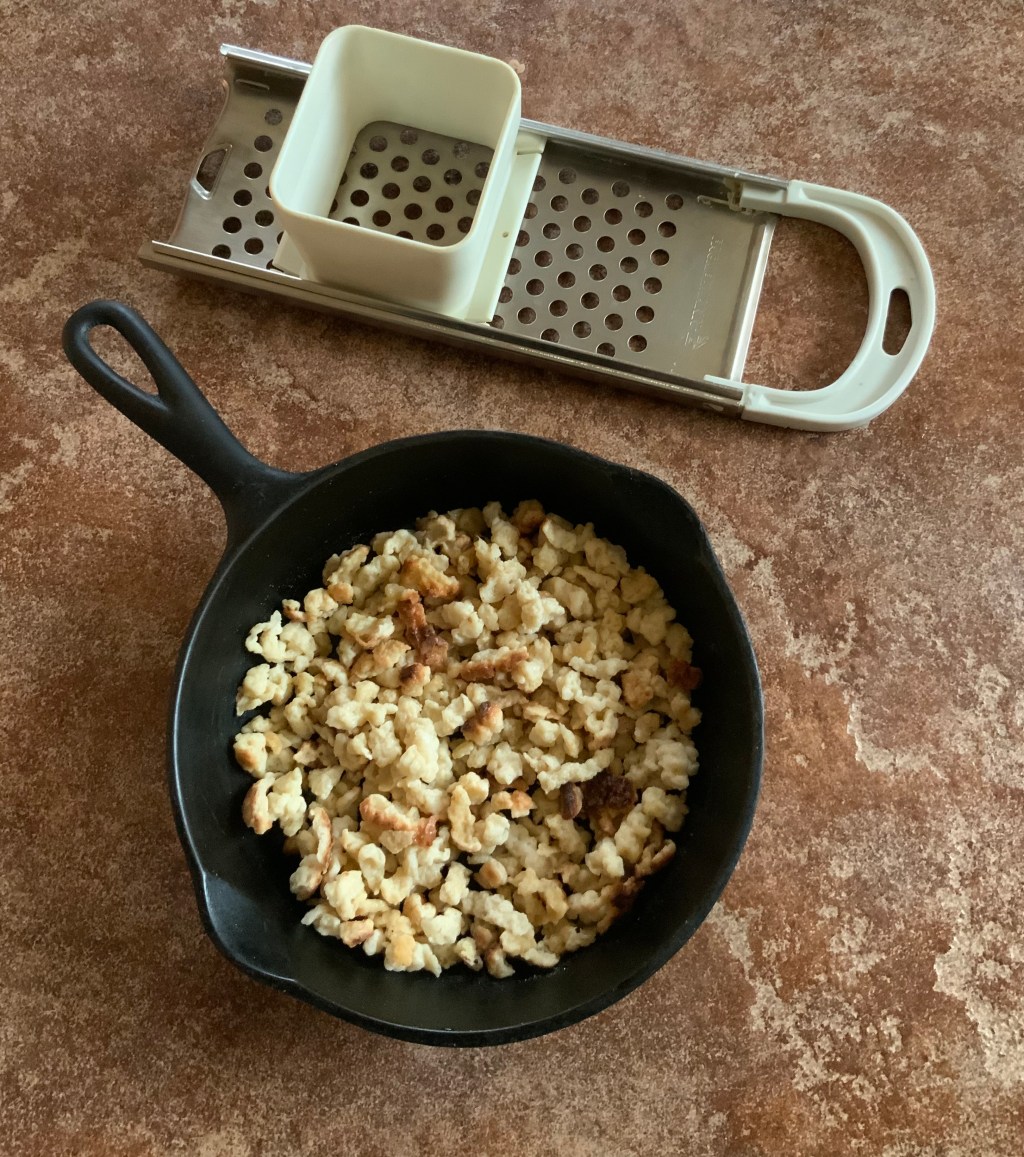
“City folk…generally ate galuska as an accompaniment to stews, but among village folk these dumpliings were more often a main course.” (George Lang from The Cuisine of Hungary (1971).
Eggs, flour, milk and water, mixed together, form the batter-like dough that turns into the little boiled dumplings known as spätzle–or, in Hungary, galuska. Austria, Germany, Hungary, and Switzerland all claim them as one of their culinary specialties. And all may do so on the good authority of having made späztle well for a long time.
In any of these countries, a spätzle maker is a common kitchen utensil, often sold in the kitchen gadget section of the supermarket. It’s a simple device with a square holder that fits on top of a metal rectangular plate that resembles a flat grater with a handle. The spätzle maker is placed over the rim of a pot of boiling water. Filling the holder with batter and moving it back and forth over the metal plate presses small blobs of dough down through the holes and into the boiling water where they cook and float to the surface–transformed into…spätzle.
Instructions directed to an American audience usually assume the absence of a spätzle maker in the kitchen and suggest passing the dough through the holes of a colander or a flat, coarse-holed grater. (An adept housewife, cooking in the old style, can pour a batch of spätzle batter onto a cutting board and flick bits of it straight from it into the pot using a knife. It takes practice and feel to perfect this technique. I have tried it without success.)
A simpler choice is to purchase a spätzle maker. Good, inexpensive ones may be bought online. With it, spätzle-making becomes a simple routine, rather than a one-time cooking experiment.
The less processed options include: Flour, Water, Milk, Salt, Nutmeg and Butter.
Note: Either European Soft Wheat Unenriched All-Purpose White Flour or Organic Hard Wheat Unenriched All-Purpose White Flour may be used. Hard-wheat flour makes a stiffer batter and a firmer dumpling. It is a bit easier to work with and the dumplings made from it sauté more easily without sticking. A soft-wheat batter will firm up some if set aside for 20 minutes or so before making the spätzle.
Equipment
- a Large Pot (8 quarts/7.5 liters or thereabout): The rim of the pot is of a width that allows the spätzle maker to rest securely on it.
- a Colander
- a Large Mixing Bowl and Wooden Spoon (or any large Mixing Spoon)
- a Spätzle Maker
- a Rubber Spatula
- a Turner (aka Flat Spatula)
- a Large Heavy-bottomed Pan: for example, an enameled cast iron sauteuse with a black baked-on porcelain enamel interior with an 8 cup (1.9 liter) capacity.
Ingredients (for 3-4 servings as an accompaniment to a meat dish with a sauce)
- 2 cups (240 g) of Organic Hard Wheat Unenriched All-Purpose White Flour or European Unenriched Soft Wheat All-Purpose White Flour: Hard wheat flour is the standard American variety. Only the organic version is guaranteed by law to be free of enrichments and additives.
- 2 Eggs, lightly beaten
- 1/2 cup (120 ml) of Minimally Processed Whole Milk
- 1/4 cup (60 ml) of Bottled Spring Water
- 1/2 tsp of Sea Salt
- 1/4 tsp ofOrganic Ground Nutmeg or Freshly Ground Nutmeg
- 2 Tablespoons of European-style Unsalted Butter
Mixing the Spätzle Batter and Making the Spätzle
- Fill the pot with water to a depth that will allow the spätzle to float freely as they cook. Place the pot on a burner over medium heat and bring it to a boil while you mix the spätzle batter.
- In the mixing bowl, combine the flour, salt and nutmeg.
- Add the milk and water and eggs and stir vigorously a spoon until the batter is smooth. A hard-wheat flour batter will be dense and elastic. It is ready immediately after mixing. A soft- wheat batter has a thinner consistency. Left to stand for 20 minutes or so, it will thicken slightly and make firmer little dumplings.
- Place the colander in the sink, ready to drain the cooked spätzle.
- Once the water in the pot comes to a boil, adjust the heat to maintain a steady, gentle boil.
- Balance the spätzle maker on the pot rim. Scrape about half the batter into the holder fixed over the metal plate. Hold the handle of the spätzle maker with one hand, and with your other hand, slide the holder back and forth, pressing batter down through the holes into the boiling water. Refill the holder with the remaining batter and continue making the spätzle.
- Set the spätzle maker aside and give the spätzle a stir to separate any that stick together. When cooked, the spätzle rise to the surface. They cook rapidly and will be done in about the time it takes to give them a quick stir.
- Drain them in the colander. Run a little cold water over them to prevent sticking and shake the colander to drain off some of the water.
- Melt the butter in the pan over medium heat. As the foam from the butter subsides, add the spätzle. Leave them to color on one side, without stirring. Test with the turner. When the spätzle tend to come away easily from the pan’s bottom, turn them and leave them to color on the second side. When the spätzle are irregularly tinged with spots of golden brown on both sides, they are ready to serve.



Leave a comment