“A visiting Englishman asked me the secret of the Hungarian cuisine. I told him: ‘It’s sweet onion, noble paprika, unmatched bacon, the very best sour cream and a thousand years of experience.” (An anonymous twentieth-century restaurateur).
“Hungarian cooking is characterized by inexhaustible variety, flavors that are explicit, a calculated use of color, a piquant juxtaposition of sophistication and family-style simplicity.” (Edward Weiss from The Paprikas Weiss Hungarian Cookbook (1930).
“In Hungary,…until very recently every girl learned cooking from her mother as part of her general upbringing and education…the techniques and procedures were known through experience. Consequently, recipes in Hungarian cookbooks were, and are, little more than chefs’ reminders.” (George Lang from The Cuisine of Hungary (1971).
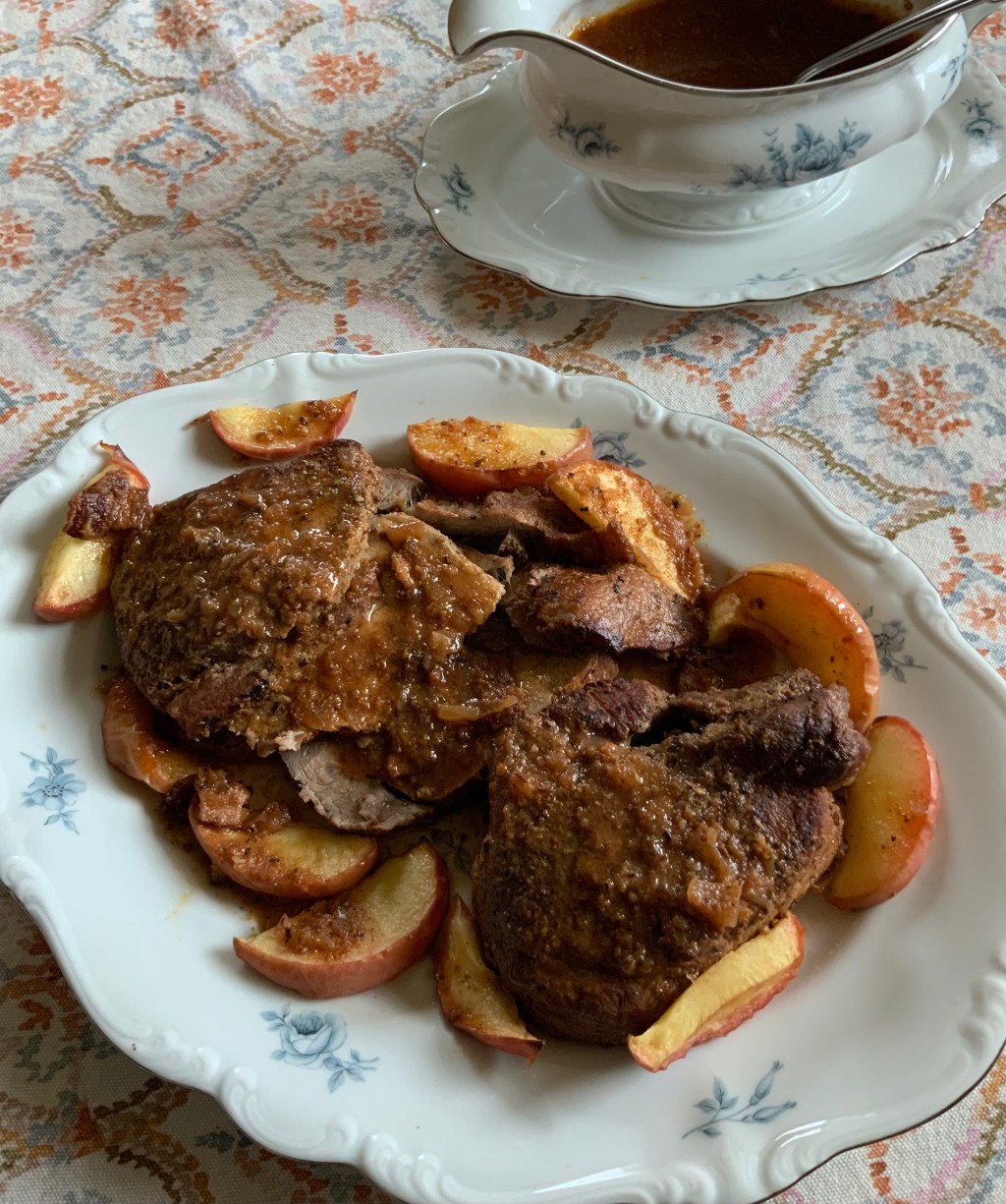
One of the distinctive techniques of Hungarian cooking is the use of fruit in sauces for savory meat dishes. The fruit gives the sauce a distinctly pleasing character, yet its presence is not immediately recognisable, since it does not make the sauce sweet. Such sauces often accompany venison or wild boar, although their use is not limited to game. Here, pork loin is braised in a fresh plum sauce. Roasted apples are also included in the dish, but they are added at the end and served with the sauce rather than incorporated into it.
These links describe the less processed ingredients in the dish: Pork Loin Roast, Fresh Plums, Apples, Homemade Vegetable Stock, Bacon, Butter, Sweet Paprika, Whole Grain Mustard, and Yellow Onion.
Equipment
- a Large Heavy Pan with High Sides and a Lid. This recipe is made with a 12-inch (30.5 cm) Cast Iron Chicken Fryer with a 4.25 quart capacity (about 4 liters). A close European equivalent is a Sauteuse Haute, which has high sides and a long handle. It is deeper than a regular sauté pan.
- a Deep, Heavy-Bottomed Pot of about 5-quart capacity: for example, an Oval Enameled Cast Iron Dutch Oven of a 5.5 quart (about 6.25 liter) capacity. White enameled cast iron does not brown as well as dark cast iron. Therefore, the dark cast iron pan is used for browning and all is then transferred to the enameled Dutch oven for braising.
- a Food Processor
- a Rimmed Baking Tray lined with Aluminum Foil
- a Flame Tamer is optional: During a long, slow simmer it helps prevent scorching and distributes the heat evenly over the bottom of the pot.
- a Large Liquid Measuring Cup
Ingredients
- a 2.2 pound (1kg) Pork Loin Roast, tied at intervals
- Whole Grain Mustard
- Coarse-Ground Black Pepper
- 1 teaspoon of Imported Hungarian Sweet Paprika, plus some to dust on the loin before refrigerating it overnight.
- 3 slices (about 5 oz or 135 g) of Sugarless Bacon
- 300 g (before pitted) of Fresh Organic Plums: Plums that give a little when tested, will be fine for this recipe. Hard plums will not purée to a sufficiently smooth consistency. Plums labeled tree-ripened often have developed more flavour and texture than the regular supermarket variety. A note on how to soften plums at home follows at the end of this recipe.
- about 1/2 Cup (75 g) of Yellow Onion, chopped
- 1 Tablespoon (14 g) of European-style Unsalted Butter
- about 2 Cups of Dry White Wine: The amount will depend upon the size of the pot. The level of the braising liquid should be kept at about halfway up the side of the pork loin.
- 2 Cups of Homemade Vegetable Stock: The recipe is here on thefoodlessprocessed: Vegetable Stock.
- 1 Bay Leaf
- 1/4 teaspoon of Caraway Seeds
Preparing the Roast for Braising
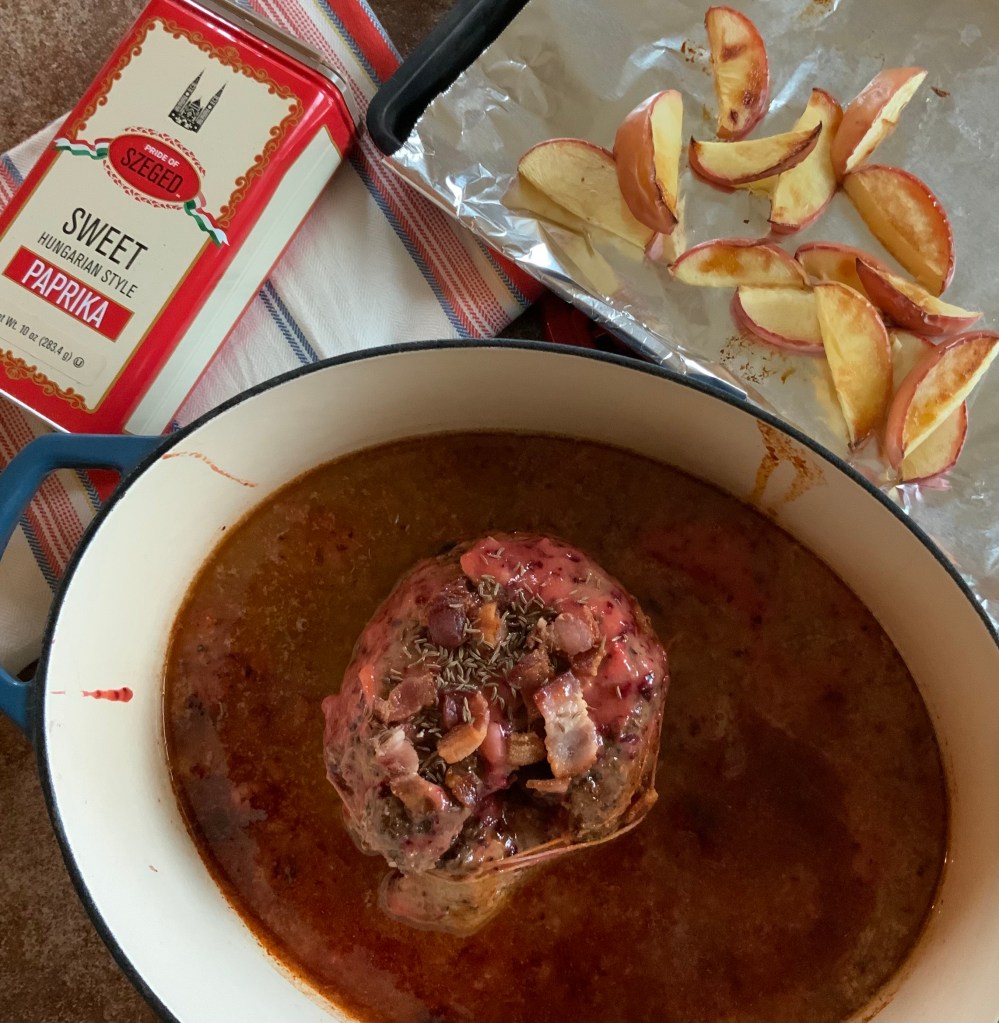
Two Timing Notes: The pork loin is rubbed with mustard, seasoned with coarse-ground black pepper and paprika, tightly wrapped and refrigerated overnight before it is braised.
Once the pork is done, refrigerating the braising liquid for an hour or so allows the fat to set so it can be easily removed before finishing the sauce, slicing and reheating the pork.
- Rub the pork loin with whole grain mustard and sprinkle it generously with coarse-ground black pepper and some paprika. Wrap it tightly in plastic wrap and refrigerate it overnight.
- Pit the plums, cut them into sections and purée them in the food processor. Set the purée aside.
- Preheat the oven to 400 F (about 205 C). Core and slice the unpeeled apples and spread them out on the rimmed baking pan lined with foil. Roast them for about 20 minutes, or until they soften, begin to brown here and there and the peels begin to wrinkle. Wrap them up in the foil on which they were roasted and set them aside.
- Cut the bacon crosswise into short segments and fry them in the heavy pan until they begin to brown but are still soft. Transfer the bacon to the braising pot.
- Add the butter to the rendered fat in the pan. Adjust the heat below the pan to a moderate level. When the foam from the melting butter subsides, add the pork loin and brown it well on all sides. Transfer the pork loin to the braising pot.
- Add the onions to the pan. When their edges begin to brown, deglaze the pan with the wine. Pour the wine and onions over the pork loin. Add the plum purée, the vegetable stock, bay leaf, caraway seeds and paprika. If the liquid does not come halfway up the pork loin, add a little more wine.
- Place the pot on the flame tamer. Adjust the heat to a low level. Partially cover the pot. The liquid should bubble steadily as the meat cooks. Check the level of the braising liquid occasionally and add wine if necessary to maintain the liquid at halfway up the meat.
- Turn the loin after one hour. Continue braising until a skewer passes easily through it without resistance. (Two to three hours is an estimate of the time required for the meat to reach this degree of doneness.) At this point, the loin will be very tender but will still hold together well enough to slice cleanly. Because pork loin is commonly bred so lean in the United States, it is often cooked only until tender enough to slice, for fear that longer cooking will cause it to fall apart. Gentle, prolonged braising, however, allows the loin to become tender while still retaining its shape.
- Remove the pork loin from the pot, wrap it in foil and set it aside.
- Pour the braising liquid into a large measuring cup. Refrigerate it until the fat rises to the surface and congeals into a waxy layer. Remove the layer of fat and return the liquid to the pot.
- While finishing the sauce, reheat the apple slices in their foil wrapping in a moderate oven (350 F/ 175 C).
- Place the pot back on the flame tamer and reduce the sauce over medium heat to a consistency which holds together, but is not thick.
- Slice the roast. Return it to the sauce and reheat meat and sauce together gently. Transfer the sliced meat to a platter. Pour some of the sauce over it and make a border around it with the roast apple slices. Alternatively, arrange slices of meat, sauce, and apple slices on individual plates. Serve the remaining sauce in a sauceboat.
Ripening Plums at Home: Plums may be further ripened at home by placing them in a brown paper bag along with a banana: Fold down the top of the bag and leave the fruit at room temperature to ripen. (Bananas give off ethylene gas as they ripen and the plums respond to the gas. A paper bag concentrates the ethylene near the fruit but still allows air to circulate.) Unlike peaches, however, plums develop their sweetness mainly before they are picked. They will soften but they will not become noticeably sweeter.



Leave a comment