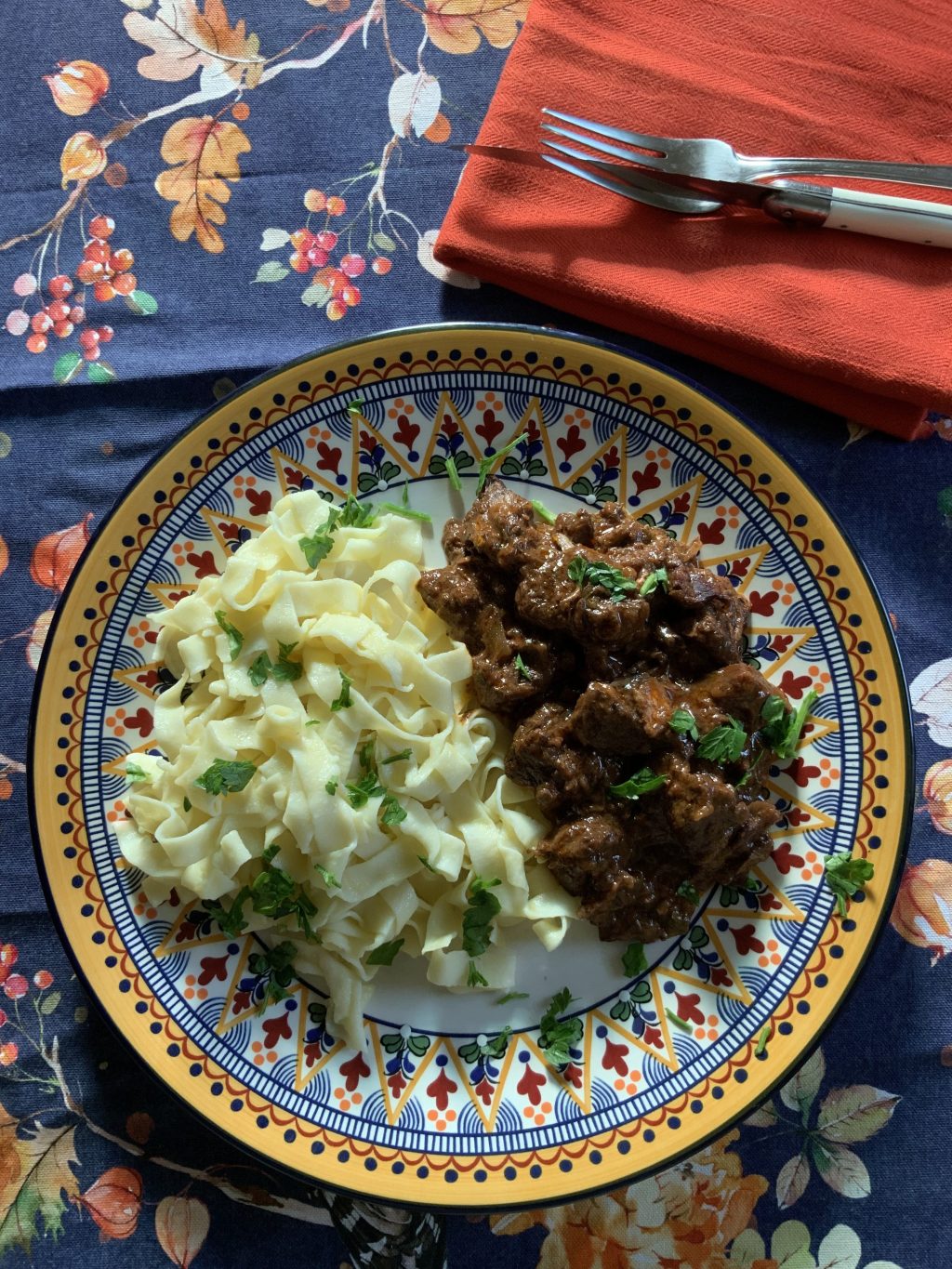
“Stews, or ragoûts, in the French sense, [are] a very particular kind of meat…cooked in liquid. The main ingredient is cut into uniform pieces…We must bring this kind of meat to tenderness without letting it become ragged…only to firm succulence, not softness. The aroma must be fragrant enough to start the mouth watering before a bite is eaten, and finally, the all-important sauce must have a well-rounded flavor and perfect consistency…There are three ways to produce a brown stew with an appetizing rich brown color, and these also improve the flavor of the stew. The meat should be properly browned before the liquid is added. The onions…[and other vegetables if including any]…should also be browned before they are added, and a little tomato sauce should be included…A true French stew does not have a thick sauce, but the sauce does have good body…Thicken the sauce if need be with a little beurre manié at the end of the cooking.” (Louis Diat from Gourmet’s Basic French Cookbook (1961).
Louis Diat’s summary of the key elements in making a ‘brown stew’ (or ragoût)
applies to lamb, veal, pork and chicken, as well as beef.
The less processed ingredient options for the ragoût are: Sirloin, Brandy, Onion, Garlic, Parsley, Paprika, Bacon, Preserved Tomatoes, Tomato Paste, Butter, and Flour.
Equipment
- a Large Heavy Pan with High Sides. This recipe is made with a 12-inch (30.5 cm) Cast Iron Chicken Fryer with a 4.25 quart capacity (about 4 liters). A close European equivalent is a Sauteuse Haute, which has high sides and a long handle. It is deeper than a regular sauté pan.
- a Deep, Heavy-Bottomed Pot of about 5-quart capacity and Lid: for example, an Oval Enameled Cast Iron Dutch Oven of a 5.5 quart (about 6.25 liter) capacity. White enameled cast iron does not brown as well as dark cast iron. Therefore, the dark cast iron pan is used for browning and all is then transferred to the enameled Dutch oven for braising.
- a Flame Tamer is optional: During a long, slow simmer it helps prevent scorching and distributes the heat evenly over the bottom of the pot.
- a Small Bowl for mixing a small amount of beurre manié
Ingredients
- a 2 lb (1kg) Top-Sirloin Steak
- Imported Hungarian Sweet Paprika
- Fine Ground Black Pepper
- 4 Slices of Sugarless Bacon, cut crosswise into narrow strips/lardons or if you are shopping in a European supermarket, a package of lardons (100g)
- 2 Tablespoons (about 28 g) of European-style Unsalted Butter
- 1/2 of a Medium-Sized Organic Yellow Onion, chopped: Recipes often describe an amount of onion in terms of the onion’s size which indicates that the exact amount is not crucial to the success of the dish.
- 4 Organic Garlic Cloves, chopped fine
- a 750-ml Bottle of Dry Red Wine
- 2 Cups (480 ml) of Homemade Vegetable Stock: The total amount may not be required. The recipe is here on thefoodlessprocessed: Vegetable Stock.
- 1/2 cup (120 ml) of Imported Italian Fine-Chopped Preserved Tomatoes
- 2 Tablespoons of Imported Italian Tomato Paste
- 1/4 cup (60 ml) of Imported French Brandy: An inexpensive one will be fine.
- Beurre Manié made by creaming together in a small bowl with the back of a spoon 2 Tablespoons (about 28 g) of Softened European-style Unsalted Butter and 2 Tablespoons of European Unenriched All-Purpose Soft-Wheat Flour: If Hard Wheat Unenriched Organic All-Purpose Flour (the American standard variety) is substituted, the sauce will simply have a somewhat thicker texture. The special qualities of beurre manié as a thickener are described in thefoodlessprocessed post: Beurre Manié. The total quantity may not be required to thicken the sauce. Any remaining beurre manié may be stored in the refrigerator.
- a small handful of Italian Flat-Leaf Parsley, chopped
Making the ragoût
- Cut the meat into pieces of a fairly uniform size.
- Sprinkle them liberally with paprika and black pepper. Set them aside.
- Add the bacon strips or lardons to the pan and sauté them until they begin to brown, but are still flexible. Transfer them to the pot.
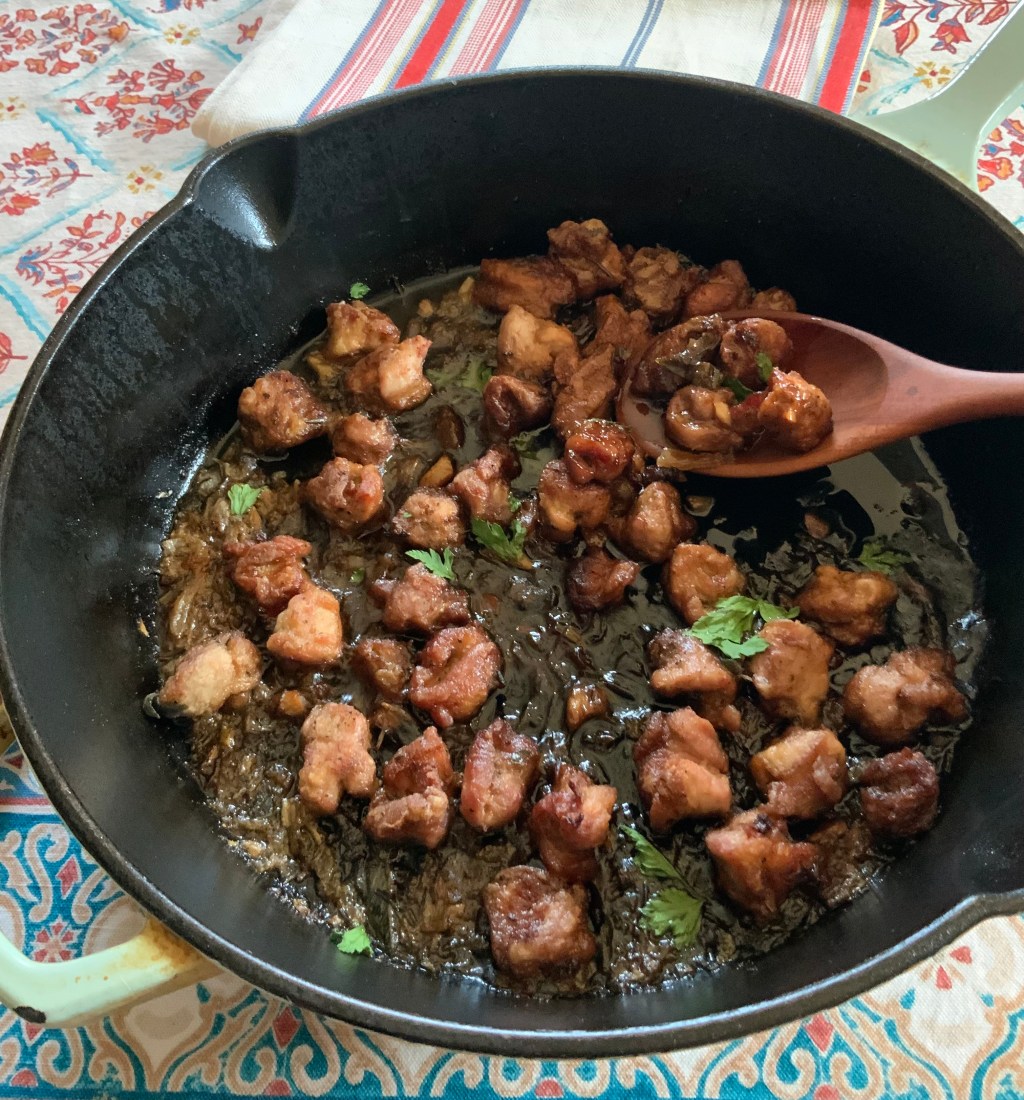
- Add 2 Tablespoons (28 g) of butter to the rendered fat in the pan and, once the foam from the butter subsides, add the meat cubes and brown them. This may be done in one or two batches, depending on the size of the pan. If the cubes are too crowded together, the cubes will steam and give off liquid without browning. Transfer the browned cubes to the pot.
- Add the onion and garlic to the pan and sauté them until the onion begiins to brown around the edges. Transfer them to the pot as well.
- Deglaze the pan with the brandy and some of the red wine and pour all into the pot.
- Add more red wine to just cover the meat.
- Add the preserved tomatoes and tomato paste. Stir to combine everything.
- Place the pot on the flame tamer over a medium low heat, partially cover the pot and bring the ragoût ingredients to a steady simmer.
- Simmer the ragoût until the meat is tender. Check the level of liquid from time to time. Add more wine (if some still remains from the 750 ml bottle)–otherwise, add enough vegetable stock to keep the meat just covered throughout the cooking time. An estimate of the total cooking time is between 2 -3 hours at a steady simmer.
- Just before serving, if the liquid has reduced considerably, add more wine or stock to bring it back to a level that just covers the meat.
- Bring the stew to a simmer and stir in the beurre manié, a teaspoon at a time, until the sauce has enough body to cling to the meat without becoming overly thick.
- Sprinkle each serving with parsley.



Leave a comment