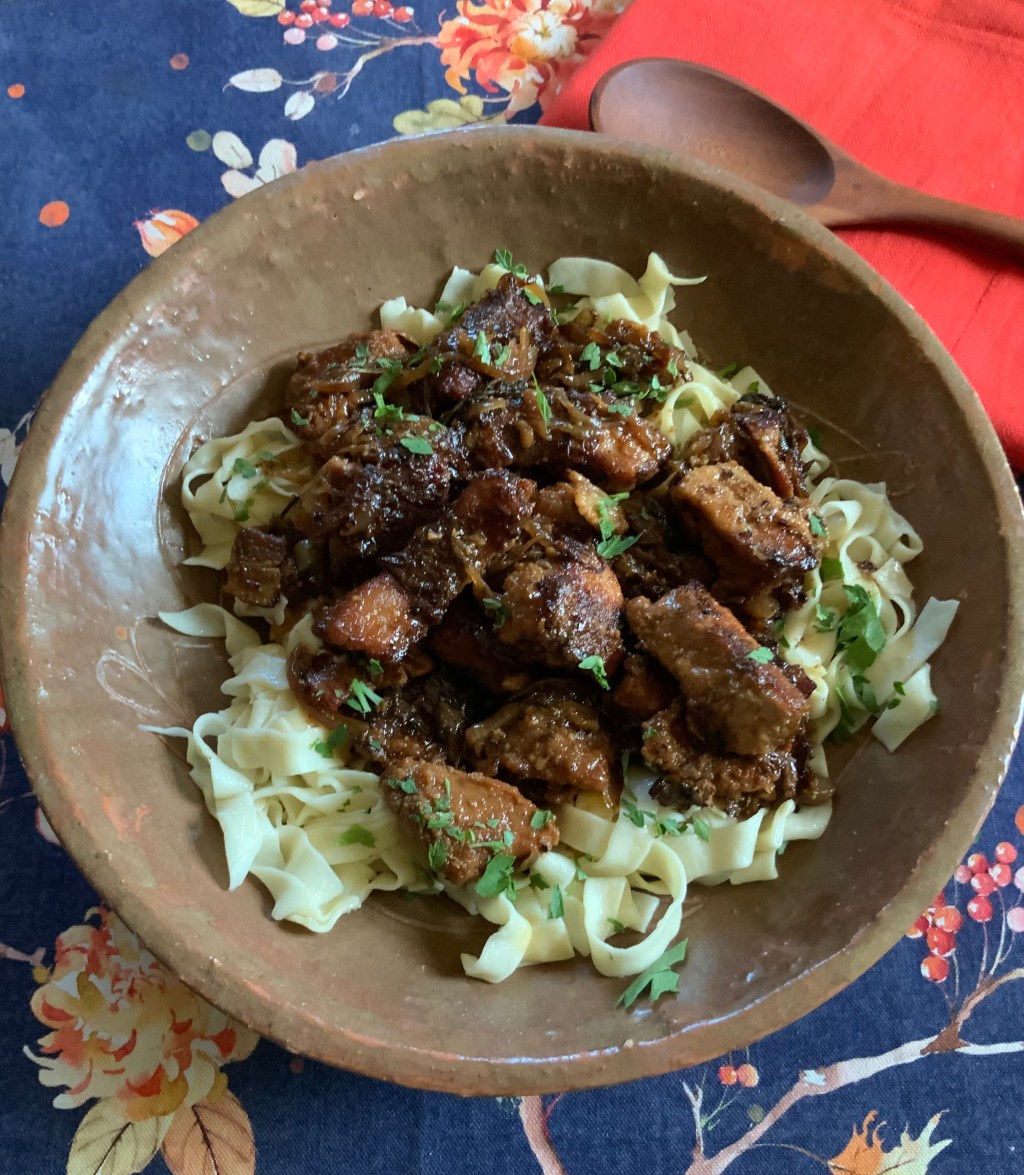
“A robust, earthenware casserole on the table is a comforting sight indeed; the rich flavour of the slow-cooked food in it and the heady smell when the lid is taken off are consoling in themselves.” (Margaret Costa from Four Seasons Cookery Book (1970).
“To the French chef any deep cooking utensil that can stand direct heat is a casserole…The well-equipped kitchen needs two or three casseroles of different sizes. You’ll find that even when you are serving the same number of people, the size of casserole you need will vary with the recipe. If, par example, the recipe includes several vegetables and also potatoes, the casserole will have to be larger….My advice is to add up roughly the cups of ingredients the recipe requires and then to use a casserole of suitable size.” (Louis Diat from Gourmet’s Basic French Cookbook (1961).
“That en casserole cooking should be popular in France is natural. The French, with their great love of good food, are willing to go to any trouble to prepare a delectable dish and will do it in spite of limited quantities of fuel and the need to be thrifty. So the casserole proves a good friend; casserole dishes are usually cooked on top of the stove, and gentle simmering requires much less fuel than roasting or broiling. Most important, long, slow cooking and the patient, gradual blending of flavours, can work miracles with meat that is not naturally tender and chicken that is no longer young.” (Louis Diat from Gourmet’s Basic French Cookbook (1961).
Note: To make a beef carbonnade flamande, top sirloin may be substituted for the pork loin. Other than the meat substitution, there are no changes in the recipe.
The options for less processed ingredients for carbonnade de porc are: Pork Loin, Beer, Bacon, Homemade Vegetable Stock, Flour, Butter, Fresh Thyme, Parsley, Onion, Whole-Grain Mustard and Homemade Apple Juice Concentrate.
A less processed option for beef in a carbonnade flamande is described through this link: Top Sirloin.
Equipment
- a Cutting Board and Knife
- a Rimmed Baking Pan or Large Plate on which to place the floured cubes of meat before browning them
- a Large Heavy Pan with High Sides and a Lid. This recipe is made with a 12-inch (30.5 cm) Cast Iron Chicken Fryer with a 4.25 quart capacity (about 4 liters). A close European equivalent is a Sauteuse Haute, which has high sides and a long handle. It is deeper than a regular sauté pan.
- a Deep, Heavy-Bottomed Pot of about 5-quart capacity and a Lid: for example, an Oval Enameled Cast Iron Dutch Oven of a 5.5 quart (about 6.25 liter) capacity. White enameled cast iron does not brown as well as dark cast iron. Therefore, the dark cast iron pan is used for browning and all is then transferred to the enameled Dutch oven for braising.
- a Slotted Spoon
- a Flame Tamer is optional: During a long, slow simmer it helps prevent scorching and distributes the heat evenly over the bottom of the pot.
Ingredients (3-4 Servings)
- a 2-2 and 1/2 pound (around 1 kg more or less) Pork Loin Roast
- European Soft Wheat All-Purpose White Flour or Organic Hard Wheat All-Purpose Unenriched White Flour: The European all-purpose flour is never enriched. American hard wheat flour (the standard variety) may be enriched if it is not labelled ‘Organic’. The consistency of a sauce made with hard wheat flour will be a bit thicker than one made with soft wheat flour.
- 2 teaspoons of Coarse Black Pepper
- 6 Tablespoons (85 g) of Unsalted European-style Butter, divided into 3 roughly equal portions
- about 1 lb (500g) of Yellow Onions
- 2 Tablespoons of Homemade Apple Juice Concentrate. Follow this link to thefoodlessprocessed recipe: Apple Juice Concentrate.
- 1⅔ cups (about 13½ fl oz or 400 ml) of an inexpensive Imported German Pilsener or Dutch-made Lager Beer. A little more may be needed during cooking if the liquid reduces too much before the meat is tender.
- 100 g (or about 3.7 oz) of Sugarless Bacon, cut crosswise into thin strips/lardons: This will be 3-4 slices of American Bacon, or, if you shop in a European supermarket, a 100 g packet of Lardons
- 1 Tablespoon of Imported French Whole-Grain Mustard
- about 2 cups (480 ml) of Homemade Vegetable Stock. The recipe is here on thefoodlessprocessed: Vegetable Stock. The stock is added in increments when needed to keep the level of liquid in the casserole at a level about three-quarters of the way up the sides of the meat.
- 1 Bay Leaf
- 2 Springs of Fresh Thyme
- 1 teaspoon of Caraway Seeds
- a small handful of Fresh Flat-Leaf Parsley, chopped
Making the Carbonnade
- Trim the loin of fat.
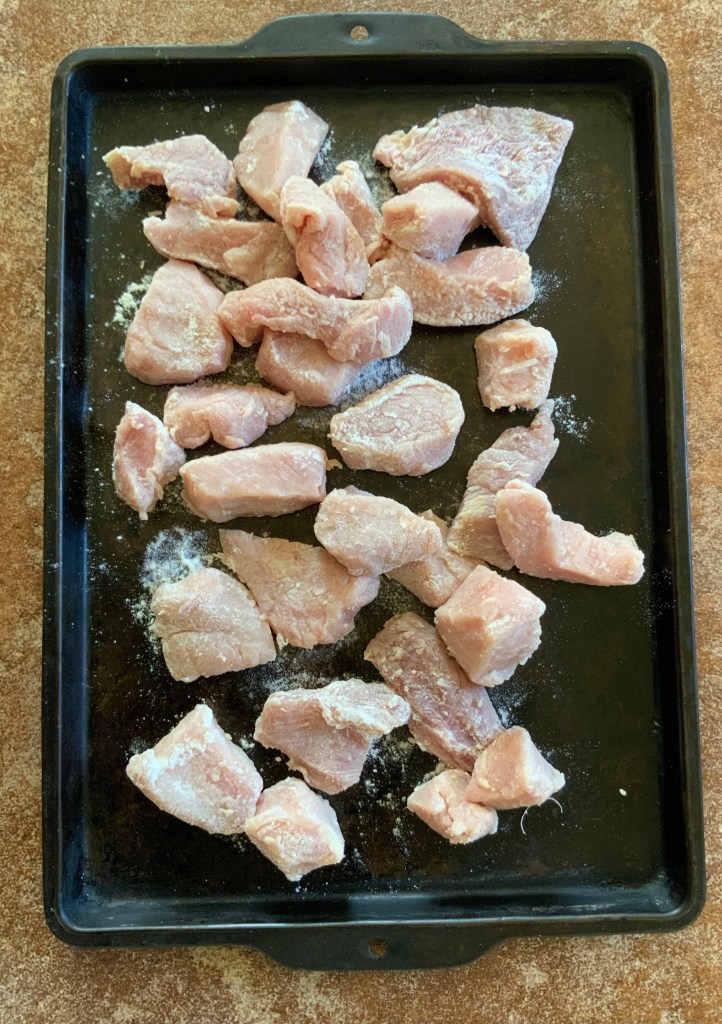
- Cut the meat into large-ish chunks and flour them. Transfer them to a tray or plate, and set them aside to give the flour coating time to adhere to the meat before browning it.
- Cut the onions into thin slices: A suggested method is to cut each onion in half vertically, then place each half flat-side down and thinly slice it crosswise.
- Place the pan on a burner over medium-low heat and add the bacon strips/lardons. Sauté them until they begin to brown, but are still flexible. Transfer them to the pot with a slotted spoon.
- To the rendered fat add 2 Tablespoons (about 28 g) of the butter. When the foam from the butter subsides, add the onion slices. Sauté them slowly over medium-low heat, stirring them about from time to time, until they begin to turn a golden brown. Add the apple juice concentrate and continue to sauté the onions, stirring them about, until they are caramelized. Transfer them with a slotted spoon to the pot.
- Add 2 Tablespoons (about 28 g) of butter and when the butter has ceased to foam, add half the meat cubes and sprinkle them with 1 teaspoon of the black pepper. Brown them well over moderate heat. Transfer them to the pot.
- Add the remaining butter to the pan and when it no longer foams add the remaining pork cubes, sprinkle them with the remaining teaspoon of black pepper and brown them. Transfer them to the pot.
- Pour the beer into the pan and deglaze the bottom of the pan, stirring and scraping up the browned bits. Pour the liquid into the pot.
- Add the mustard, bay leaf, thyme and caraway seeds.
- Add vegetable stock until the liquid almost covers the meat (or about three-quarters of the way up the sides of the meat.).
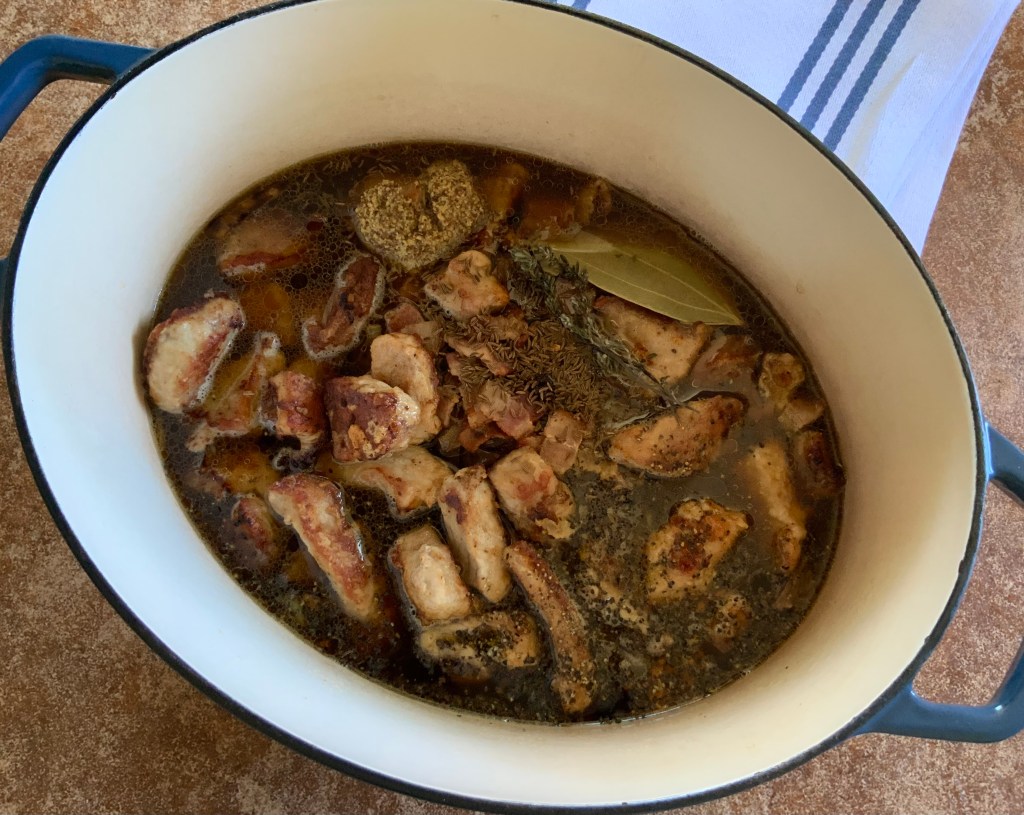
- Place the pot on the flame tamer and partially cover it with the lid. Bring the meat to a gentle simmer over medium low heat.
- Turn the meat cubes at the end of an hour. If the liquid is not much reduced, there is no need to add more beer or stock.
- Again, partially cover the pot and continue to simmer the meat gently. The liquid will reduce to a thin, slightly syrupy sauce that coats the onions and meat. A skewer or knife blade will pierce through a cube of meat without resistance when it is done. When ready, the carbonnade is neither dry nor swimming in sauce, rather, the sauce binds together the onions and meat into a coherent whole. The estimated total cooking time is about 1 and 1/2 hours.
- If the carbonnade is not served at once, add a little beer or stock before serving and reheat it gently.
- Sprinkle the carbonnade with parsley just before serving.



Leave a comment