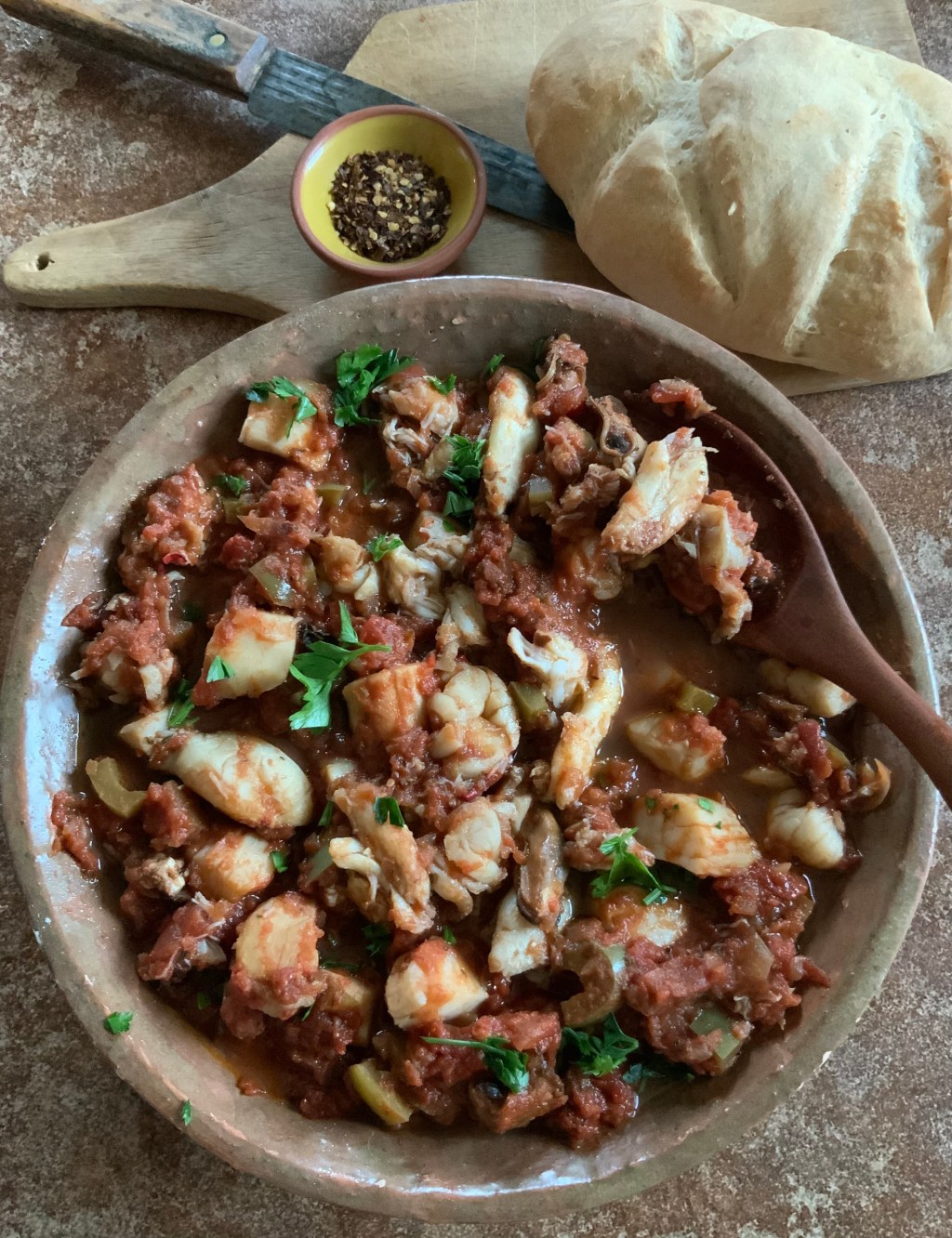
“Cioppino sounds authentically Italian, but both the dish and the name were invented in San Francisco, with the freest of fantasy in both cases. Cioppino is a seafood stew which admits of infinite variations, oftenest built around crab, and the Italian-looking word is explained as a reduction of the English word ‘chop’ to its Italian phonetic equivalent.” Waverly Root from Eating in America (1976).
“[Sam Vella] started out in 1920 with a two-burner coal-oil stove in a sixteen by eighteen foot tent…Sam was a good cook and his reputation spread…Sam cooked…the cioppino to order, that is, the sauce, made well in advance, simmer[ed] on the stove, but the fish [was] added only when an order [came] in.” Doris Muscatine from A Cook’s Tour of San Francisco (1963),
“[Some] leave the shellfish in the shells; [others] remove the meat. It’s a matter of taste…Many are the versions of this famous stew. Virtually anything goes if the sauce is good.” Clementine Paddleford from How America Eats (1960).
Sam Vella began making cioppino for his customers on the beach at Tiburon on San Francisco Bay back in the 1920’s. His method called for long, slow simmering of the sauce, generous amounts of olive oil and red wine and a free hand with the herbs and other seasonings. thefoodlessprocessed follows these same basic principles in making cioppino today.
The less processed options for ingredients used to make the cioppino are: Scallops, Mussels, Crab, Lobster, Onion, Green Pepper, Olive Oil, Preserved Tomatoes, Tomato Paste, Chilli Flakes/Dried Crushed Red Pepper, Basil, Dried Thyme, Parsley, and Oregano.
After he acquired more permanent quarters and a bread oven Mr. Vella served his own fresh bread with the cioppino. We do the same. Either of these breads from thefoodlessprocessed are good accompaniments: White Beer Bread or Le bâtard ~ a French loaf of many uses.
Equipment
- a Large Heavy Pan with High Sides and a Lid. This recipe is made with a 12-inch (30.5 cm) Cast Iron Chicken Fryer with a 4.25 quart capacity (about 4 liters). A close European equivalent is a Sauteuse Haute, which has high sides and a long handle. It is deeper than a regular sauté pan.
- a Knife and Cutting Board
- a Slotted Spoon
- Kitchen Scissors (used to cut through the underside of the lobster tails before cooking them)
- 2 Large-ish Bowls (one to hold the cooked shellfish while you remove the meat from the shells and another for the shelled meat before it is returned to the sauce.)
- a Flame Tamer is optional: During a long, slow simmer it helps prevent scorching and distributes the heat evenly over the bottom of the pot.
Ingredients (This cioppino will serve 4 persons easily as a main course.)
Note: The seafood varieties in the cioppino are a matter of choice. Some cooks like to include firm-fleshed fish as well as shellfish.
- 1 cup (about 150 g) of Organic Green Bell Pepper, chopped
- 1 and 1/2 cups (about 225 g) of Organic Yellow Onion, chopped
- 1/3 cup (80 ml) of Extra-Virgin Olive Oil
- 1 Box of Imported Italian Preserved Chopped Tomatoes and 1 Box of Imported Italian Preserved Finely Chopped Tomatoes: Each box holds 26.46 oz (about 750g or 3 cups). Use approximately the same quantity of preserved tomatoes of whatever brand you choose.
- about 2 Tablespoons of Imported Italian Tomato Paste
- 2 cups (475 ml) of Dry Red Wine
- 1 Stem of Fresh Genovese Basil
- 1 and 1/2 teaspoons of Organic Dried Thyme
- 1 and 1/2 teaspoons of Dried Cut-Leaf Oregano
- 2 Bay Leaves
- 2 teaspoons of Chilli Flakes (aka Dried Crushed Red Pepper)
- a Tablespoon or so of Organic Fresh Italian Flat-Leaf Parsley, chopped
- 3 Wild-Caught Lobster Tails
- 2 pounds (about 1 kg) of Wild-Caught Mussels
- 1 pound of Wild-Caught Dry Scallops: Scallops sold as ‘wet scallops; have been treated with a solution, often containing phosphates, that helps them retain water. They release more liquid during cooking and are harder to brown than untreated dry scallops.
- 8 ounces of shelled, cooked, Wild-Caught Dungeness Crab Meat: The brand used contains only crab and salt–with no preservatives, sugar, extracts or other ingredients.
Making the Cioppino Sauce
- Heat the olive oil in the large pan. Add the bell pepper and onion and cook until the onions begin to brown around the edges and both pepper and onion soften. Add the preserved tomatoes, the tomato paste, the wine, the stem of fresh basil, the bay leaves, the dried thyme and oregano and the chilli flakes.
- Place the pan on the flame tamer. Partially cover the pan and simmer the sauce over low heat for 1 and 1/2 hours. The mixture will thicken to a smooth, but not dry, consistency.
- Prepare the shellfish for cooking while the sauce simmers.
Preparing the Shellfish
- With scissors, cut lengthwise along the undersides of the lobster shells to make it easier to remove the meat later.
- Clean the mussels under cold running water, scrubbing the shells to remove any dirt or debris. Pull off the beard—the fibers protruding from between the shells—by gripping them firmly and pulling toward the hinge of the shell.
- Rinse and dry the scallops. If the scallops are large, cut them in half.
Making the Cioppino
- Bring the sauce to a simmer and add the mussels and lobster tails. Cover the pan. When the mussels open, remove them to a bowl with a slotted spoon.
- The lobster shells will turn bright red as they cook and the meat will become an opaque white. Transfer the tails to a plate to cool a little before shelling them.
- Remove the mussels from the shells and place them in a bowl. Return any sauce or liquid that may have settled in the shell bowl to the sauce in the pan.
- Remove the meat from the lobster tails and cut it crosswise into slices.
- Bring the sauce to a simmer. Add the mussels, the lobster meat, the scallops and the crab. Stir gently and cook for about 10 minutes, partially covered, to cook the scallops and thoroughly heat the stew. Add the chopped parsley.
- Remove the stem of basil and the bay leaves before serving.



Leave a Reply